
The 1851 census of England and Wales is especially useful because it moves beyond the sparse 1841 household tally. It usually records each named resident’s relationship to the household head, marital condition, age, occupation, and more specific birthplace. The census night was 30 March 1851. Search by a combination of name, approximate age, known parish and neighboring people, then check the original enumerator’s book. The National Archives holds the England and Wales returns within the HO 107 series. A search-result transcript is a route to the record, not the full evidence: a birthplace or relationship may have been misread, omitted, or altered in indexing.
Identify the parish and registration district used in 1851
Start with a dated marriage, baptism, tax list or later census that places the family near 1851. Write the contemporary parish, town, hamlet and registration district as separate search terms. A person whose family called a settlement by a local name might appear under an adjoining parish or a different civil district. Search that administrative geography before widening to the county. Inspect the first pages or district description of an enumeration book; it can explain which streets and rural lanes the enumerator intended to cover. Do not replace the historical county in your notes with its modern successor without explaining the change. For the next step, our guide “1950 Census Enumeration District Maps” explains how to find an address when name search fails.
Use a structured name search before switching to page browsing
Try full name and approximate age first, then surname variants and an age range several years wide. Search one family member with a less common given name, or a known spouse, instead of repeating the same head-of-household query. Where available, FreeCEN provides free transcriptions, but its geographic and year coverage must be checked rather than assumed. Commercial index and image access can differ by provider. If an index returns a plausible line, obtain the scanned page and examine entries around it. If the search fails, choose a registration district or known street and browse the appropriate enumerator’s book.

Read the relationship column without manufacturing parentage
The 1851 relationship is stated relative to the household head. A listed daughter may be the head’s daughter as understood by the person supplying information, but the entry does not by itself establish biological parentage or a particular baptism. Stepchildren, relatives, employees and visitors may share a dwelling. Transcribe the word used by the enumerator before translating it into a modern family-tree relationship. Keep marital condition and ages alongside the relationship: a supposed spouse aged 30 with a child aged 25 should trigger scrutiny of names and ages, not a forced connection. Check parish baptism and marriage originals when a parent-child link matters.
Turn reported birthplaces into a testable parish search
A specific county and parish of birth in 1851 can point toward a baptism, but informants might state a nearby market town, the place of upbringing or simply a county. Write the birthplace exactly as the original page records it, and then add a separately labeled standardized place. Compare it against 1861 or 1871 entries for the same individual, asking whether the candidate’s age, occupation, spouse and children remain plausible. Two people with the same surname in one village are not interchangeable. If the reported birthplace moves across censuses, search both places and document whether the discrepancy reflects an error, a boundary or a different person.
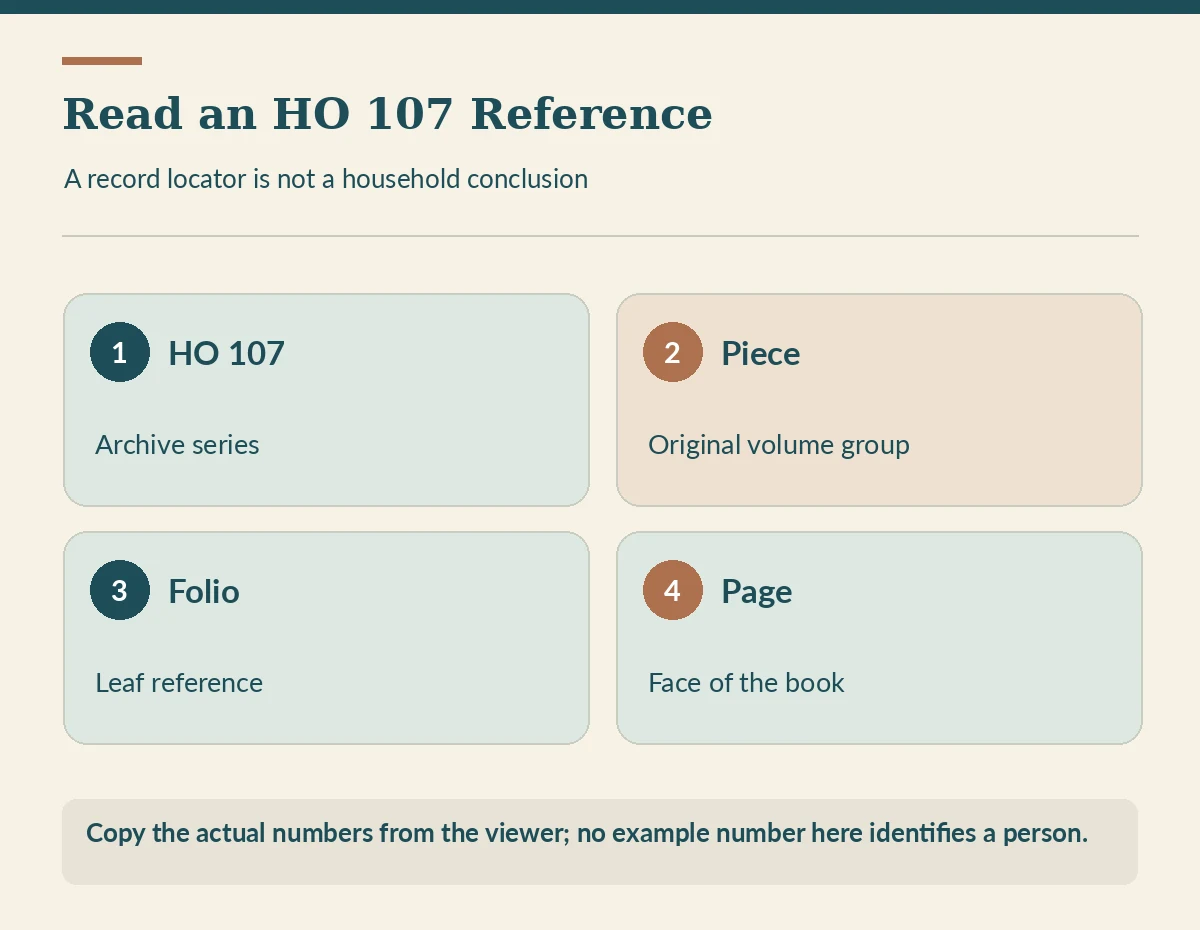
Build the full HO 107 piece, folio and page citation
For 1851 the National Archives reference is HO 107, followed by the piece number and usually a folio and page. A folio number may appear only on every other side of a leaf, so the folio is not the same as the printed page number. Copy the identifiers from the image viewer and inspect the adjacent page when a household continues. A usable citation identifies England or Wales, the county, parish or registration district, enumeration district if shown, HO 107 piece, folio, page, and the website or repository consulted. Save the image identifier too. Never construct a piece number from a person’s birth date or postcode. Our guide “1871 England and Wales Census” shows how to verify households, birthplaces, and RG 10 references.
Reconcile split households and suspicious transcription details
A household sometimes extends onto the next page, and an enumerator may have used ditto marks for surnames or birthplace fields. Look above and below the alleged family and check whether the surnames on every line were explicitly written or supplied by the indexer. Where an occupational abbreviation or indistinct number matters, consult the adjacent handwriting for comparison. Make a two-column transcription: what is legible on the page and what the index supplies. If a child appears in a separate household nearby, do not call the child a son or daughter of your subject until independent records connect them. A page boundary is not a family boundary.
Separate the 1851 census claim from subsequent genealogical proof
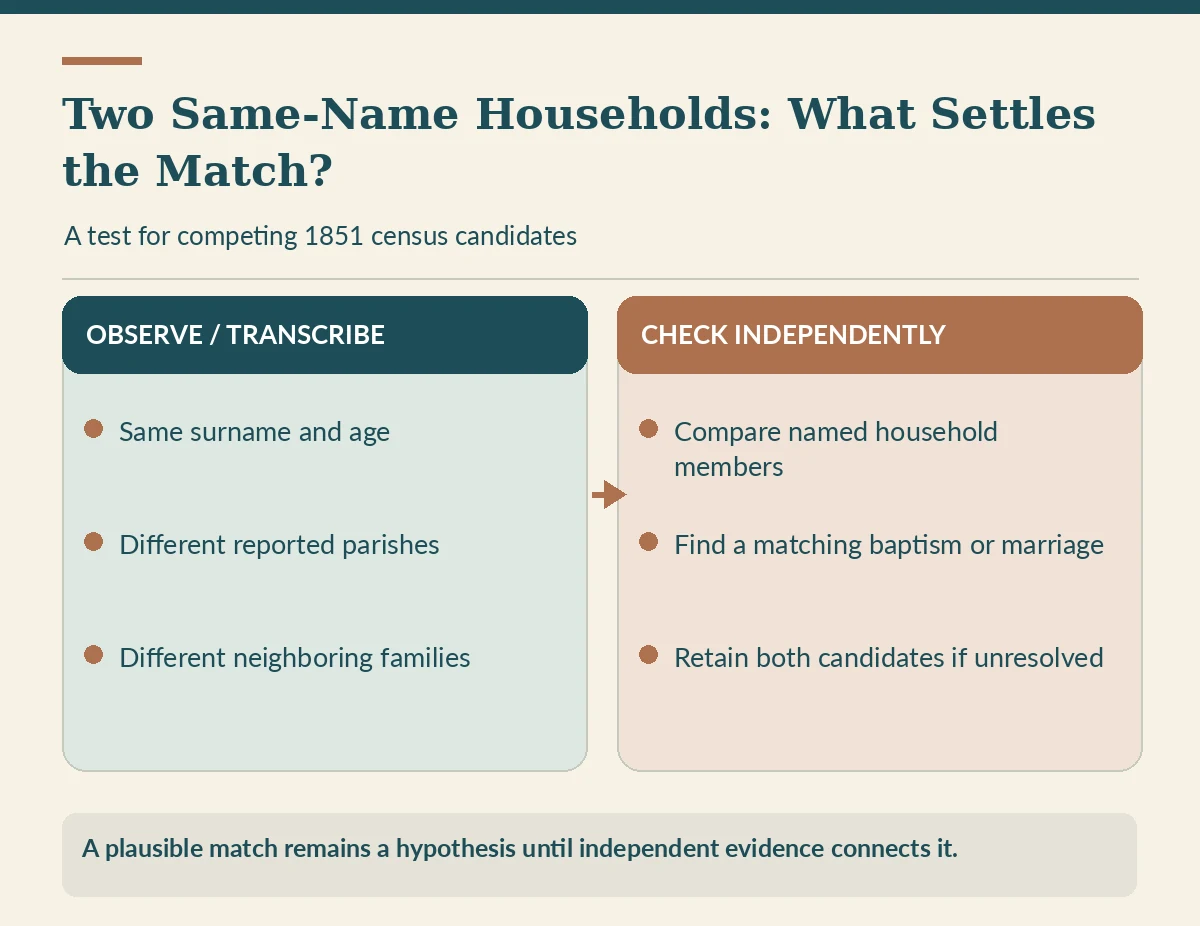
Use the census to support a statement such as “a person called Mary Price, reported as aged 23 and born in a specified parish, was enumerated in this household.” It may guide you to a baptism, a marriage, a burial or another census; it does not directly prove those events occurred. For two plausible Mary Prices, list both 1851 candidate households with age, birthplace, occupation, relatives, image citation and contrary evidence. Choose an independent record tied to a parent, spouse or street to break the tie. If neither candidate can be resolved, retain both hypotheses and document what would change your conclusion. Our 1841 England census genealogy guide goes into more detail.
Make no-result searches reproducible and targeted
Do not equate an empty surname search with an absent census entry. Log the platform, variant, parish, date of search and whether the actual pages were browsed. The National Archives distinguishes searchable indexes from access to digitized originals; coverage, fees and interfaces may differ. Note illegible or damaged images without asserting an entire parish is missing. If you cannot find the correct folio, move back through the district description, find a street index when one exists, or compare the same family in 1841 and 1861. Keep every negative result tied to its actual search scope.
More Records and Archives Guides
How We Research 1851 England And Wales Census
For this specific record class we examined the repository explanations for dates, the physical or digital arrangement, fields actually collected, and known limits: first official collection guide; second institutional source; additional archive resource. The drawn images are explanatory reconstructions, never photographs or transcripts of a particular original. No affiliate relationship is asserted for these sources. Read the affiliate disclosure.
Yes. The National Archives identifies HO 107 as the series for 1841 and 1851 England and Wales returns; record the 1851 piece, folio and page.
No. It reports a relationship to the head on one census night. Baptism, marriage and other independent records are needed for stronger kinship conclusions.
Some transcriptions and indexes are available without charge, but coverage and access to original images differ. Check FreeCEN and the National Archives guidance.
A census birthplace could reflect memory, an informant’s estimate, a neighboring place or an enumerator’s transcription. Compare dated independent evidence.
Record the county and locality, HO 107 piece, folio and page, the named household and the image repository you actually consulted.