
Use the Journal of the Afro-American Historical and Genealogical Society to discover documented family-history arguments, then follow the article’s citations to original records before adding a relationship to your tree. The publisher’s publications page describes a journal of scholarly and family research, with the latest content available through member access and past issues through its store. A journal article is a valuable interpretive source, but a printed family connection may rest on a baptism, land transfer, census, Freedmen’s Bureau record or other underlying evidence. This guide turns an article into a reproducible record-retrieval plan instead of an unsourced copy of someone else’s pedigree.
Identify the Journal, Issue, Article, and Research Question
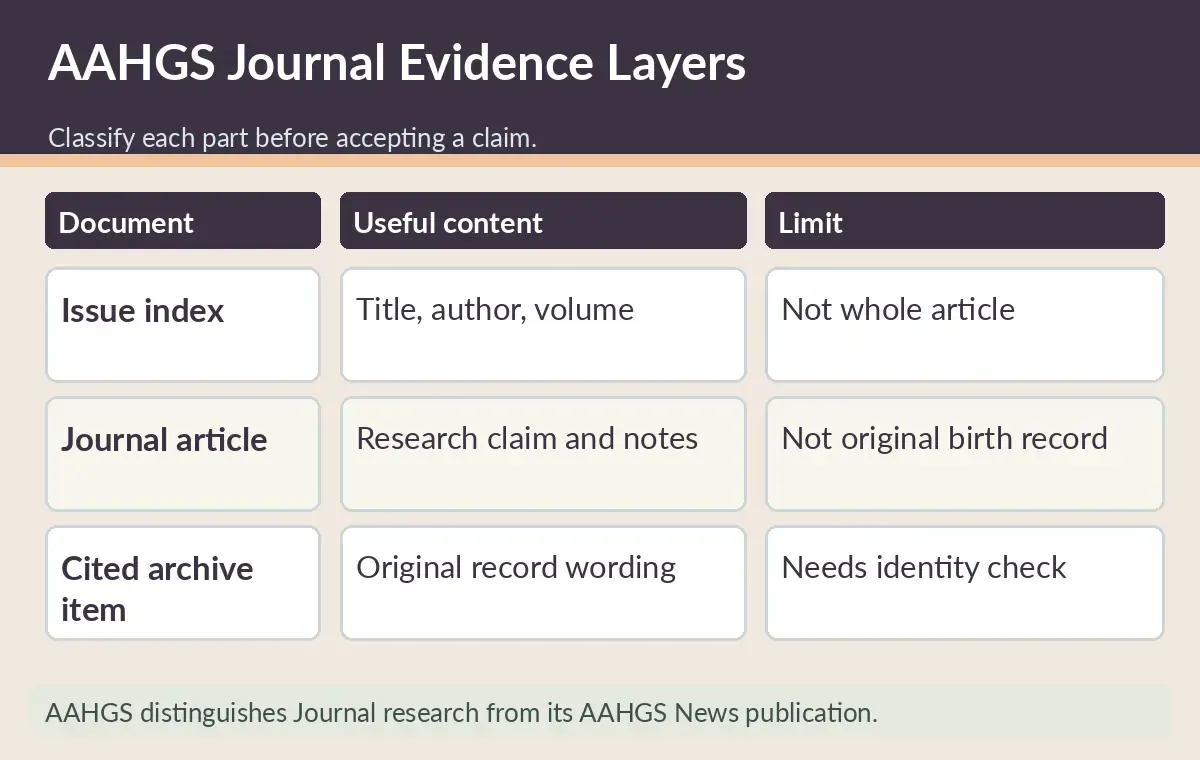
The Journal of the Afro-American Historical and Genealogical Society is distinct from the society’s newsletter, AAHGS News, and from individual chapter newsletters. Record the exact serial title, volume or year, issue if given, article title, author and page span before extracting a name. A promising headline about a surname can be a regional study, biographical profile or argument about documentary methodology rather than a record for your particular person. Define one precise question: whether a named person lived in a district, had a specific parent, or appeared in a particular archive. Read the article’s scope and dates before searching for a surname in text extracted by optical character recognition. OCR can miss names or confuse typefaces; searching only by full name may omit a family discussed under an alternate spelling, occupation or historical locality.

Locate Back Issues Through Society and Library Holdings
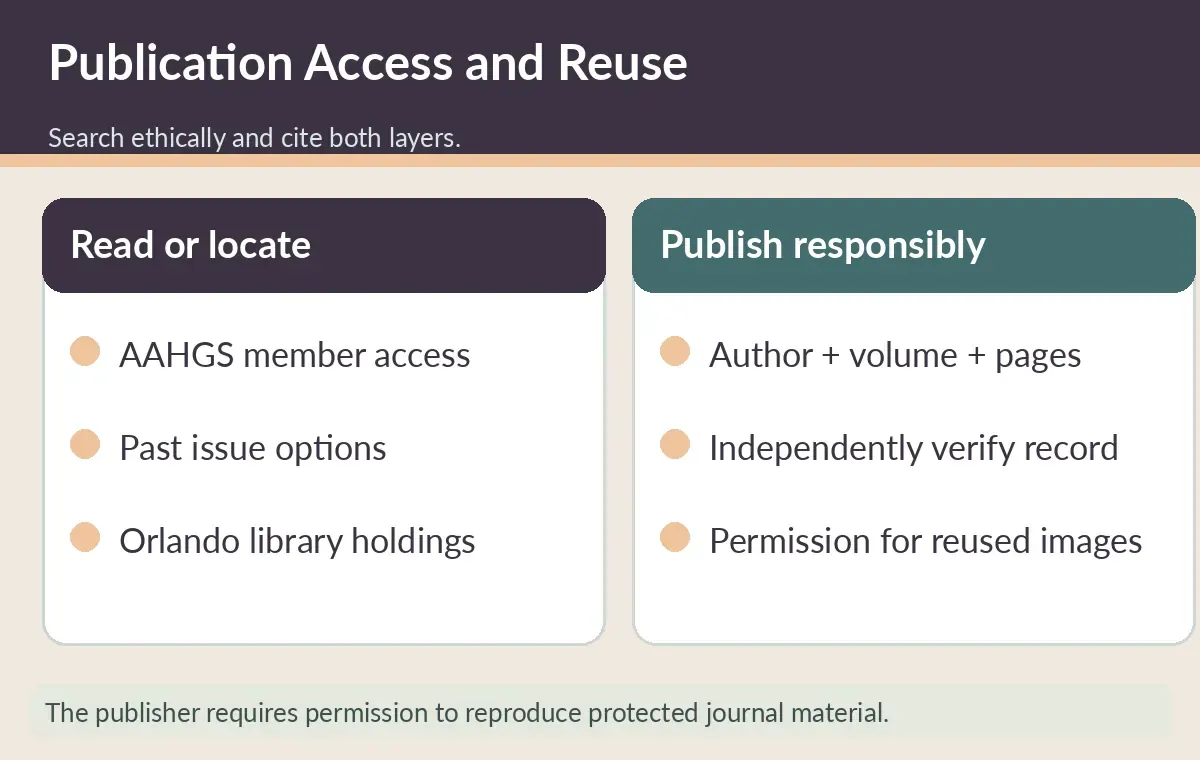
The society’s publications page points researchers to the latest member-access journal and opportunities to obtain past issues. Do not equate a visible table of contents or purchase listing with free access to the complete article. The University of Central Florida Libraries guide identifies holdings in the Orlando Public Library Genealogy Collection and notes two index resources: an older journal index for the quarterly years 1980–1990 and an index to back issues from volume 11 onward, described as 1990 forward. These are finding aids, not a promise that every article is online. Search by author, subject, county, church or household surname and cite the index itself when that is all you viewed. If a holding is local or membership-based, request a legitimate library lookup rather than reproducing copyrighted full text.
Follow Footnotes to the Record that Supports Each Claim
When an article identifies a parent and child, underline the specific sentence and assign it a numbered research claim. Check whether the author cited an original register, a translated abstract, a contemporaneous newspaper report, a later family compilation or another researcher. A journal’s editorial reputation improves the value of its argument but cannot magically make an indirect reference an original civil record. For each claim create columns for article page, exact note number, archive and series, record image or file, what the original says and what remains inferred. If the note points only to a web address that has changed, search the repository’s catalog using the archival identifier rather than citing a now-broken link as verified. Never supply a roll number, family group or relationship that the cited document has not established.
Respect Different Historic Contexts and Record Purposes
African American research may involve emancipation-era records, formerly enslaved people, free Black communities, churches, military service, migration, segregation or family oral histories. A person named in a historical enslaver’s account, a Freedmen’s Bureau document and a postwar census must not automatically be merged into one identity. Records may use imposed classifications and inconsistent names; describe that context respectfully and do not apply historical labels as a contemporary identity judgment. If an article proposes a pre-emancipation family link, reconstruct the supporting localities, dates and persons and test at least one independent trail. Silence in a biased or incomplete record is not evidence that a marriage, child or community never existed. Separate the words of a historical source from a modern author’s interpretation and from your own hypothesis.
Resolve Similar Names Without Copying a Published Pedigree
Imagine that a published case mentions two nineteenth-century women named Eliza Jackson in adjacent counties. The article’s combined narrative may be carefully reasoned, but your tree must preserve the distinct events and citations until you can retrace the link. Build a timeline containing spouse, children, residence, church, labor or land activity, and explicit witnesses, with uncertainty markers for ambiguous dates. A repeated uncommon surname is only a clue: it does not prove parentage or an enslaved person’s relation to a later household sharing that surname. Compare the author’s cited originals, then test whether a different Eliza could fit the events. If original access is unavailable, attribute the claim to the journal author instead of presenting it as a personally inspected primary source. A nuanced ‘plausible, not yet proved’ conclusion is stronger than a categorical ancestor claim.
Cite the Journal Ethically and Preserve a Search Audit
A reproducible journal citation includes author, article title, journal’s full name, volume or issue, publication year, pages and the library or authorized access platform used. Cite the original records independently when you have actually seen them. AAHGS explicitly requires permission to reproduce or adapt copyright-protected journal writing and visual material; do not add a full article scan or copied chart to your own site. Summarize findings in your own words with attribution, document access limits, and keep private information about living relatives out of public examples. An empty library index query is a limited search result, not a declaration that no African American family history exists in a locality. See our affiliate disclosure; linked society resources are editorial references, not alleged paid partners.
More Records and Archives Guides
How We Research This Collection
We used the AAHGS publisher’s publications and copyright notices together with the UCF Libraries guide to past-issue discovery. We did not assert that all back issues are downloadable or reproduce journal text. The Eliza Jackson scenario illustrates how to audit a claim but is not a real case drawn from an article.
No. The society lists them as separate publications with different editorial roles and access routes.
The publisher directs readers to past issues, and UCF Libraries identifies Orlando Public Library holdings and older index tools.
No. Cite the journal for its argument; cite a census or other original separately only when you have inspected it.
Do not assume that. The society identifies member access and purchasing options, while some libraries hold physical or restricted materials.
The society states that permission is required to reproduce or adapt its copyright-protected journal material.