
For an older Huron County, Ontario, grave, first identify the correct cemetery in the Huron Branch table, then check its transcription and look for a burial record if you need to establish an actual interment. The Huron Branch of Ontario Ancestors reports transcriptions of 116 county cemeteries, made largely in the 1980s. Some stones have since become harder to read, making these transcriptions valuable preservation evidence. The branch also warns that an earliest dated stone is not necessarily the cemetery’s opening date, and a monument relocated from elsewhere can be older than its current site. This guide distinguishes transcription, grave location and interment while accounting for the branch’s collection relocation to Seaforth Library in 2025.
Identify the Cemetery by Historical Township, Not Surname Alone
Huron County’s branch lists cemeteries by current municipal grouping and includes former townships, legal lot or concession descriptions and location context. Begin with a dated death notice, church or family source that specifies a locality. Then translate its historical township into the branch’s table rather than assuming the nearest cemetery to a modern city is correct. Similar surnames can occur in neighboring churchyards and family plots. The branch provides a geographic map for locating grounds, but a map pin proves only the location of a site, not that a particular person was interred there. Preserve historic and modern cemetery names in your research log. If a grave appears in a different township, consider changes in travel routes, religious affiliation or residence without treating these possibilities as facts. Search a second cemetery only with a documented reason or clearly marked hypothesis.
Understand What the 1980s Stone Transcriptions Preserve
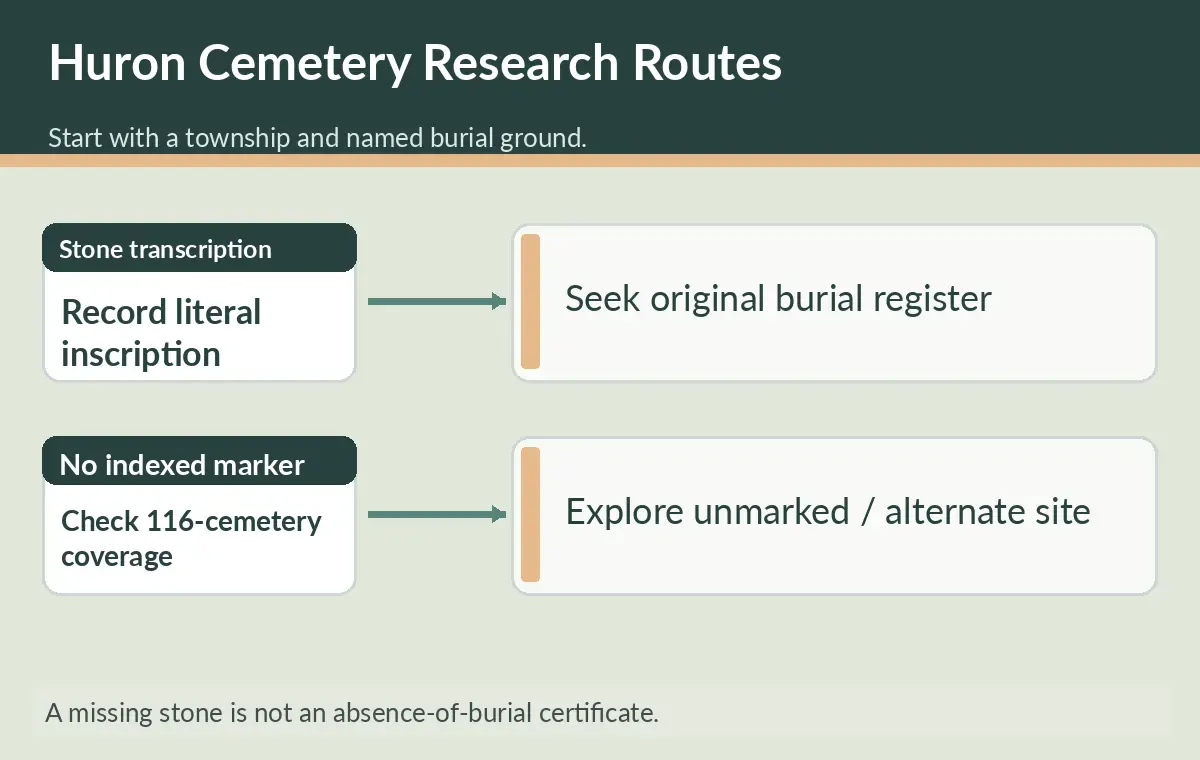
The branch explains that volunteers transcribed known stones across Huron County during the 1980s, including badly weathered markers, and indexed the results. It counts 116 cemetery transcriptions. These are observations of surviving inscriptions at the time of the volunteer survey, not official municipal burial books. A memorial may name a spouse who died elsewhere, include a family inscription added decades later, or omit individuals who were buried without permanent stones. An unreadable modern marker may nevertheless have been legible to the volunteer; preserve that difference in your citation. If you use a purchased digital transcription, record its exact cemetery name, publication details, indexed page and literal wording rather than claiming to have read a gravestone yourself. A transcription can provide a lead to a birth or death date, but does not independently establish the deceased’s parents.
Read Cemetery Opening Dates and Earlier Deaths Precisely
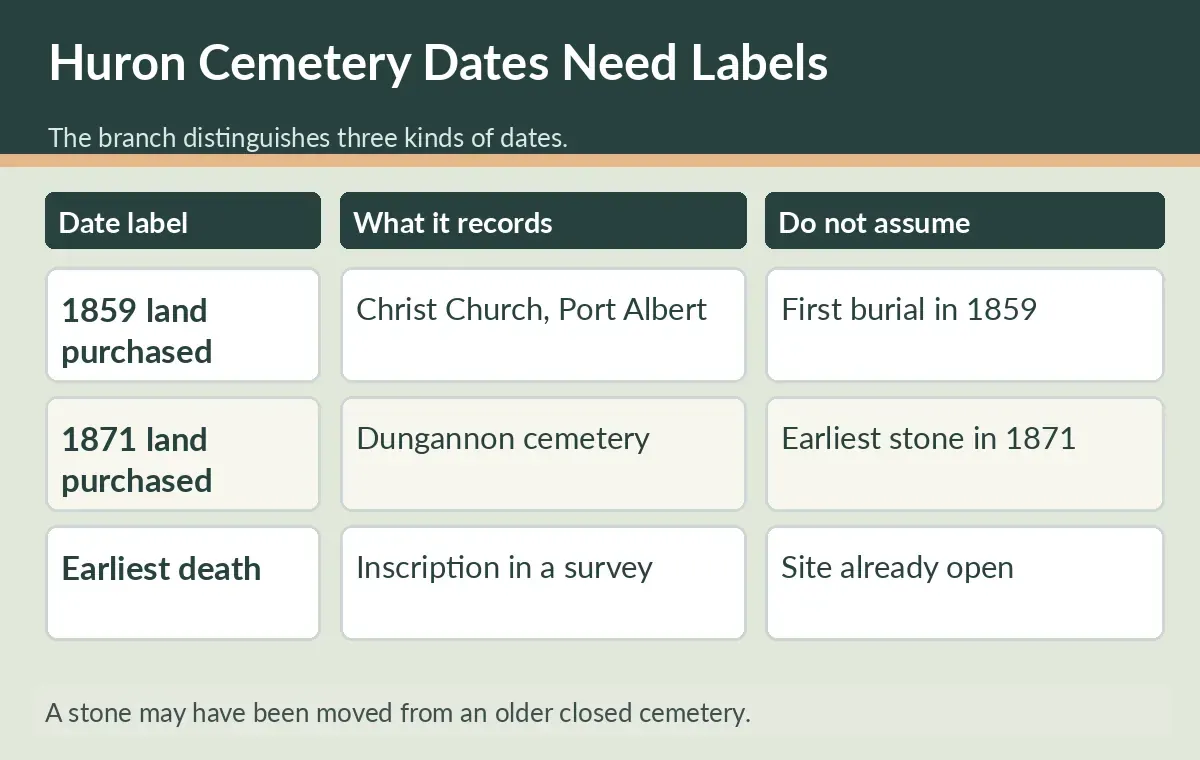
The branch’s cemetery table deliberately distinguishes a date on a stone from a date when land was acquired or a cemetery began operation. For example, its table lists Christ Church Anglican at Port Albert with an 1859 land purchase and Dungannon with an 1871 land purchase, while another entry may be described by its earliest recorded death. Do not collapse those labels into one uniform ‘cemetery opened’ year. The branch cautions that some stones were transferred from cemeteries that closed, so a death predating a site can reflect a moved monument. Make a small evidence grid with cemetery, label type, date, original wording and what the field can actually support. If an inscription predates a land purchase, search for a relocation or an earlier site before suggesting that someone was buried there in the earlier year.
Find the Transcription, Then Request the Underlying Register
The Huron Branch offers indexed cemetery transcriptions as separate digital publications. Locate the correct cemetery and retain its indexing system before searching for a person. When a candidate appears, separate the stone’s literal inscription from additions in a volunteer footnote or editorial index. Ask who controls the cemetery burial ledger: it may be a municipality, church, cemetery board or another custodian. A death registration can show the event date but not necessarily the grave; a burial register may identify the actual interment and sometimes a plot. These classes should be cited independently. If the name does not appear in an inscription index, it may indicate an unmarked grave, loss of a stone, missing historical transcription or a different burial ground, not proof that a death did not occur in the county.
Use the Seaforth Library Collection After the 2025 Move
On August 12, 2025, Huron County announced that the Ontario Genealogical Society Huron Branch collection moved from the Huron County Museum’s log cabin to the Seaforth Branch of Huron County Library. The holdings include cemetery transcriptions, family histories, church and census material, and the county says the collection is for in-branch use. A reader should not go to the old museum location or assume every item can be downloaded. Plan a focused request with cemetery name, approximate death date, township, any inscription index reference and a precise unresolved question. The county says branch volunteers remain involved in assisting research. That assistance does not imply a specific result, fee or remote reproduction right; check the current library’s procedures before a visit.

Prevent Shared Stones and Neighboring Plots from Becoming Families
Imagine two fictional ‘James Campbell’ memorial entries recorded in different Huron townships. A place and surname may favor one candidate, but neither shared inscriptions nor adjacent graves proves a parent-child link. Build an identity sheet including the inscription, transcription date, grave or row location if supplied, a separate burial register entry and an independent death or marriage record. Note whether a date came from the marker, an indexer’s annotation or a government event record. Preserve contradictions visibly and avoid borrowing one candidate’s spouse or child for the other. If a site shows no stone, record only the scope of the search; do not invent an unrecorded burial. The next action should be named and testable, such as checking a particular municipal interment ledger or historical newspaper issue. For reader transparency consult our affiliate disclosure; library and branch citations here do not represent sponsorship.
More Records and Archives Guides
How We Research This Collection
We verified the Huron Branch cemetery table, its volunteer transcription account and the dated Huron County announcement of the 2025 physical collection move. We distinguish publication-era inscriptions from administrative interment evidence and keep location dates labeled by their stated meaning. The Campbell example is fictional; no particular grave was searched or attributed.
The Huron Branch reports indexed transcriptions of 116 cemeteries, produced through volunteer work largely in the 1980s.
No. The branch warns that some stones moved from older sites and that earliest inscription dates differ from cemetery opening dates.
A dated Huron County notice says it moved to the Seaforth Branch library in 2025 and is available for in-person use.
No. They record inscriptions observed by volunteers; the interment register is a separate administrative source.
No. Confirm each claimed relationship with independent records such as civil registrations or documented church entries.