
Cemetery records are not a single database. An interment register may record who was buried and when; a plot map indicates where a grave or section lies; an ownership ledger tracks rights in a lot; and a headstone supplies a memorial inscription that might have been made years after death. For genealogical research, decide which question you need to answer before choosing a record type. This guide focuses on locating and interpreting cemetery documentation, not on physically navigating to a particular grave.
Choose the cemetery record that answers your question
The FamilySearch record-type guidance distinguishes cemetery records from more specific categories such as burial registers, grave records, plot maps and grave-owner directories. Those differences matter. If the question is ‘Was this individual interred here?’, an interment register or burial entry is more directly relevant than a lot purchase. If you need exact physical location, a section-and-lot map is more useful than a general cemetery name. A photographed stone shows a visible inscription at the date photographed but may not establish that remains lie directly beneath it.
Before searching, draw up a one-line question and the likely best source. ‘When was the burial?’ points to an interment ledger or burial permit. ‘Who held burial rights?’ suggests lot-ownership files. ‘Does a marker exist?’ suggests cemetery surveys or photo inventories. ‘Was a second family member in the same plot?’ calls for the cemetery’s individual interment list, not only the names cut into the monument. One person can appear in several records, and each may describe a different event or legal fact.

Find the custodian before searching a name index
Identify the cemetery’s historic and present name, religious or civic affiliation, municipality, and operating organization. Small burial grounds may have changed ownership or merged with neighboring cemeteries; historic records can be held by a church, municipal office, funeral director, regional archive or cemetery association. A web search that returns no name could simply mean the custodial register is not online. Determine whether the needed years and record type survive and whether the custodian permits public research. Avoid assuming local rules about fees, privacy or viewing original volumes.
A concise request to an office should contain the deceased person’s name and variants, an approximate burial period, the basis for believing the cemetery is relevant, and a question such as ‘Does your interment register contain a dated entry or section-and-lot reference?’ Ask how the office prefers requests and what restrictions or copying charges apply. If multiple people share a name, include independent context without sending Social Security numbers or unnecessary living-family details. Record the response, staff or office name, date and the specific book or system consulted when supplied.
Search digitized cemetery collections without assuming coverage
FamilySearch’s cemetery search can locate cemetery site pages, names linked in its tree and user-added locations. It is a discovery route, not proof that all burials in a cemetery have been indexed. Research guides, catalog entries, digitized registers and local surveys may provide stronger source information. When a search returns a memorial profile, ask who supplied the dates and whether a primary register image or marker photograph is linked. A user-added map pin can help navigate but does not by itself confirm an original burial position.
Search surname variants, possible former names and neighboring cemeteries with awareness of the historic town boundaries. Death certificates, funeral programs and obituaries can name a burial place, yet the cemetery could have been renamed or a body reinterred. Recheck the location by date rather than copying the current map label back into an earlier era. For veterans, the VA Nationwide Gravesite Locator is an additional dedicated source with defined coverage; it is not a global index of civilian or all private-cemetery burials.

Separate burial, ownership, memorial and reinterment
A plot-owner’s name on a cemetery lot record is not automatically the occupant of the grave. Family lots may have been purchased decades before burial, transferred, subdivided or left unused. Similarly, a shared stone can commemorate people buried in different places. Interment registers are stronger for burial events, while official reinterment or removal records may explain why an early grave location conflicts with a later memorial. Describe the exact record rather than labeling every cemetery document ‘death record.’ Neither an inscription nor a burial date necessarily establishes the place of death. For the fuller picture, see our guide “Guildford Stoke Cemetery Records”.
Use a four-column evidence grid: document type, exact wording, event it describes, and limits. An entry stating ‘Lot 12 sold to Taylor family’ documents a property or burial-rights transaction, not the death of Taylor. A book stating ‘burial of Taylor, section B, row 7’ is closer to interment evidence, subject to correct identity. A photograph captioned ‘Taylor family memorial’ may name a monument and not an individual grave. These sample labels are invented only to illustrate method; do not mistake them for archival quotations from real records. Our walkthrough on how to search for a grave by name in online memorial indexes sets out each step.
| Record type | Usually addresses | Cannot establish alone |
|---|---|---|
| Interment register | Recorded burial and its date | Birth parents or cause of death |
| Lot-owner directory | Ownership or interment rights | Who actually lies in the lot |
| Plot map | Location key or section plan | That each mapped plot contains remains |
| Memorial photograph | Inscription seen at a particular date | Original burial or accuracy of dates |
Document gravestones responsibly and preserve context
When viewing a memorial, photograph the full stone, inscriptions and location context when rules permit; note date of observation, cemetery, section, plot, orientation and photographer. Record damaged or ambiguous lettering as uncertain rather than reconstructing it silently. A modern replacement stone might carry information supplied by descendants, so compare dates with death and civil records. Avoid destructive cleaning, chalking, aggressive rubbings or moving fragile markers. Cemetery regulations, conservation guidance and local cultural or religious practice should govern access and documentation.
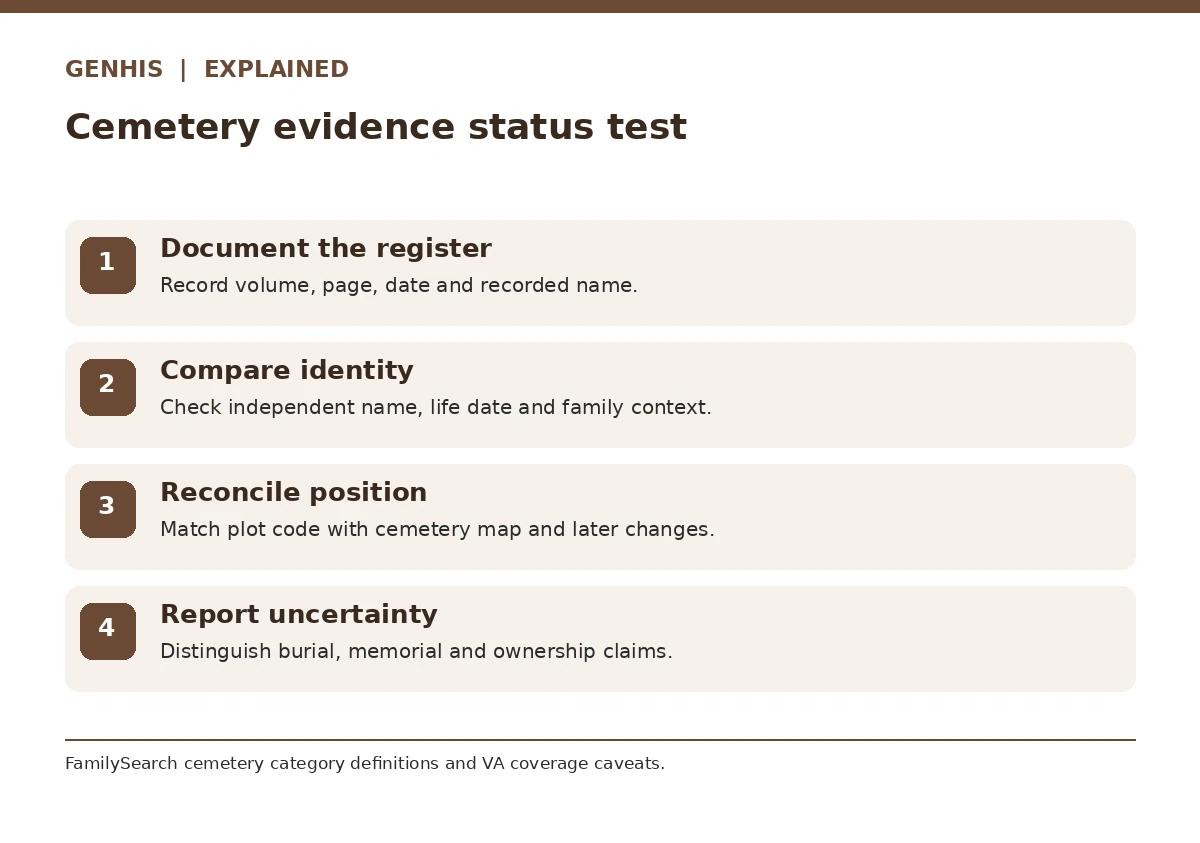
If an inscription differs from a register, retain both and ask why. The date on a gravestone might represent birth, death, burial, an anniversary or a later memorial decision. Historic ledgers can also contain clerical mistakes and old plot codes. Try matching the deceased through additional evidence such as a funeral record, obituary and family context before declaring a conflict solved. Be especially respectful of Indigenous, sacred, or restricted burial places and never post sensitive coordinates without appropriate permission. Our guide “Gravestone Search” shows how to read old headstones without inventing family facts.
Cite the specific record and record a qualified result
A useful cemetery citation includes official cemetery name as identified for the period, relevant administrative body or collection, register volume and page or entry number if available, name and burial date as written, current repository, medium and access date. For a photographed marker include the cemetery section or reference number, the inscription, photographer and photograph date. For a digitized transcription cite both the hosted index and any underlying photograph or register separately. Avoid inventing a page or lot number when the database has none. Our guide “Limerick Gravestone Inscriptions” shows how to compare Mount Saint Lawrence sources.
Conclude with the narrow finding supported: a named person appears in a dated burial ledger; a family purchased rights to a specified lot; a memorial bearing a date was photographed; or the cemetery’s complete searchable coverage remains unknown. When the purpose changes to locating the actual grave for a visit, ask for a current plot map and office confirmation. The cemetery may exist even when no visible stone survives, and a precise burial location may remain unknowable despite extensive documentation. Our walkthrough on how to find where an ancestor is buried when no grave appears online sets out each step.
How We Research: sources, uncertainty and scope
For this article we compared guidance from cem.va.gov, familysearch.org. We focused on the exact source type, its geographic and chronological coverage, the difference between reported information and documented events, and the limitations of indexes, transcriptions or contributed data. The worked examples are explicitly hypothetical, not discovered historical people. Recheck repository terms and local jurisdictions before making a purchase, requesting a record or visiting a site.
More Records and Archives Guides
Authoritative sources and limits of this guide
familysearch.org — original institutional guidance. FamilySearch categorizes cemetery records separately from burial registers, grave records, plot maps and ownership directories.
familysearch.org — original institutional guidance. FamilySearch documents its cemetery search, site maps, and user-contributed burial location tool.
cem.va.gov — original institutional guidance. VA describes the population covered and omissions in its veterans burial locator, including private-marker limitations.
familysearch.org — original institutional guidance. FamilySearch explains how burial and plot information are represented separately in Family Tree.
Editorial disclosure: GenHis supplies general research information, not a legal finding, guaranteed archival inventory, record-ordering service or proof of an individual family relationship. Local rules and surviving sources vary. We do not claim partnerships or paid recommendations in this guide. See our affiliate disclosure for site policies.
No. Administrative burial registers, ownership books and plot maps may exist even when no marker is photographed or indexed.
No. Ownership or burial rights are different from a dated record of interment.
The site may be unindexed, the marker may be absent, or the historic record custodian may not have digitized its files.
Yes. Markers can be installed later, altered or transcribed incorrectly; compare them with dated records and the original inscription.
Ask whether an interment record exists, the burial date, exact section and lot, surviving map, repository name and any restrictions or fees.