
For Riverside Cemetery in Rochester, New York, check the University of Rochester’s historical interment database for records through 2002, then compare the plot location with Rochester Genealogical Society maps or ask the cemetery office. The City of Rochester’s burial-search page distinguishes the archived online record layer from maps and more recent cemetery-office information. This is essential because the city also operates Mount Hope Cemetery: a person found in an online database may belong to the other cemetery. A recorded interment, a specific grave location and a family relationship require different evidence.
Confirm Riverside, Not Mount Hope, on the Search Result
Rochester’s municipal cemetery system includes both Riverside and Mount Hope, and the city links historical interment searching for the two locations. Start with the exact cemetery name as well as the person’s name. Do not assume any Rochester cemetery result describes Riverside. A memorial-site entry might be assigned to a different cemetery or copied from a secondary index. The city’s Riverside visitor page gives a physical Riverside location on Lake Avenue and a record-search link; record that distinction before mapping a grave. If a family story uses only the phrase ‘Rochester cemetery,’ keep both facilities as candidates until there is documentary support for a specific interment. An incorrectly chosen cemetery can produce an apparently plausible plot map and an entirely wrong visit plan.
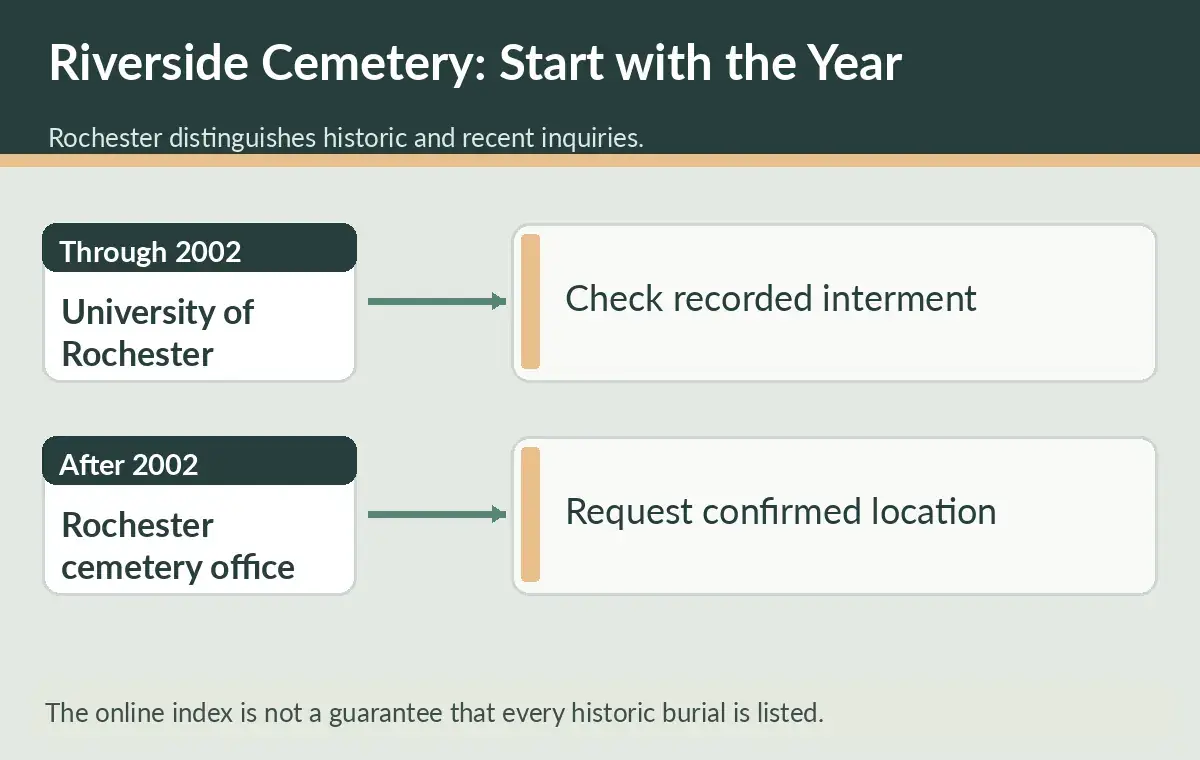
Search the Historical Interment Layer Through 2002
The City of Rochester explains that many interment records through 2002 may be found in the University of Rochester cemetery database. Treat ‘through 2002’ as the described historic record-search horizon, not a promise that every death or burial in those years is present. Search surnames with variations and use a known death or funeral date if the interface supports narrowing. Capture the full indexed name, cemetery, reported interment date and administrative location or record identifier if displayed. A database record may derive from an office ledger rather than an observed gravestone, so do not quote a monument inscription unless you actually read one. If two same-name people are listed, preserve each as a separate candidate and compare distinguishing facts before selecting one.
Use Plot Maps Without Inventing a Family Section
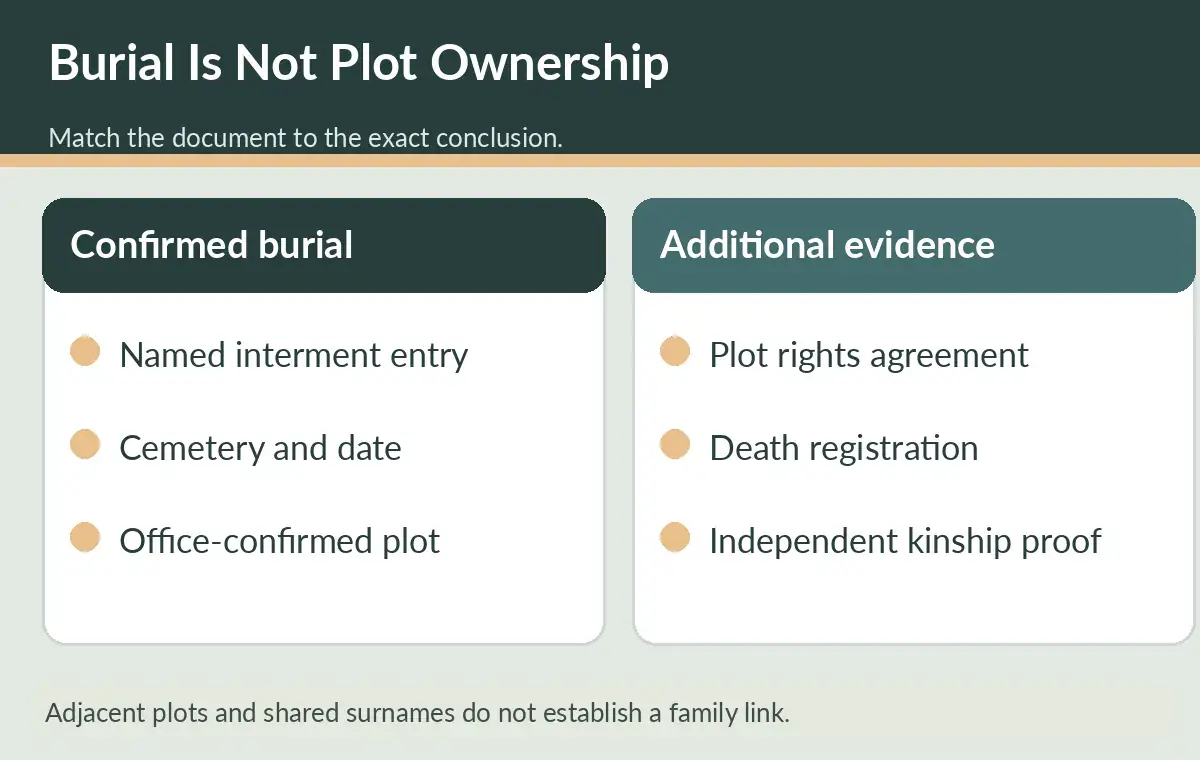
Rochester Genealogical Society supplies digitized plot maps for both cemeteries according to the municipality, while the cemetery office has access to mapping tools. First identify a section, lot and grave number from an authoritative burial result or office correspondence. Then look up the appropriate Riverside map sheet and save its title, sheet date if given, section and location. A plotted space is geographic evidence about where the office expects a burial or plot; it does not by itself prove who owns burial rights or that adjacent graves contain biological relatives. Plot maps can change with expansions or renumbering, so reconcile the displayed map with cemetery-office records for an on-site visit. Do not label a neighboring headstone as the sought grave when section or lot numbers do not agree.

Ask the Cemetery Office About Later Interments or Unclear Locations
The municipality says cemetery staff can help with more recent interments and maps, and a computer station can be used to consult the available databases. If the historical online search fails or only provides partial location details, prepare a concise request with the full name, spelling variants, estimated death date and candidate section or lot. Ask what administrative evidence can confirm an interment and how to interpret the map. Do not assume the absence of an online image means no stone exists. The city publishes visitor information and grounds rules on its Riverside page. A dated cemetery-office statement can strengthen location verification, but the correct conclusion is limited to what staff confirmed; they may not have independently investigated the deceased’s genealogy.
Separate Death, Burial, Plot Right, and Monument
A death certificate can report a death event; a cemetery interment register can record burial; a lot ownership or rights document concerns administration of a parcel; and a gravestone records an inscription chosen and erected by someone. None of these sources automatically proves all the other claims. Create a four-row evidence ledger with source creator, date, named person and the exact claim established. One grave may have multiple interments; a memorial stone may commemorate someone interred elsewhere. Two people with a surname on adjacent markers might share family connections but require an independent marriage, parent-child or estate record to establish a specific relationship. Retain each inscription literally, including uncertainty from weathering, instead of substituting a polished online memorial transcription for the stone itself.
Worked Example: Two Riverside Candidates with the Same Name
Imagine a fictional Mary Thompson listed as interred at Riverside in 1918 and another Mary Thompson with a similar death year at Mount Hope. A surname-only search might merge them. Compare cemetery name first, then reported age, section or plot, burial date and any independently documented address or spouse. If one result gives an administrative section but the other offers a photograph, do not choose the photograph just because it looks more compelling. Check that its location really matches the record. Draw a confidence boundary: ‘Riverside interment recorded’ may be supported by the office database, while ‘this Mary was my great-grandmother’ still needs another source. If neither candidate is distinguished, hold both open and search contemporary newspapers or civil death files rather than guessing.
Cite the Index, Map, and Follow-Up as Separate Sources
For each result, save the database name, exact cemetery label, person spelling, burial identifier, date, University of Rochester citation if supplied and date accessed. Cite the Rochester Genealogical Society plot sheet separately, and identify any municipal office correspondence by date. Do not combine them into a single anonymous ‘Find a Grave’ citation. If a visual map and the ledger disagree, report the conflict and seek clarification rather than redrawing the cemetery coordinates to match an expected family plot. A failed index search, map lookup or office request can remain a useful dated research log entry but is not proof of non-burial. Review the site’s affiliate disclosure; this article is independent of the cemetery and historical societies.
More Records and Archives Guides
How We Research This Collection
We compared the Rochester municipal burial search, Riverside visitor information and separate Mount Hope location description. The University of Rochester historic database, genealogical maps and later operator records are intentionally not treated as a single original source. Hypothetical matching scenarios are clearly fictional.
Rochester points to the University of Rochester cemetery records for many historical interments through 2002.
The city describes record access for both facilities, so confirm the cemetery named on the result.
The municipality links Rochester Genealogical Society plot maps for Riverside and Mount Hope.
Ask Rochester cemetery staff for recent interment and map information.
No. Plot administration and interment locations cannot independently establish a family relationship.