
For a death in Mobile County between 1876 and 1908, start with the Mobile Public Library’s historical death-document collections instead of assuming the event belongs only to Alabama’s modern statewide certificate index. The Mobile Death Records 1876 collection contains original document images and says the Local History & Genealogy division has death records for 1876–1908. Alabama’s statewide registration began in 1908, according to the Mobile County Health Department. This guide follows the local paper trail and shows why a year, jurisdiction and image identifier are more useful than a bare matching surname.
Separate Mobile Local Records from the 1908 Statewide System
Death documentation in Mobile predates standardized Alabama statewide certificate filing. The Mobile County Health Department says state filing began in 1908, but death-certificate recording in the city began much earlier. The digitized Mobile Public Library series is a particular surviving local collection, not a promise that all deaths since the early nineteenth century are online. Begin by noting whether the death occurred in the City of Mobile, another part of Mobile County, or somewhere else in Alabama. Each possibility can change the likely record creator and custodian. For an event before 1908, do not automatically call an image an Alabama state certificate; check the printed heading and issuing official. For an event in the transition year, inspect both local documentation and the relevant statewide route, rather than assuming one is an exact copy of the other.
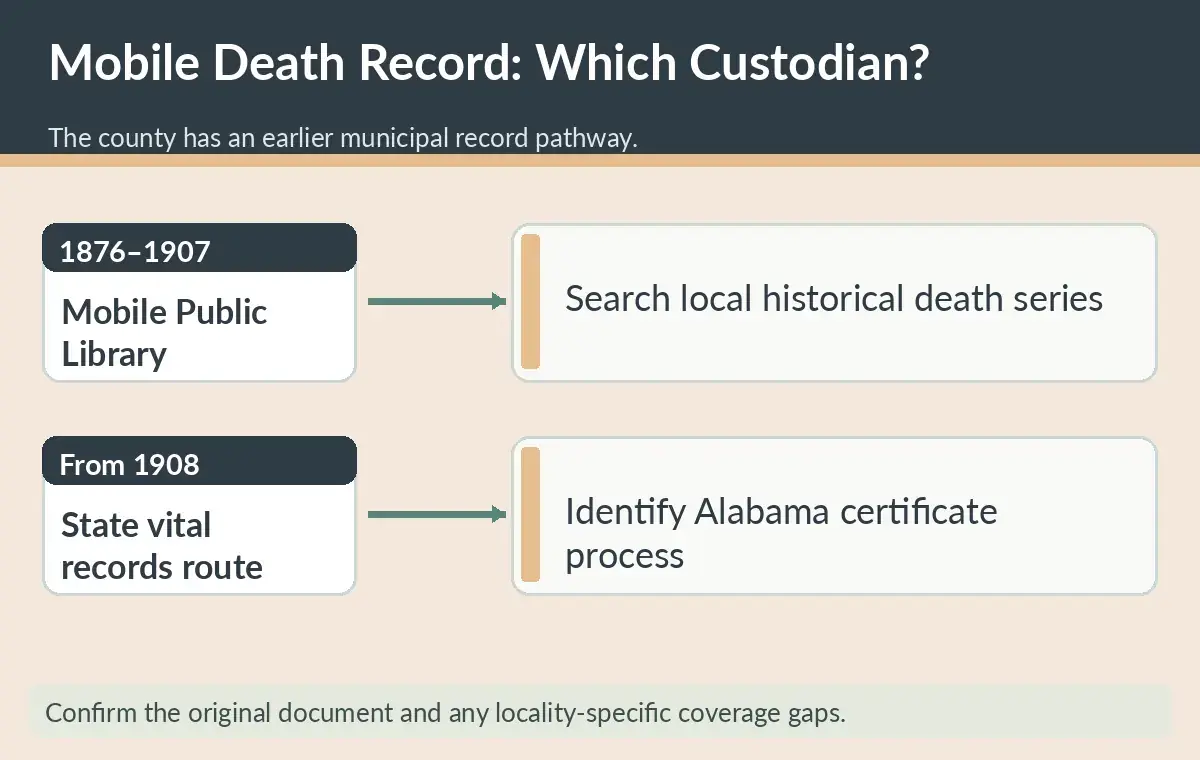
Open the Mobile Library’s 1876–1908 Document Sets
The digital library offers year-specific collections including 1876 and 1908. The 1876 collection description identifies more than a thousand digitized items and individual documents, while the 1908 collection describes its own year of death documents. Search the historical name as written, and try variants for initials, given names and family names. Capture the document’s collection title, person label, date, identifier and direct item location. View the original image where available: an index entry may omit fields or modernize a name. Never invent an age, parent or cause of death from a filename alone. Some item descriptions refer to ‘infant of’ a named adult, which should be transcribed as recorded instead of converting it into an unsupported full child name.
Ask the Local History & Genealogy Library for Unseen Years
The library explicitly states that its Local History & Genealogy staff can help with a search of the wider 1876–1908 death-record holdings. Its research collection summary also lists earlier death or burial sources from the 1830s. If a year is not represented by a convenient online page, do not conclude that the library has no relevant material. Provide the name, spelling variants, approximate date, expected Mobile County locality and any archive reference already identified. Ask whether staff can confirm a record and provide a retrievable citation or copy under current policies. Make the request narrow enough for a record search; avoid expecting archive personnel to construct an entire family tree. Clearly label a lookup response as archive research assistance rather than an original you saw yourself.
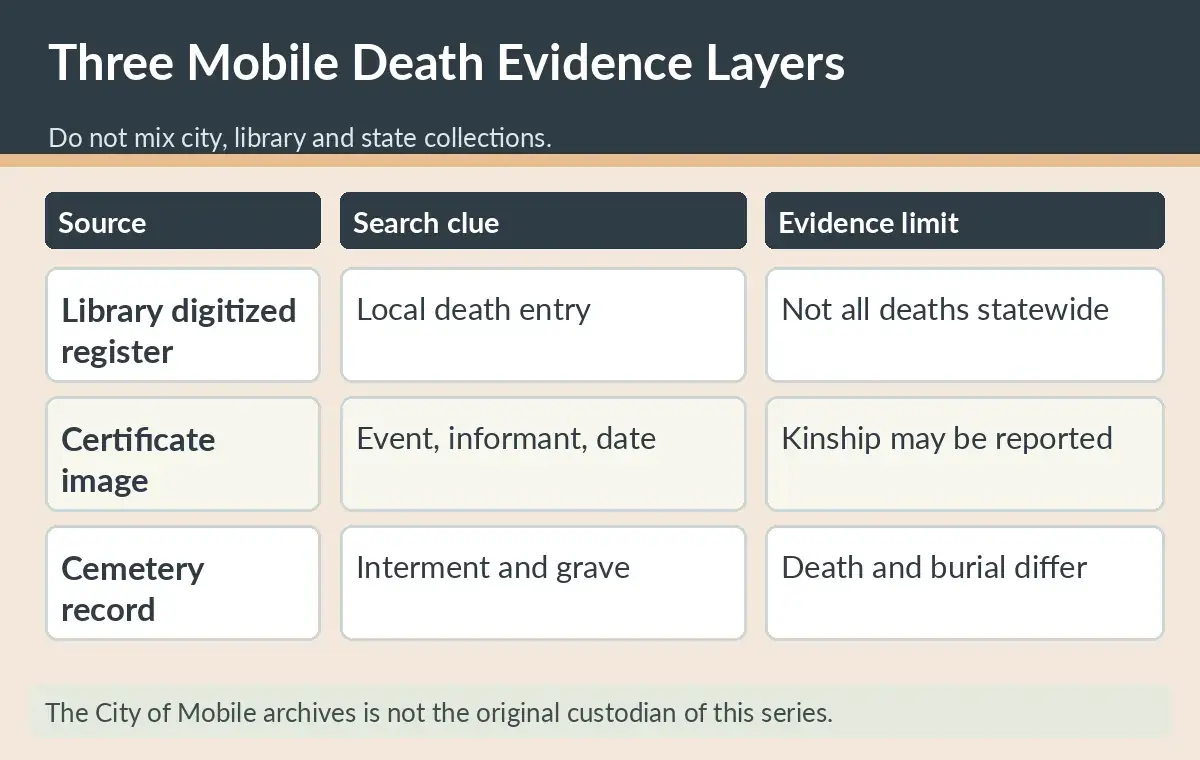
Read the Original Form Before Trusting an Index Detail
A death document may have informant and medical or administrative fields, but those vary by era and form. Transcribe each visible field exactly, including the date used for death and the distinct date of reporting, issuing or filing. A modern transcription can substitute standardized spelling that did not appear on the manuscript. A stated age is not automatically a proven birth year; derive a birth interval cautiously and compare it with independent census or religious records. If an informant reports a parent’s name, evaluate whether they were likely to know it. Include the occupation and residence when recorded to distinguish two same-name residents of a port city. A death certificate can prove a recorded death event more directly than it proves family relationships supplied by another person.
Use the Correct Office for Modern Certified Copies
Mobile Municipal Archives explains that it preserves city administrative documents but does not hold birth or death certificates; its official guide directs certificate seekers elsewhere. The Mobile County Health Department describes the Alabama certificate service, including eligibility restrictions for more recent deaths and the broader availability of older certificates. This access system is different from consulting digitized nineteenth-century library items. When a certified extract is needed for a legally authorized purpose, follow current rules and fees published by the health department. Never assume a copy of a local 1876 document can be ordered under precisely the same process as a modern Alabama state certificate. Do not disclose information about living relatives from a recent record without a proper basis.

Compare a 1908 Local Hit with a State Registration
Imagine a fictional Thomas Jackson who appears in a Mobile local death document dated 1908 and a Thomas Jackson in a state index that year. Do not count them as one person merely because both entries share a name and year. Compare exact age, residence, attending official, filing date and any other recorded identifiers. The documents may concern the same death captured by different offices, or two men with the same name. Record whether a form is a local record, a state certificate or an index transcription. If only one image is accessible, describe the second source as an unverified candidate and plan to view the original. A same-year record across jurisdictions is not automatically independent genealogical proof until provenance and identity agree.
Write a Local-Source Citation and a Negative Search Log
Cite the specific Mobile Public Library digital collection and item, the year, person label, date of consultation and the underlying record image or document identifier. If a staff lookup supplies a register citation, add that reference while preserving who performed the search and what they actually saw. Do not attach a guessed death certificate to a same-name ancestor in a statewide index. Record spelling variants and year ranges already checked so another researcher can repeat the process. When the library has no identified item, consider county burial records, contemporary newspapers and church registers as distinct alternative evidence, each with its own coverage. The site’s affiliate disclosure applies; we have no connection to the library or Alabama records offices.
More Records and Archives Guides
How We Research This Collection
We checked the Mobile Public Library’s two digitized year collections and Local History holdings, the county health department’s statewide timeline and city archives’ record-custody guidance. The transition-year case is fictional and the article does not imply access to private certificates.
Yes. The Mobile Public Library describes local death documents for 1876–1908 and some earlier death or burial resources.
The Mobile County Health Department states that statewide birth and death certificate filing began in 1908.
The library maintains a digitized 1876 collection with individual historical document entries.
Contact the Mobile Public Library Local History & Genealogy division with a narrow name-and-date search.
No. Historical archive access and present-day certified certificate rules are different services.