
Find a Resident, Not Just a Surname
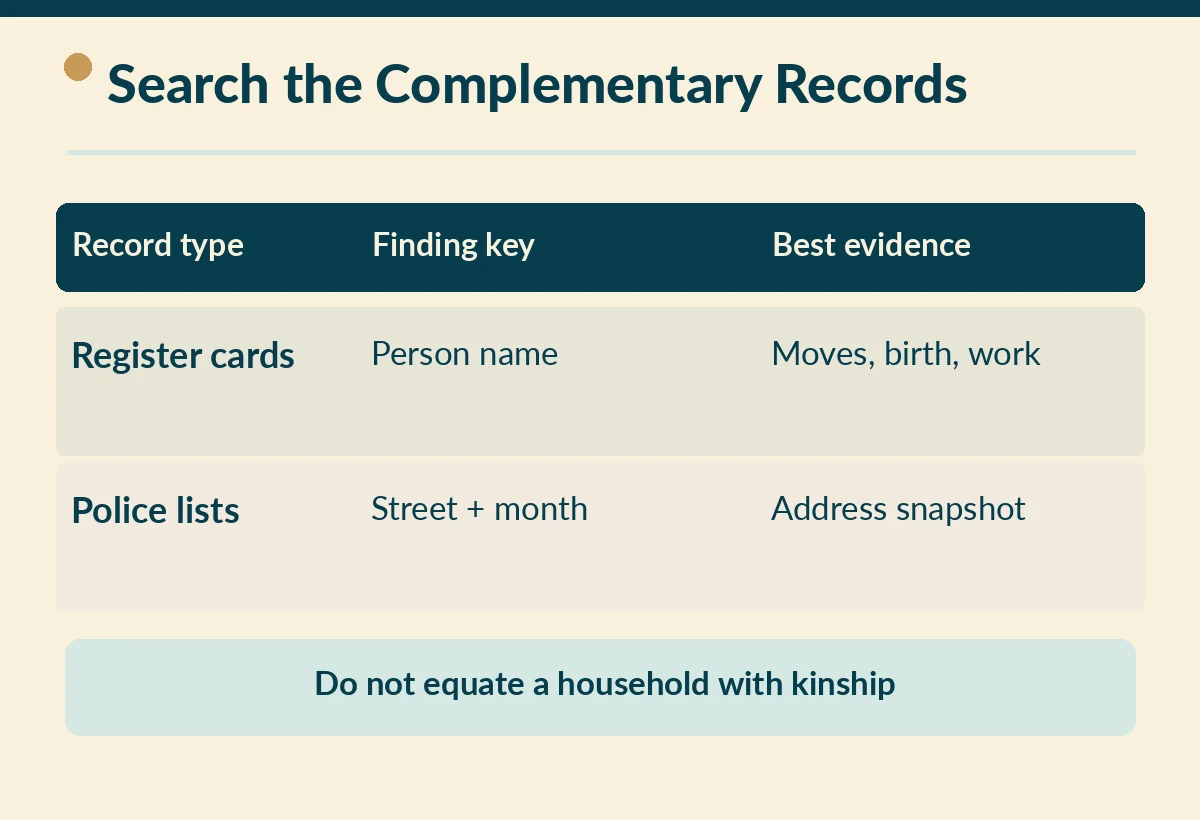
The best starting point for a Copenhagen resident between 1890 and 1923 is the city archive’s Politiets Registerblade, or police register cards. Search the transcribed cards by the person’s name, then check birthplace, work, and the sequence of addresses against independent family evidence. A matching name is a candidate, not a confirmed ancestor. The cards were designed for keeping track of residents, not for certifying family relationships.
The Copenhagen City Archives describes the cards as predecessors of the municipal population register. They concern Copenhagen residents aged over ten in the stated period, but the way a person appears can vary. Some people have their own principal card; others appear as additional people on someone else’s card. Before transcribing a result, decide which role the searched name occupies, because an additional entry need not identify a spouse or child.
Distinguish Principal Cards from Added People
In the archive’s instructions, a hovedperson is the person to whom a card belongs, while a biperson is an additional person named on another card. Adult lodgers and servants could be recorded, not only members of a nuclear family. The archive explains that children around ages ten through thirteen could appear on their father’s card. Do not interpret the column, position, or proximity of two names as a documented parent-child relationship without a separate record.
Search a principal person’s full name, then try surname-only, alternative spellings, initials, birthplaces, and occupations. Repeat the process for possible additional people when a name search does not yield a separate card. Save the card image or stable identifying reference alongside the transcription. Note which words are printed, which are handwritten, and which you supplied as a modern reading. Record your interpretation separately so that later researchers can revisit an ambiguous letter.

Use the Address Trail as a Second Identity Test
A register card can show several places where a person lived. Copy street names, building numbers, and the associated dates precisely as visible, including dates that are hard to read. A move is particularly valuable when two people share a surname and occupation: the sequence of addresses may distinguish them even though an index search cannot. A neighborhood move is evidence of a reported residence change, not evidence that the person owned either home.
For an independent address check, use the archive’s Politiets Mandtaller. These household lists are browsed by street, year, and month, not searched by personal name. The police compiled them in May and November. They usually begin in 1869, with sparse material from 1865–1868 and known missing street-year runs. Choose a card address and its corresponding reporting period, then browse the street entry rather than assuming that every address remained continuously occupied.
Do Not Confuse Register Cards with Police Lists
The two record families answer related but different questions. Register cards were arranged for tracking named individuals and movements; police population lists were organized around a street at a particular enumeration time. The archive’s description of the mandtaller identifies typical fields such as name, age, birthplace, work, and address. From May 1892, birth dates may appear instead of age; from May 1894, the previous-list address was also recorded. The reader must inspect the dated form before treating a field as present.
Imagine two hypothetical residents named Anna Nielsen. One card reports a seamstress in one street and later another, while the other candidate works as a maid at a different address. If the same birth town appears only on the first and the street list matches her occupation, that is stronger identity evidence than the common surname alone. Still verify the connection with a baptism, marriage, census, or other independent source. The illustration is a method, not an actual archive finding.
Translate Notes without Assuming a Crime
Some cards contain special police annotations. The city archive maintains a guide to police notes explaining abbreviations and where related archives might be sought. A notation could refer to support obligations, public assistance, an administrative district, an inquiry, or a different institution. It must not be read automatically as a conviction or as proof of improper conduct.
Transcribe a note letter by letter; compare the archive’s own glossary before translating it into English. Distinguish the clerk’s administrative observation from an adjudicated event and from the genealogist’s interpretation. A note may point to another collection, but the archive cautions that linked files are not necessarily preserved. In a family history narrative, it is safer to report that the card contains a particular annotation than to supply an unsupported story about why it was written.
Recognize Boundaries and Missing Returns
The register-card series ends in 1923, when the city’s municipal population register took over the function. The archive describes a searchable subset of approximately 38,000 later withdrawn main cards for deceased residents from 1923–1932, but that is not a comprehensive continuation of every person’s 1890–1923 police history. Keep those later holdings distinct. For a move outside Copenhagen, seek the receiving locality’s records rather than extrapolating a Copenhagen address forward.
Street lists have uneven preservation. The archive publishes examples of missing individual streets or months and says that some gaps may reflect losses or digitization omissions. A failed street browse means the selected image may be unavailable, not that your resident never lived there. In your log record the searched street and spelling, month, year, available volumes, and whether you browsed the complete relevant interval. Do not convert a missing return into negative evidence unless the coverage has actually been demonstrated.

More Records and Archives Guides
How We Research Copenhagen Residence Cards
We begin with the Copenhagen City Archives’ own series descriptions, not a third-party tree. First we search both principal and additional card entries. Next we transcribe the specific birth or occupational clue and the address sequence. We then compare an address with a May or November mandtal where the appropriate street volume survives. Finally, we seek independent vital or parish evidence to test the identity and any proposed family connection.
Our review keeps three statements separate: the card records an address; the dated street list may corroborate residence; an unrelated document is needed to establish a familial relationship or ownership. We preserve original Danish wording, mark uncertain readings, and cite the exact card or page. For transparency, the site’s affiliate disclosure explains editorial and commercial relationships; no payment or product purchase is needed to follow this archival method.
No. The city archive explicitly distinguishes principal people and people added to other cards, including some household members.
They are police residence-registration records, not a complete household census snapshot for one day.
No. A person may be a servant, lodger, or other resident; confirm kinship in an independent source.
Try spelling variants and additional-person entries, then browse street-based mandtaller when an address is known.
Check the municipal population-register resources described by the archive, recognizing that online subsets are incomplete.