
A cemetery’s paperwork may preserve burial events, plot ownership, grave locations and later transfers in separate record series. Those are not interchangeable facts. This guide concentrates on reading and reconciling cemetery administrative records once you know a plausible cemetery, rather than on discovering a burial place from scratch. Its working tool is a five-record comparison chart: interment register, lot book, owner ledger, plot plan and monument entry. The chart tells you which kind of record can support a particular claim and where a gap remains.
Identify which office kept each cemetery record
Start with the cemetery’s current managing body and ask which office created the relevant books. A municipal cemetery may have a parks department, an older church burial ground may have a parish clerk, and an inactive private cemetery may have deposited records with a successor institution or archive. Ownership and custodianship can change while the historical cemetery name remains constant. Record names of the office and series exactly as the current finding aid gives them. Do not assume every cemetery operated a plot map or kept each register continuously.
FamilySearch’s record classification guidance differentiates cemetery records from burial registers, grave records and plot maps. That classification matters because an online site may index a memorial without having any administrative burial evidence. Search the catalogue for original-series titles, volume dates and holdings rather than expecting one name-search box to represent all material. For each source capture the record creator, date span, archive or office, volume or image locator and any access restrictions. Where no books survive, explicitly mark their fate as unknown or documented lost.

Read the interment register as an event record
A burial or interment register commonly records a deceased person’s name, an interment date and sometimes an age, last residence, officiant or grave identifier. The FamilySearch burial-register description makes clear that fields vary by record type and place. Copy exactly which columns exist on the original page. Do not assume a register’s burial date equals a death date or that a recorded age is calculated from a birth certificate. The register proves that its custodian recorded a burial, subject to identification and transcription checks.
Some registers have consecutive numbers, annotations for removals or references to a ledger. Follow those pointers before concluding that two lines concern the same plot. A person may be moved to another site, and an individual may be recorded under a married name, title, nickname or spelling variant. Compare date, residence and plot reference with other records. If a transcription conflicts with a scanned register, cite the original entry and note the discrepancy. For a hypothetical case, a burial dated June 8 with death reported June 5 is compatible; it does not justify entering June 8 as the date of death.
Distinguish grave occupancy from lot ownership
A lot book or deed may identify who purchased rights in a cemetery section. The purchaser can be a relative, funeral director, association or unrelated sponsor; the plot owner does not automatically have kinship with every interred person. An unused plot can be owned for decades. Grave-rights transfers and reassignments may postdate an original burial. Draw separate lines from person to interment and from owner to lot rights; connect those lines only if records support a relationship. The word “family lot” in an index should not be converted into a pedigree without other documents.
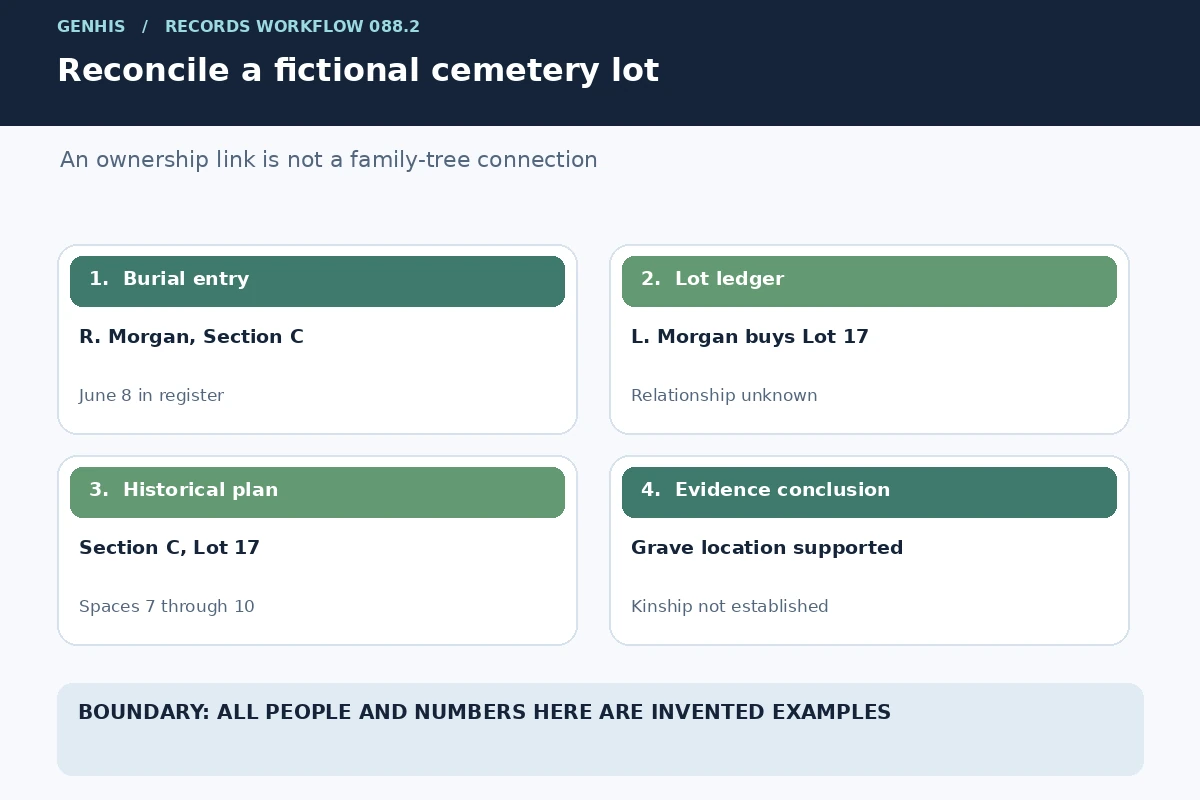
Build a sample comparison with invented identifiers: burial register says R. Morgan was interred in Section C, grave 8; lot ledger says Section C, Lot 17 was purchased by L. Morgan; map labels Lot 17 with spaces 7–10. These records jointly locate a grave and name a purchaser but do not prove R. and L. were siblings or spouses. Keep each entry’s own date and citation. If the lot changed ownership, write its sequence of transactions as a timeline instead of treating the latest owner as the historical one at burial.
Decode plot maps before planning a visit
A cemetery plan may refer to sections, ranges, blocks, lots and individual graves in a hierarchy that is particular to that site. A map index may use numbers that do not match modern GPS positions or volunteer memorial identifiers. Record its edition or revision date and legend. Revisions can rename sections or reflect expansions, removed paths and reburials. Plot coordinates are an administrative address, not automatically a headstone’s surveyed physical position. The same surname on neighboring stones may reflect shared purchase rights, not documented ancestry.
Ask the office whether historical lot numbers were renumbered and whether a supplemental map exists. Compare the register, lot ledger and plan before choosing a route or ordering a photograph. FamilySearch describes how cemetery site and burial-location data may be associated with mapped sites; those mapped points can be added by users and should be verified against the register and plan when precision matters. A blank place on a digital map cannot establish that no burial took place there.
Add the monument entry without treating it as a burial
A monument register, inscription book or photograph documents commemoration, sometimes much later than the interment. One stone may mention absent relatives, an unburied service member or family members interred elsewhere. A replacement stone may have introduced dates not present in the burial books. Make another chart row for marker transcription, recorder, observation date, location and whether the stone was physically inspected. Keep the difference between written inscription and a cemetery clerk’s administrative event record clear in your notes.
When reconciling conflicts, prefer the source most closely connected to the particular claim: the interment book for recorded burial, the plot plan for cemetery layout, and a direct image for what a stone reads now. None is universally best for biological relationship or birth date. For a disagreement in grave numbers, consult map editions and reinterment books instead of silently choosing the more attractive record. Identify uncertainty openly and preserve both conflicting citations. Our walkthrough on how to find where an ancestor is buried when no grave appears online sets out each step.

Build a defensible cemetery-record conclusion
Your final worksheet can have rows for interment, lot ownership, grave placement, relocation and inscription, each with a source locator, statement, date and confidence limit. Cite a named cemetery plus the exact volume/page or file and custodial repository. If access requires a request, supply the relevant names and probable dates without requesting living-person details unnecessarily. Public databases can suggest starting points, but their user-created text should not replace the cemetery’s own surviving records. To go further, our guide “Gravestone Search” shows how to read old headstones without inventing family facts.
A successful conclusion may be narrow: “Cemetery register records burial of R. Morgan in section C on June 8; contemporaneous plot map identifies lot 17; ownership records do not establish relationship to the lot purchaser.” That statement offers usable evidence and tells the next researcher precisely what is still missing. It prevents three common errors: mistaking a grave purchaser for family, conflating death and burial dates, and treating a memorial mention as proof of physical interment. Our walkthrough on how to search cemetery records sets out each step.
More Records and Archives Guides
How We Research: Sources and Proof Boundaries
We consulted FamilySearch classification standards for burial registers, plot maps and the broader cemetery-record category. We also compared this record reconciliation method with earlier GenHis instructions for locating an archive custodian. Our five-source worksheet is about the evidential meaning of a register, rights ledger, map, transfer note and monument listing after a likely cemetery is established. The invented lot example illustrates why ownership and blood relationship must not be conflated.
Sources reviewed (20 October 2026): FamilySearch cemetery record types. FamilySearch burial registers. FamilySearch cemetery search. Cemetery classification material identifies administrative record types, not the survival or contents of any particular cemetery ledger.
Disclosure and limits: The guide is informational and carries no cemetery-service endorsement. Our affiliate disclosure explains the site policy. Cemetery offices differ in retention and access; ask their current staff before relying on an old finding aid. No unpublished cemetery ledger is claimed to have been examined.
No. Ownership, purchased burial rights and kinship are separate claims that must be supported independently.
No. Record burial and death in separate fields; one event may occur days or longer after the other.
Cemeteries can renumber sections, expand and revise plans. Compare map editions and ask the custodian about conversions.
No. Memorial inscriptions can commemorate people buried elsewhere; look for an interment entry and plot record.
Document the missing records, investigate successor custodians and compare municipal, church, funeral and historical society sources.