
To find someone at Mornington Cemetery in Victoria, use the Mornington Peninsula Cemetery Trust deceased search, beginning with a surname, and cross-check the official cemetery map. The cemetery is on Craigie Road in Mount Martha, not at every burial ground on the Mornington Peninsula. A searchable entry may identify a burial, an ashes arrangement or a memorial; preserve the exact wording and ask the trust when a plot or interment is uncertain. A nearby stone or familiar surname does not, by itself, establish family relationships.
Choose Mornington Cemetery, Not Another Peninsula Ground
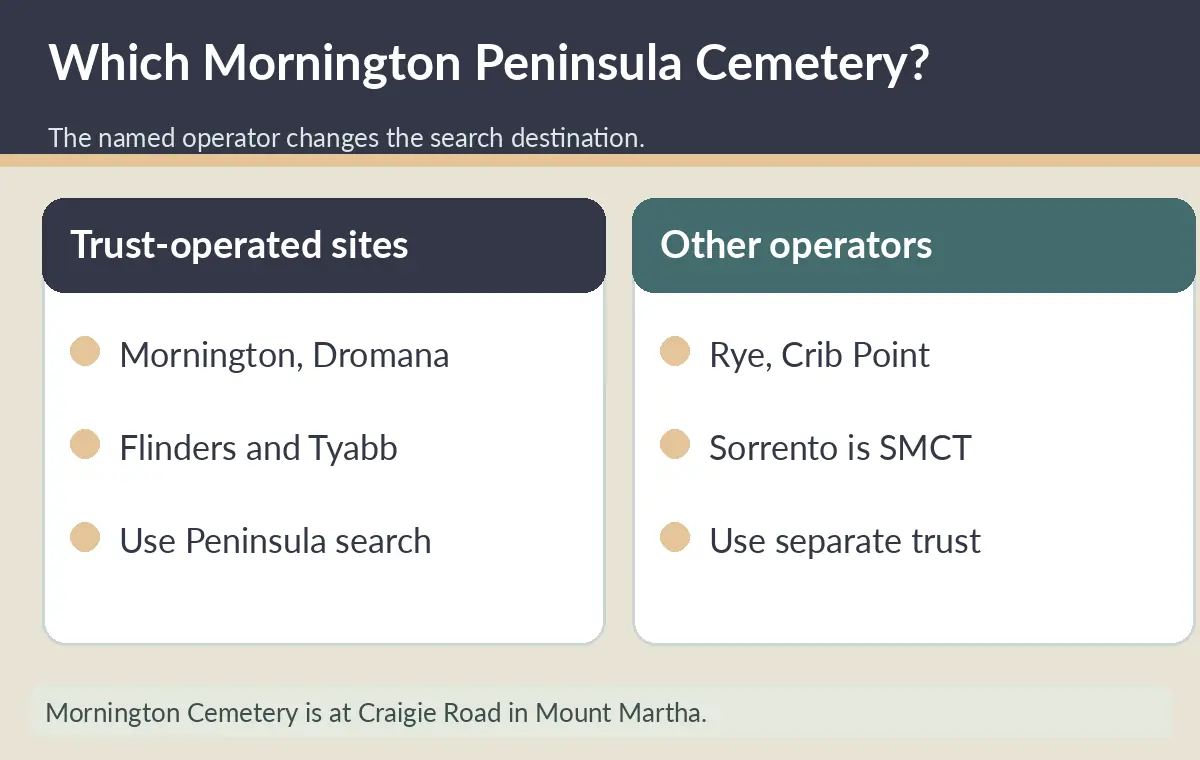
Mornington Peninsula Shire identifies four cemeteries managed by its Cemetery Trust: Mornington, Dromana, Flinders, and Tyabb. It specifically distinguishes Crib Point, Rye and Sorrento as cemeteries administered by other trusts. Before typing a name into a search tool, copy the actual cemetery named in a funeral notice, obituary or register. A person who died in Mornington could have been buried elsewhere on the peninsula, and the word ‘Mornington’ in a residence line is not evidence for a particular burial plot.
The official Mornington Cemetery listing gives 40 Craigie Road, Mount Martha 3934, near the Nepean Highway. Its current descriptions mention lawn-section burials together with garden and wall memorials. Those are different physical and administrative arrangements, so verify whether an index result refers to a body interment, a memorial position, or another service. The site’s access hours and maps can guide a visit but are not historical proof of who is in any individual grave.
Use the Trust Surname Search and Record Exact Fields
The Shire’s cemetery page links to a deceased-person search and directs users to begin with the surname. Search the literal known surname and then carefully documented variants. Copy every relevant displayed field: exact name, cemetery, event or interment date, service type, and plot or memorial locator if the interface supplies one. A common surname can yield multiple candidates with different ages or locations, so do not select the first attractive match. Keep a record of the search date because online records and public fields may change.
If the deceased does not appear, broaden by year or documented spelling and ask the trust for guidance. A no-result page is not proof that the person never died in the region or was not interred at a trust-operated ground. Some historical material may be incomplete or require an administrative lookup. Avoid inventing a register or section number; request exact location details through the operator. For a family account, cite the live record as an operator search result unless you have also inspected the original register.
Match a Cemetery Reference to the Official Map
The official site provides a map for Mornington Cemetery, separate from maps for Dromana, Flinders and Tyabb. If a search result gives a row, section, memorial wall or grave identifier, use the matching plan for the correct cemetery. Copy the reference character for character and note any dated change of plot naming. A map can help physically locate a memorial, but it does not establish the identity of every person buried nearby. Do not substitute a modern overview map for an original interment or plot-rights record.
For a visit, follow current cemetery access arrangements and respect existing mourners and maintenance areas. Photograph inscriptions without disturbing the site, and record the full lettering and date of the photograph. If the stone does not show the searched name, check whether the trust supplied a memorial rather than a burial reference or whether the monument was never installed. An unmarked burial can remain documented in a register; an extra name on a stone can commemorate someone buried elsewhere.

Keep Burial, Ashes, and Memorial Claims Separate
The council’s Mornington page explicitly mentions lawn sections, gardens and wall memorials. If an operator result refers to an ashes arrangement or memorial placement, do not automatically write that a coffin was interred in a grave. Equally, a funeral notice about cremation does not identify where ashes were later kept. Separate three questions: did a death occur, what disposition is recorded, and what physical place can be verified? Each may require a different document and date.
Victorian cemetery trusts are subject to records-management responsibilities, and the Victorian Government emphasizes maintaining records. A trust search result is valuable but should not be treated as a complete reconstruction of a family. Rights of interment or plot administration may be recorded under another person’s name; ownership, actual interment and memorial wording remain separate claims. If there is a conflict, ask for clarification and preserve both source citations.
Consult Trust or PROV Records When the Result Is Unclear
The Public Record Office Victoria burial-record guide advises beginning with the cemetery’s name and searching available trust-related records. This is a holdings route, not a guarantee that PROV has all Mornington burial registers or that every volume can be viewed online. When necessary, contact the Mornington Peninsula Cemetery Trust directly to ask which register was searched, its years of coverage, and whether a precise interment or grave-rights reference is available.
For historical identity verification, compare a registration of death or a dated funeral notice with the cemetery entry. A nineteenth-century death certificate may identify an informant and reported family particulars; its place of death need not be the burial site. A newspaper can report a future ceremony that later changed. Keep the event date, date of printed notice, interment date and later memorial dedication in separate fields, with a citation for each.

Reconcile Same-Name Candidates and Record What Is Proven
A hypothetical Ellen Harris might appear in two records with close dates and a shared surname. Compare age, former residence, spouse, funeral details, documented plot and independent death information before merging the results. A neighbor in the same cemetery may have no relationship to the target person. Even two people buried in the same grave are not automatically parent and child. Use a simple candidate table listing each observed claim and the records that support or contradict it, and leave a relationship unresolved when the evidence is weak.
The illustrative cemetery diagrams in this article are not the operator’s maps or representations of specific living families. Cite the cemetery trust’s name-search result or staff reply precisely and state whether the physical location has been verified. Any service fees or access limits should be checked directly with the operator; this is independent historical research, not a paid recommendation. General commercial policies appear in the GenHis affiliate disclosure. A careful answer may establish an interment while leaving the memorial or precise grave position uncertain.
More Records and Archives Guides
How We Research This Collection
We verified Mornington Cemetery’s Mount Martha address, lawn and memorial options and trust-managed map against the Shire’s full cemetery inventory. We checked that other peninsula cemeteries have separate trustees and compared the Victorian Government’s cemetery-record responsibilities and PROV’s archival holdings method. We make no claim that a map pin, neighboring stone or surname proves biological relationship.
The official address is 40 Craigie Road, Mount Martha 3934.
Mornington Peninsula Cemetery Trust manages Mornington, Dromana, Flinders and Tyabb cemeteries.
Not necessarily. Record the indicated service and distinguish burial from garden, wall or ashes memorials.
No. The Shire lists them among cemeteries managed by other trusts.
No. A map helps locate a section or grave; kinship requires separate evidence.