
Start a Warringal Cemetery search with the Banyule Council cemetery records service, not a family-tree profile. Warringal lies in Heidelberg, Victoria, and its older monumental areas are quite different from newer lawn graves and ashes memorials. Search the deceased person’s reported name, compare dates and cemetery, then follow the location to the correct section. A result may establish a recorded burial or memorial position, but it cannot by itself prove that a similarly named person is your ancestor—or that other names in the same grave are relatives.
Locate the correct Banyule cemetery search before comparing names
Banyule Council manages Warringal and Greensborough cemeteries, and its online tool spans more than one burial site. Begin at the council cemetery hub, locate the searchable burial and memorial records, and check that the record explicitly identifies Warringal. Enter the known surname first and use variants of given names, married names and spellings when the first search is empty. A cemetery-level filter matters: a convincing matching name in Greensborough is not automatically a Warringal burial.
Create a result transcript containing the deceased’s displayed name, the event wording, date, cemetery, area or section, plot identifier if supplied, and a retrievable link or screenshot reference. Save the date you searched. Do not turn a memorial inscription into a burial without checking the record type. For a person whose surname changed, use an obituary, death registration or contemporaneous newspaper notice to connect the name forms. Keep an unmatched candidate rather than treating the nearest age as confirmed identity.
Know Warringal’s 1855 history and its changing sections
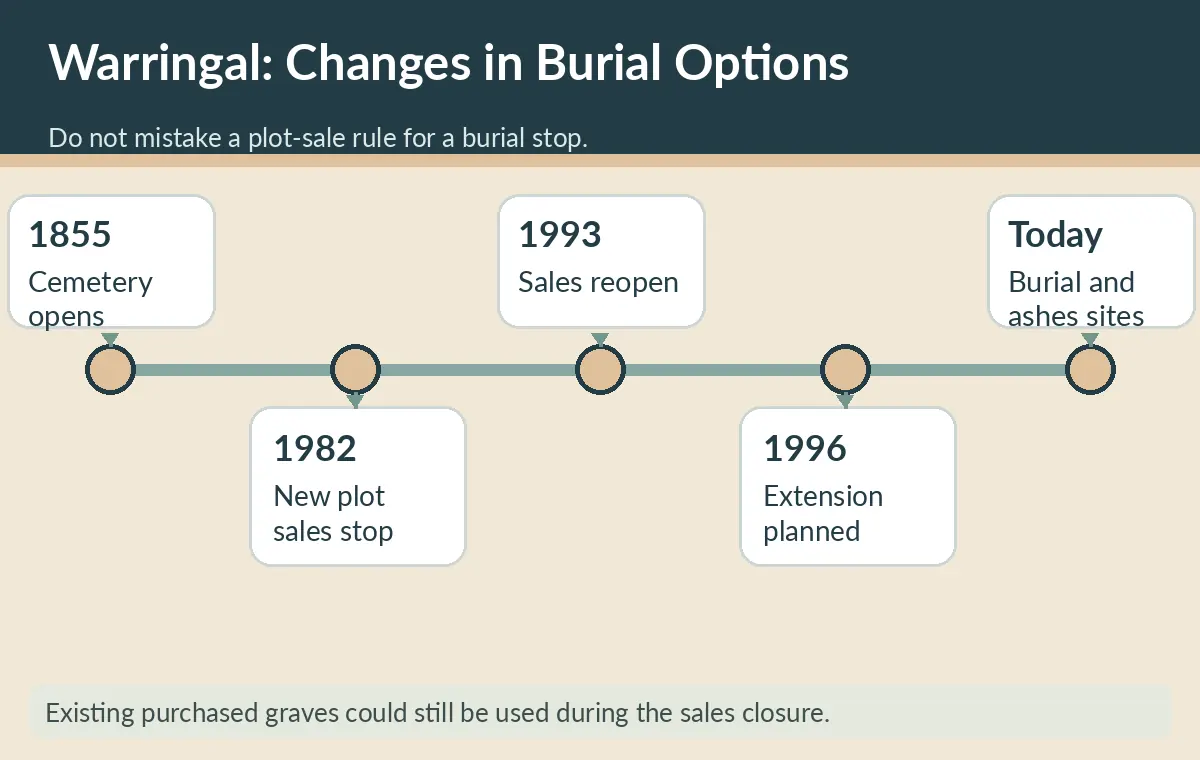
The council’s cemetery history dates Warringal to 1855. The historic cemetery is mainly monumental, with areas associated with Roman Catholic, Wesleyan, Presbyterian and Church of England burials. The modern configuration also includes the Powlett and The Cedars lawn areas and a Pergola Walk section. These labels are useful geographic clues, but they do not establish a person’s denomination without an independent religious or church record.
The cemetery’s administrative history has discontinuities: it closed to sales of new burial plots in 1982, while previously purchased plots could still be used; sales reopened in 1993. A burial occurring between those dates therefore does not mean a newly purchased grave was available. Similarly, a recorded interment in an older grave is not proof that the purchaser was a parent of the deceased. Preserve burial date, purchase date and commemorative inscription as three independent events when reconciling family stories.
Distinguish full burials from ashes and memorial positions
Warringal provides arrangements for cremated remains and memorial placements as well as conventional graves. Banyule identifies several ashes-interment and memorial options, including the Cedars Memorial Wall, Bowen Wall, Garden Bed and Rotunda. The phrase ‘memorial location’ does not by itself prove a coffin burial in the ground. If the database returns a plaque or niche reference, write that exact description, then ask the council whether the entry signifies ashes interment, commemorative inscription or another record category.
Avoid treating all nearby plaques as a shared household. Memorial walls often group positions by available space or purchase sequence rather than family relationship. One surname repeated across a section may represent different people or multiple independently purchased positions. For an unmarked plot, check whether the operator’s record reports an interment even though no headstone is visible. For an engraved name with no burial result, record the discrepancy and verify through council records, not an unsourced online memorial duplicate.

Convert a cemetery result into a reliable physical location
A location reference is only useful if it is read against the right map and section convention. Write the section or lawn name exactly as displayed, together with the grave or memorial number. If a modern locator supplies a map pin, treat it as a wayfinding aid rather than a legal survey. At the cemetery, check entrance and section signs before using rows or neighbors to identify a stone. Weathered stones and unmarked graves are common reasons that an apparent blank location cannot be settled from a photograph.
Warringal has entrances and paths around its Heidelberg site, but a historic map and a current digital locator may use different labels. For conflicting positions, contact the Banyule Cemeteries Team with the exact result and request clarification about the grave-map reference. Do not move objects, scrub the headstone or assume an adjacent plot is part of the same family. If visiting is impossible, distinguish the council-supplied location from any third-party photograph and cite both only for the claims each actually supports.
Test the deceased’s identity with independent records
Imagine a search returning two historic Mary Wilson entries at Warringal. One gives a matching year but no age; another lists a different grave area. Do not select a person solely because the first index hit matches a grandmother’s name. Make a two-row candidate matrix comparing recorded dates, known residence, spouse, contemporary notices, and the names and ages actually reported. Follow a strong candidate to Victoria civil death records or a newspaper funeral notice without assuming that either document has been consulted until you obtain it.
The strongest conclusion may be narrow: ‘A council index records burial of a Mary Wilson in this section on this date.’ To say she is the Mary Wilson in a specific household requires further agreement in age, place, linked relatives or another distinctive attribute. Two people with the same surname in one cemetery are not automatically cousins. A purchaser or nominated right-holder can also differ from the person buried. Write those roles separately in the research log so later readers know what is proved and what remains plausible.

Record negative results and cite the operator accurately
If a search produces nothing, note the name variants, date span, filters and date of search. A missing online result could reflect transcription, mistaken cemetery attribution, an alternate recorded name or incomplete transfer of an older ledger; it is not conclusive proof that no interment occurred. Check whether a death notice names a different cemetery or only mentions a funeral service. Ask the operator for the record class and time coverage relevant to the reported event rather than sending a broad request to ‘find the family.’
A useful citation combines ‘Banyule Council, Warringal Cemetery records,’ the name exactly as displayed, type and date of event, section or position, stable link or search details, and access date. Add a second source citation for any independent civil death or obituary evidence. Do not claim the council’s database grants rights to reproduce the operator’s maps or someone else’s photograph; use your own evidence diagram when explaining the search. See the GenHis disclosure policy before using optional third-party services.
More Records and Archives Guides
How We Research This Collection
We anchored the local history and section labels to Banyule Council’s official Warringal page, and the search procedure to its cemetery records hub. We distinguished administrative history, interment type and physical wayfinding, then tested a fictional same-name case against independent identity evidence. Our diagrams do not recreate a real burial entry or map. Record access and search interfaces can change; verify the current council instructions at the time of your own enquiry.
Use Banyule Council’s cemetery records portal, filter to Warringal, and record the exact entry, not just the name.
Yes. Banyule Council dates the cemetery’s establishment to 1855.
Yes. The cemetery includes ashes memorial walls and other memorial positions; read the record type before inferring interment.
No. The burial record, plot rights and documented relationship are different claims requiring different sources.
Check section labels, preserve the displayed reference and ask Banyule Cemeteries Team to clarify the position.