
Searching for a grave by name is not the same task as proving which cemetery holds an ancestor’s remains. This guide starts when you have a name and approximate death period and want to navigate digital grave and memorial indexes efficiently. It uses a match-ranking sheet that weights cemetery location, date consistency, aliases, photographs and plot details, while marking volunteer-created entries separately from records of an interment. The aim is a reliable short list for verification, not a confident conclusion from the first surname hit.
Prepare a name and location search envelope
Write the deceased person’s name as found in at least one independent record, likely date range and candidate death or burial places. Include spelling alternatives, initials, married surnames, nicknames and historical geographic names. If the person lived in several states, do not default to the last known residence as the burial locality. Name similarity alone is weak, particularly where many people share a common surname or family given-name tradition. Keep birth information and death information in separate fields so a mistaken age cannot dominate the search.
An illustrative case is a fictional “Clara Bell Turner,” reported dead sometime from 1919 to 1922. Reasonable search variations include Clara B. Turner, C. B. Turner and a documented prior surname if known. An invented example keeps the method concrete without implying a real memorial exists. If you know only a county, start at county scale; avoid a single-city filter that silently excludes rural and church cemeteries. Keep track of which query produced each possible match rather than combining results across databases without source labels.

Use memorial-search controls deliberately
The Find a Grave help page documents name fields, wildcards, date ranges, cemetery location and additional filters such as maiden-name search. Start fairly broad, then use one discriminating constraint at a time. If you enter an exact death year before verifying it, a monument with only an estimated year may disappear from the result set. Compare returned memorial IDs, not only names and photographs, because indexes can contain multiple memorials for the same reported person or transcribed variants.
Search the cemetery separately where possible. Find a Grave’s cemetery-search guide explains that place, alternate cemetery names and map listings can help locate the correct site. Distinguish a cemetery landing page from an individual memorial entry. A town can contain several burial grounds with similar church names, and a site’s pin may be approximate. Once inside a plausible cemetery listing, try the surname without a first name, then compare other family candidates only as leads, not as proof they are related.
Test a second index with independent criteria
FamilySearch’s cemeteries search instructions show another way to find sites by location and person. Its tool can link to collaborative family-tree profiles and user-added mapped burial locations. That linkage can be useful for navigation, but it is not automatically an independent source validating a contributor’s lineage. Record whether the second service is displaying a new photograph or simply replicating information drawn from the same memorial listing. Two websites showing the same original submission are one evidence chain.
When a promising candidate appears, compare at least three identifiers independent of the surname: death era, known residence, spouse or parent named in outside records, age, and grave location. Treat any relationship labels in a memorial as unverified until you inspect documents. A real burial register or gravestone image can add different evidence from a copied biography. Separate the existence of a search hit from a confirmed identity match. If none of the candidates has two convincing identifiers, preserve them as unresolved rather than choosing one.
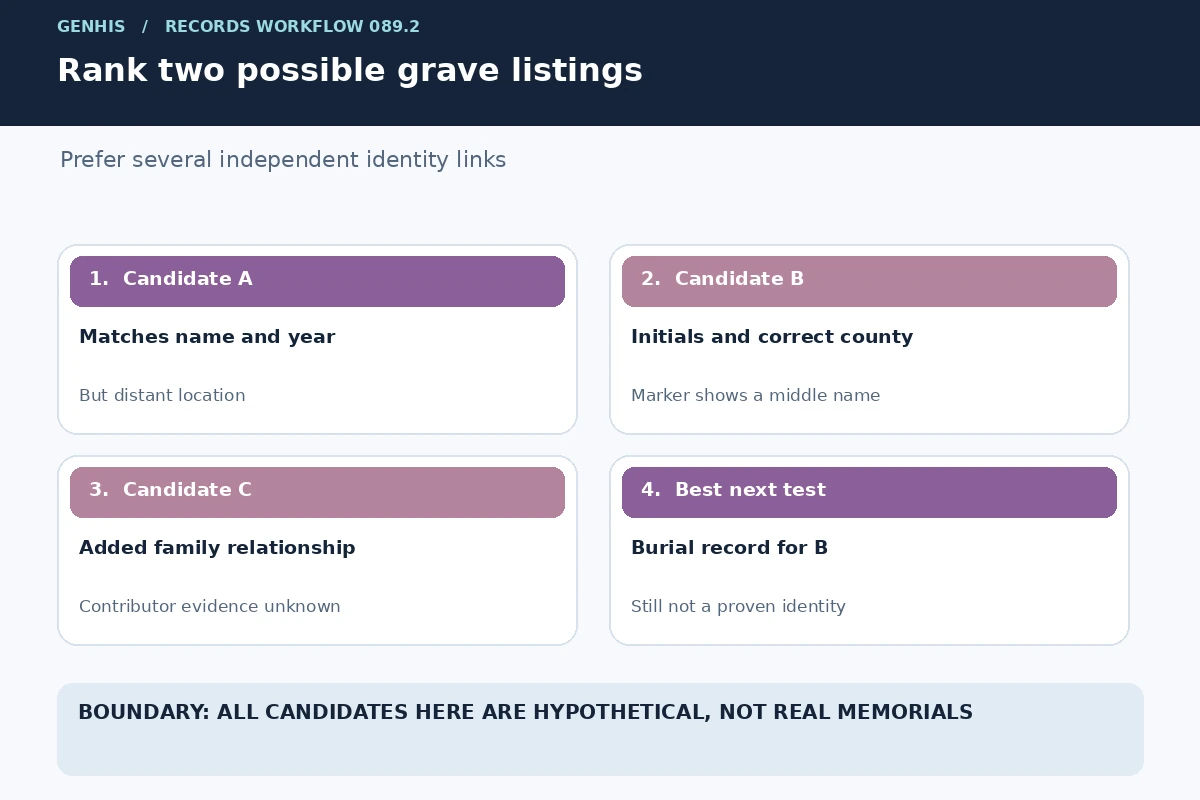
Rank candidates instead of choosing the first hit
Create a small table with columns for memorial or result ID, reported name, cemetery, dates, image present, plot identifier, outside comparison, and confidence status. A good first candidate may match the date and county but lack a stone photograph; a different candidate may show a matching spouse from a marriage record. Keep confidence as a reasoned explanation rather than a numeric probability invented from a couple of matches. Mark any date sourced only from user-supplied memorial text as reported, not verified.
Use the fictional Clara Turner example: Candidate A matches the name and year but is 300 miles from the documented residence; Candidate B has initials, a cemetery in the correct county and an image with a middle name; Candidate C has a family relationship added by an unknown contributor. Candidate B should be investigated first, not proclaimed correct. Request or seek the actual cemetery register or death record to link the candidate to the right individual. A memorial photograph is useful, but cannot automatically verify relationships in the surrounding user-written biography.
Handle missing markers and duplicate memorials
No online result might mean an unphotographed stone, an unindexed burial, an altered surname, a lost marker or a missing database contribution. It does not prove someone was never buried. Likewise, one memorial without a grave photograph may refer to a cenotaph, a burial described by a third party or a virtual memorial depending on the site’s labels. Check whether the site marks it as a non-cemetery burial or monument before planning an actual visit. Avoid inventing GPS coordinates from map pins.
If two entries appear to describe the same person, record both IDs and evidence for the suspected duplication. Do not combine families or edit a collaborative entry based only on matching names. Refer to the platform’s supported correction process, and avoid posting personal details about living relatives. Where cemetery staff can verify an interment, request a lot reference with the minimum necessary information, noting any fees and access rules directly from the custodian rather than assuming a standard policy.

Report a named grave result at the correct confidence level
A defensible result states whether you located a database memorial, read a photograph of a stone, matched a cemetery interment record or confirmed an exact grave position. Those are different achievements. Include the memorial ID and observation date, cemetery as named, outside identity documents, and unresolved conflicts. If your goal is a physical visit, verify the current map and access arrangements separately; this search article is primarily about identifying a credible person-level result in a digital catalogue. Our guide “German War Graves Search” shows how to read Volksbund entries without assuming service.
The final short list should be actionable. For a strong but unconfirmed match, write: “Memorial entry may concern Clara Turner; date and county fit, but independent interment documentation is outstanding.” For a rejected candidate, note why the death date or independently identified spouse conflicts. That audit trail prevents future researchers from repeating unproductive searches and preserves the distinction between an online grave listing and proof of burial of a particular ancestor.
More Records and Archives Guides
How We Research: Sources and Proof Boundaries
We verified the Find a Grave site documentation describing current memorial and cemetery search filters and checked FamilySearch information about its cemetery-search tool. Unlike the existing GenHis article on tracing an ancestor to a physical burial site, our distinctive output is a scored-in-words candidate list for a name-based online index search. Fictional candidates deliberately demonstrate uncertainty; neither a memorial biography nor a pin is assumed to be original proof of identification.
Sources reviewed (20 October 2026): Find a Grave memorial search help. Find a Grave cemetery search help. FamilySearch cemetery search. FamilySearch cemetery record types. Product and help guides establish current search controls; online memorial contributors may add unverified family details.
Disclosure and limits: No memorial platform is represented as a GenHis advertising partner. View the GenHis disclosure policy. Search interfaces and submitted memorial text can change; personally identifying facts about living contributors should not be reprinted without a legitimate reason.
Search variants, initials, documented married names and wildcard options when supported by the chosen index.
Contributors may create duplicates, or different people may share identifying facts. Compare IDs, photographs and independent documents.
Not necessarily. Some pins mark the cemetery rather than a grave, and user-added coordinates may be approximate.
No. It may reflect an unindexed cemetery, unphotographed or lost marker, variant name or limited collection coverage.
No. Memorial biographies and relationships may be user contributed. Check a marriage, birth or other relevant record.