
The Sussex Family History Group (SFHG) Baptismal Index can point to a baptism, but it is not a substitute for the church register. SFHG describes nearly 1.7 million entries dating from 1537–1900, mostly from Anglican parishes, with some nonconformist records and Sussex-related entries elsewhere. The index is a members-only resource, not a promise that every Sussex child appears in it. Start with a plausible parish and a broad date range, record the indexed spelling and reported parents, then obtain the underlying page. The society’s index description and its explicit primary-source warning make this an evidence-checking task rather than an exercise in collecting names.
Identify the parish before choosing a surname candidate
Build a small locality sheet from the records you already trust: town or hamlet, denomination if known, likely birth period, neighboring settlements, and at least one other person associated with the family. Sussex parishes do not always follow modern town boundaries. A family described as living near a larger town might have worshipped in a smaller neighboring parish. Do not force the first matching surname in the county into your tree. Write the location in the form used by the historical record, along with any modern spelling, and search adjoining parishes when necessary.
Use the West Sussex Record Office parish-register guide to identify surviving register ranges and the ecclesiastical parish map. Start with a broad surname and approximate event window, then narrow only when something independent supports a date. Remember that a baptism date is not necessarily a birth date. An infant could be baptized shortly after birth, but older children and adults also appear, and later copying can introduce mistaken years. This distinction will affect whether a seemingly perfect indexed baptism fits other family documents.

Read the SFHG collection description and access rules carefully
SFHG describes nearly 1.7 million baptism index entries covering 1537–1900. The majority concern Anglican parishes within Sussex, but there are some nonconformist birth events and Sussex families recorded beyond the county. The society also says its Anglican material is virtually complete while only a portion has been checked; those statements describe the index project, not universal survival of the original books. The service requires active membership. A researcher without member access can use the parish custody guidance and alternative indexes rather than treat a locked interface as an absent record.
If you use the SFHG search, transcribe the exact indexed wording, including unusual spelling, parish designation, date, names of parents, and any record reference actually displayed. Note whether the interface identifies a transcription source or an original register. If the search does not find a candidate, remove speculative given names, consider short forms, and use nearby parish ranges. Keep a dated query log. A negative result within a society index cannot establish that the baptism did not happen: a parish book may be damaged, omitted, mistranscribed, or filed under an unexpected spelling.
Find the underlying register image or archival volume
The FamilySearch Sussex parish-register collection describes indexed baptisms, marriages, and burials over a broad 1538–1910 span, with locality-dependent coverage. An indexed item there may not reproduce an original page. Confirm the name of the parish, the event and the precise period before using its browsing or record-source links. Do not combine two same-name entries from different platforms as independent witnesses if both transcribe the same register page. Their agreement may reflect a shared original or a shared transcription error.
The West Sussex Record Office advises browsing a register page by page when a name search fails in a parish where you have reason to expect a person. Consult its A–Z holdings and distinguish parish registers from transcripts or bishop’s transcripts. An image may be accessible via a library terminal even if home access requires a subscription. If there is no scan, request the archival shelfmark, register type, and folio or page range from the custodian. Cite the volume and the specific entry rather than merely the date of an online search.

Extract parentage, dates, and neighboring entries literally
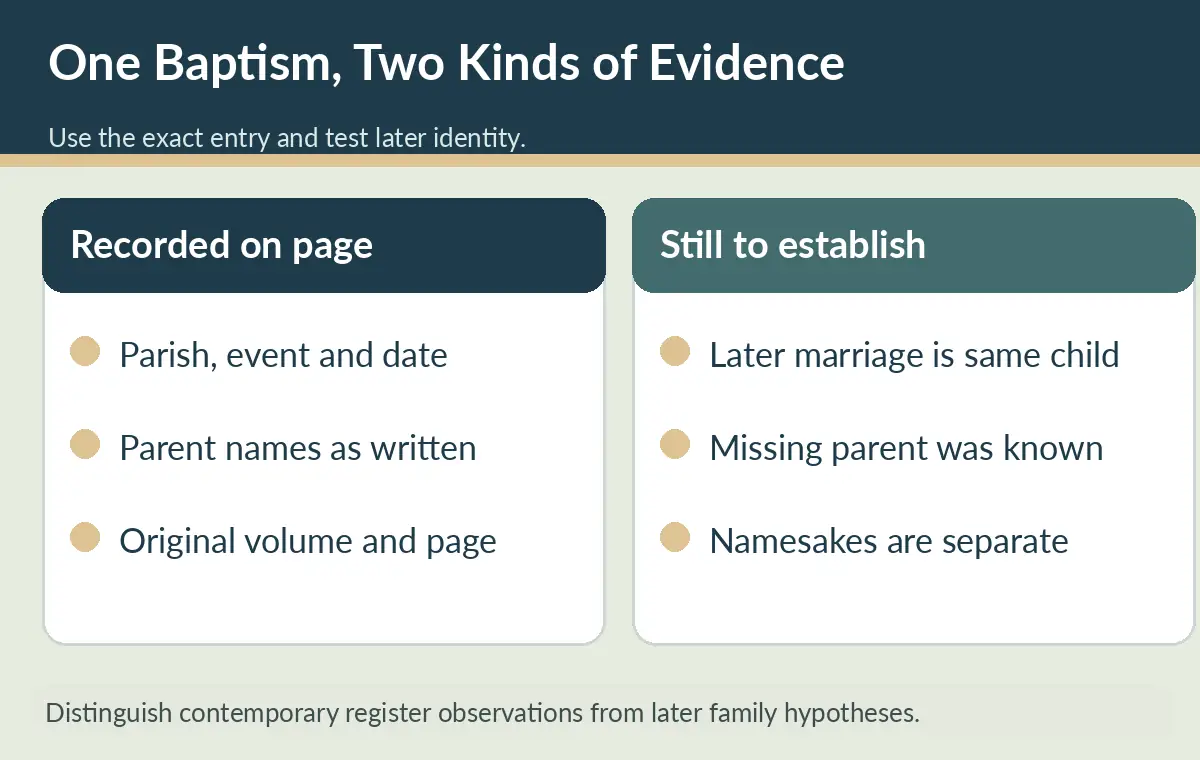
Once you can view a register page, copy what it actually says. Some entries name one parent; others name both, and later forms may show a residence or father’s occupation. Do not silently add a mother to an earlier entry because a marriage elsewhere names her. Note whether the written event is baptism or birth, and preserve damaged or abbreviated wording. When a priest uses a running family group or an unusual name abbreviation, inspect surrounding entries to understand the handwriting before interpreting the line.
A fictional example shows the risk: two Mary Bakers were baptized in neighboring parishes within a year, but only one page explicitly names father Thomas Baker. A later marriage mentioning Thomas is suggestive, yet not conclusive without place and further family context. Create two candidate rows and compare parent names, village, father’s occupation if given, siblings and subsequent appearances. A baptism can support the parent relationship as reported by the original register, but it does not automatically link that child to every later same-name individual.
Understand what a missing baptism result really means
A no-match outcome has several explanations. The parish might have surviving registers for the desired period but an indexing gap, the family might have belonged to another denomination, or the event may have occurred elsewhere. The family may also have entered a birth in a nonconformist register that is not in the particular Anglican browse set. Use a coverage table: parish, register type, surviving dates, index checked, original examined and alternative source. Each blank should be recorded honestly. When an original book is missing, searching the same database with more spellings will not restore it.
For events after July 1837 in England and Wales, investigate civil birth registration separately from baptism. Registration is an event in a different system and may help distinguish two infants with the same name. For an older Sussex family, parish marriages, settlement and apprenticeship material can supply residence and parent clues, but these are not substitutes for a baptism automatically. SFHG’s Sussex People Index and other specialist databases have different inclusion rules: never treat them as a single census-like catalogue of all county residents.
Create a citation that survives a platform change
A reproducible baptism note identifies the event, original parish, register volume or catalog reference, entry date and page or folio, archival custodian, and the online image or transcription site used. Add the date you accessed an image and a short quotation of the decisive words. If you used the SFHG index first and then found the page at another service, keep both references while naming the underlying record once. This is especially important when a surname appears in an index under a corrected spelling rather than exactly as the clerk wrote it.
Keep your inference separate from your transcription: ‘the register names John and Ann as parents’ is an observation; ‘this child later married in Brighton’ is a hypothesis until linked. If birth and baptism dates appear to conflict with census ages, retain both rather than choosing the more precise-looking one. Explain which date refers to which event. That small discipline prevents a clean-looking database hit from becoming a fabricated line of descent, and it makes it easier for another researcher to test your conclusion.
More Records and Archives Guides
How We Research This Collection
We compare the membership and scope claims on SFHG’s own Baptismal Index page with the group’s warning that transcriptions are secondary data. We use West Sussex Record Office parish holdings and FamilySearch’s collection description to distinguish index, transcript, register image and unavailable original. For every candidate we preserve the literal entry, event type, reference and unresolved conflicts; a shared surname or parental given name is never the sole identity test. Read our affiliate disclosure; archive links here are references, not claimed paid partnerships.
SFHG identifies its baptismal index as a members-only service. Alternative archive guides and indexed sources may offer a different access route.
No. Its described span is 1537–1900 and its scope and checking status vary. Births and baptisms are also different events.
Check the relevant parish in the record-office holdings lists; an online index result by itself does not identify physical custody with certainty.
No. Record exactly which parent or parents are explicitly named and test any additional relationship independently.
Request the volume, page or entry reference from the custodian and consult the surviving parish register or appropriate transcript.