
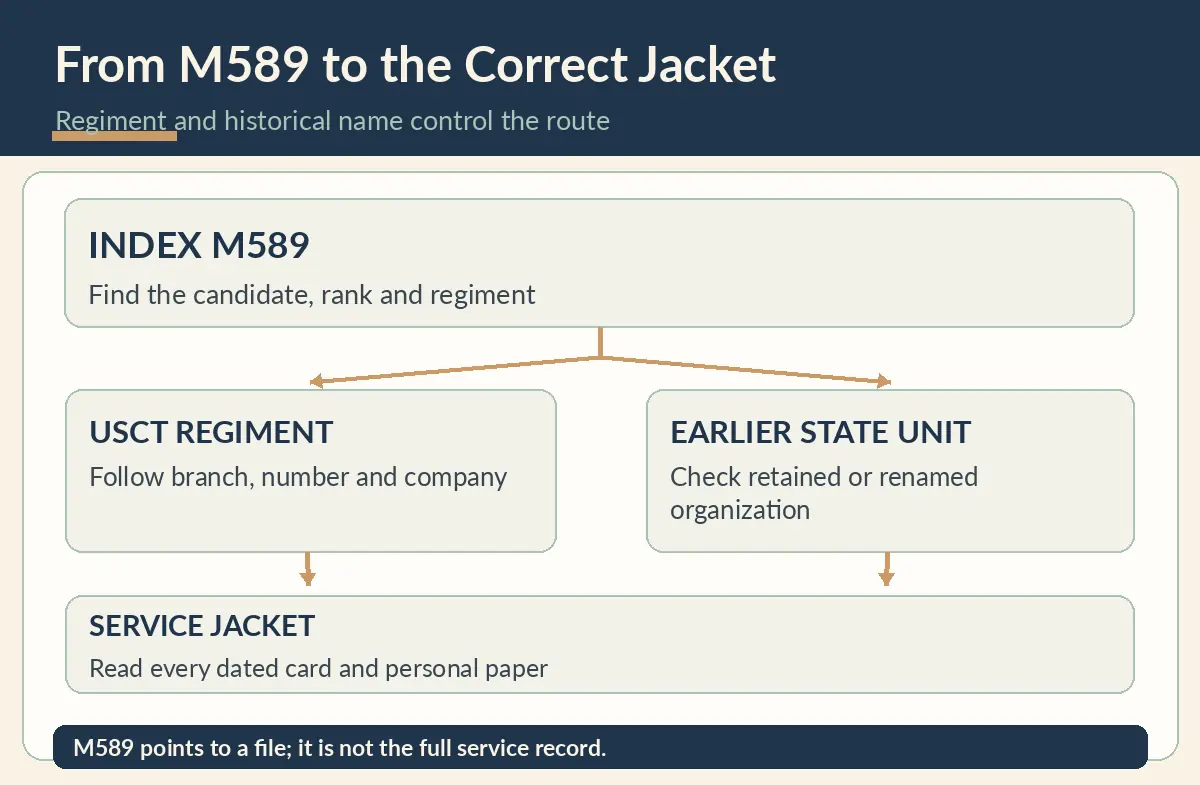
To research a soldier in the United States Colored Troops (USCT), start by identifying the regiment and its historical designation. The alphabetical microfilm index M589 points toward a compiled military service record (CMSR), but the index card is not the service jacket. The National Archives guide explains that CMSRs were assembled later from muster rolls, pay records and other wartime documents. Confirm the original unit before interpreting a name, and never assign an unverified parent or birthplace from a simple military match.
Know What the M589 Index Can Actually Identify
M589 is the index to volunteer Union soldiers who served with USCT organizations. Its purpose is to locate a soldier’s compiled service material. A name entry can include unit information, but it is not a continuous service chronology and may not explain the full identity of a same-name soldier. Record the rank, spelling, unit and any index reference before requesting or opening a detailed jacket. An exact surname is less useful than a reliable regiment match.
Not all Black Union units were administratively named USCT from the outset. The National Archives historical account describes Louisiana formations that changed designation, and some state units retained their identities. Search the original state or early unit name when a family document predates reorganization. Otherwise the later name might hide a real soldier or attach the wrong man to the record.
Move From an Index to the Full Service Jacket
A CMSR is commonly a jacket holding one or more card abstracts made from original military returns. Its organization is linked to branch of service, regiment and the soldier’s name. The NARA USCT service-record page explains that many jackets also contain papers not reducible to a one-line index. Treat the jacket number and relevant cards as the research target, not the index transcription.
Search digitized images when available, noting whether they are fully browsable or limited to selected units. If a free catalogue reveals only an index, the original jacket may require a different database, archive access or an order. Do not claim the soldier’s file is lost based on a provider’s missing thumbnail. The first action after finding M589 should be to identify the exact organization and consult the record availability guide.
Read Muster-In, Absence and Discharge Cards Carefully
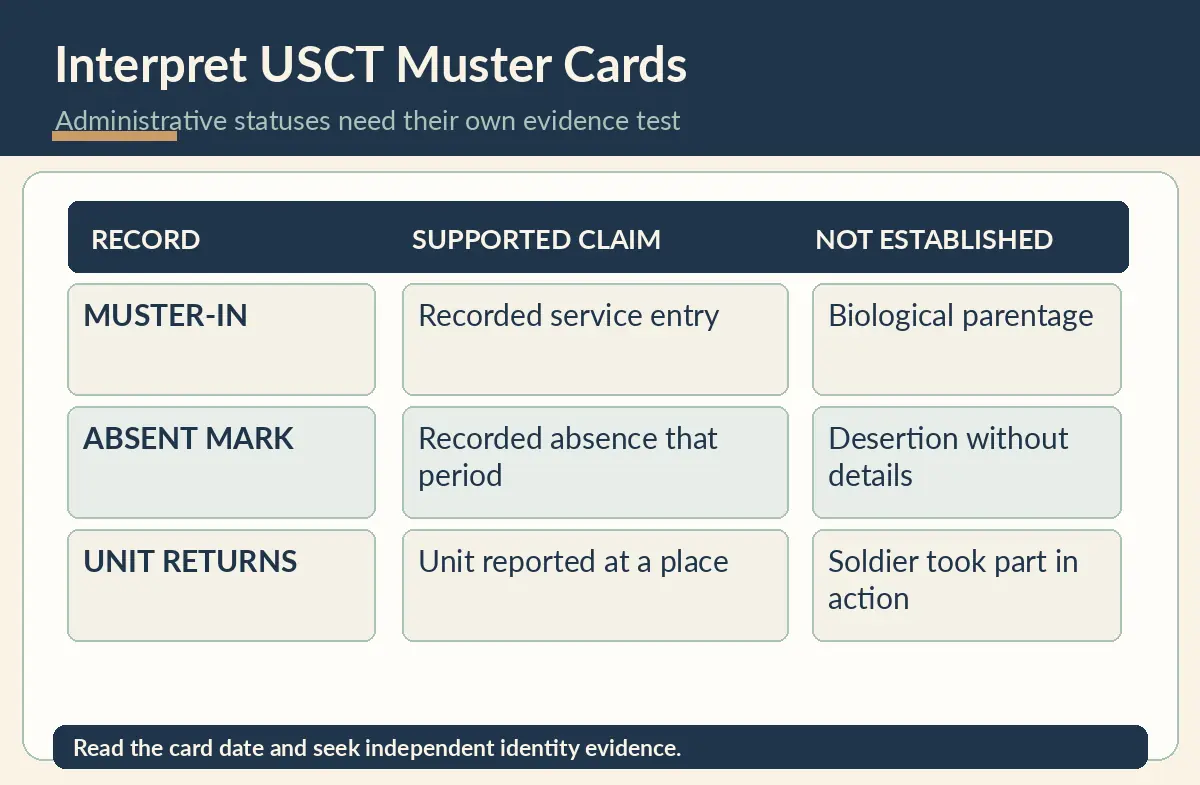
A muster-in card reports the administrative entry to service; later cards usually cover defined return periods. Some state a rank, presence or absence, wage details, transfer, wound or hospitalization. Read the period heading before converting a single ‘absent’ tick into an event. Absence might mean an assignment elsewhere, a medical situation, a move to another organization or an unexplained entry, rather than desertion.
Record each card’s original source roll or form, the date range reported, and the precise status word. Then arrange cards chronologically while preserving overlaps. If a later abstract was filed out of date order, moving it within your analysis is acceptable only if you retain the original citation. A compiled record is an official derivative assembled from wartime materials; where necessary, consult the underlying rolls to investigate conflicting statements.
Watch For Renamed Units and Multiple Jackets
Historical USCT regiments included infantry, cavalry and artillery, with some formations beginning as state or local volunteer units before federal renumbering. NARA warns that a soldier who served in multiple organizations can have more than one jacket. Do not assume a similarly named regiment is identical in two years; compare date, branch, company, officers and the regiment’s documented organizational history.
A separate unit history can explain movement through places where the soldier later appeared, but being in a regiment does not prove participation in every battle it fought. Use a personal card to establish an administrative assignment, then consult unit records for the reported location and action. An illness or detached-duty card might show that the soldier was elsewhere during a major engagement.

Separate Personal Papers From Institutional Claims
Some USCT jackets include enlistment-related papers, correspondence, oath forms or documents associated with the status of formerly enslaved men. The National Archives description notes special materials such as manumission documents and claims papers in certain contexts. Do not assume that every soldier’s folder contains such material or that the administrative characterization of a person is the entire story of that individual’s life.
An 1860s military paper may reproduce the words of an official, claimant or witness. Keep those claims attributed rather than converting them into an unquestioned family narrative. A person’s presence in a personnel file supports the recorded military administrative action; a reported kinship, prior enslavement or place of origin may require corroboration from a separate primary record.
Test Two Soldiers With the Same Name
Imagine two hypothetical men named Henry Williams. One is listed in an infantry company organized in Louisiana; another appears in a cavalry unit associated with another state. A birth decade guessed from a later family record does not resolve the match. Compare unit, enlistment place, stated age, personal description and the sequence of muster cards, then look for a pension claim or independently verified family residence to discriminate.
Do not rely on an online tree attaching the first plausible CMSR to an ancestor. A surviving personal paper might distinguish the men; in other cases the identity remains unresolved. Note contrary evidence explicitly. When a soldier’s name spelling shifts between forms, check whether unit, service number and dates continue consistently before deciding it is the same man.
Use Pensions and Civil Records for Family Links
A soldier’s CMSR chiefly documents military administration. The NARA CMSR guide cautions that such jackets generally do not name parents or next of kin, and rarely list all battles. Pension files may contain later statements by relatives, while marriage, census, land and community records can test a proposed family connection. These are separate sources with different informants and possible conflicts.
Start a verification table with columns for soldier’s claimed identity, exact CMSR evidence, later pension testimony, family-civil evidence and contradictions. A death or discharge reference in the jacket should be checked against separate events when precision matters. If the family’s earliest verified residence is far from the recruiting district, that is a research question, not an automatic disqualification.
More Records and Archives Guides
How We Research M589 and USCT Jackets
We identify the proper USCT or retained state unit, use M589 as a pointer, then read the jacket card by card. We compare formation changes, month-level rolls and any personal papers against independent records. Our conclusion distinguishes a soldier shown on a muster, a probable same-name identification and a family relationship supported by corroboration; we do not invent relatives or battle participation from absence of detail.
Keep the exact index reference, regiment, company, card type and image locator in every citation. Check access claims against NARA before paying a third party for a record already accessible elsewhere, and see our affiliate disclosure. Preserve historical terminology accurately while treating each person’s humanity and history with care.
No. M589 is an alphabetical index. Follow its unit and name information to the separate compiled military service jacket.
A man who served in more than one military organization may have a separate file under each unit or designation.
Usually not. NARA cautions that CMSRs generally omit parents and next of kin; look for independent family sources.
No. Check the exact notation, dates and related cards for sickness, detached duty, transfer, administrative gaps or other explanations.
No. Some state-designated Black units retained their state names and some earlier organizations were renamed; research the exact historic regiment.