
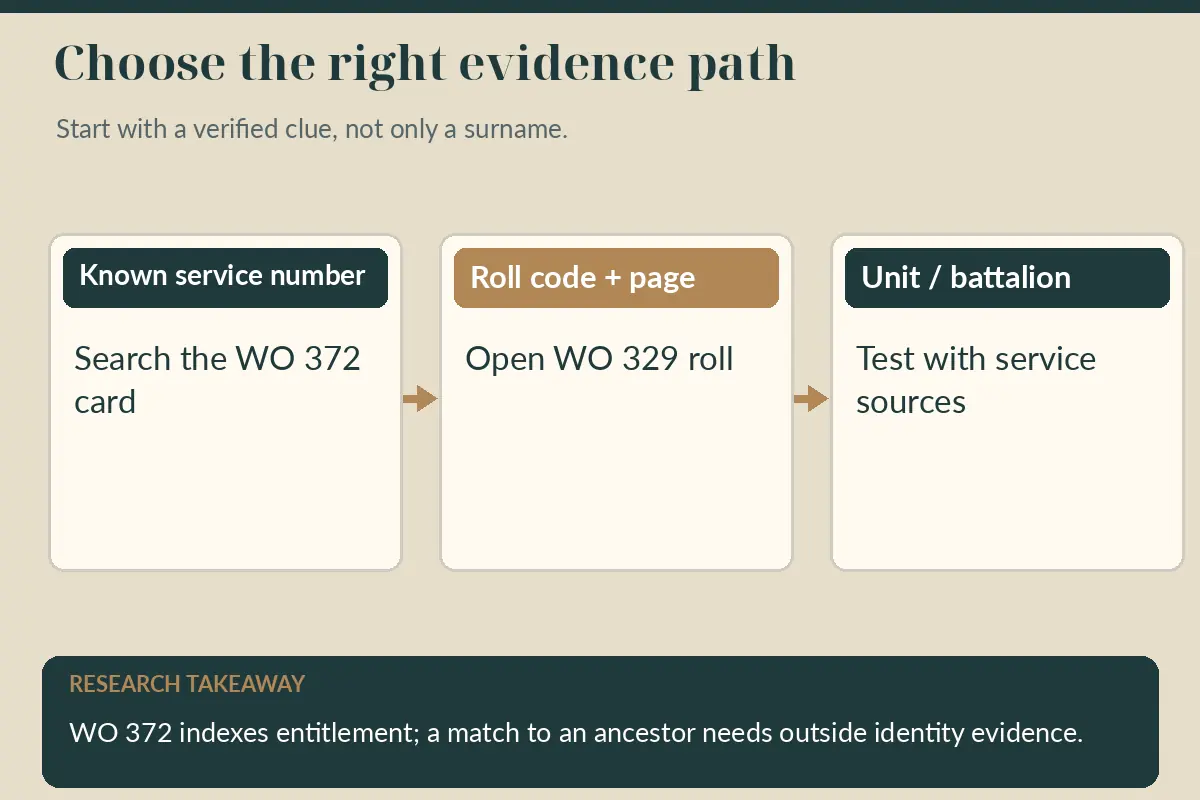
For a First World War British Army medal, start with the named soldier’s WO 372 medal index card, copy its medal-roll reference, then consult the matching WO 329 roll. The National Archives explains that WO 372 includes more than five million cards created by the Army Medal Office. Most concern campaign-medal entitlement, not a full account of military service. A card may identify a regiment, service number, rank or first theatre; a linked roll may add a battalion. This article follows those distinct layers and documents where each conclusion came from. Consult the official medal card guide and our affiliate disclosure.
Identify the Correct WO 372 Card
Begin with whatever makes your soldier distinctive: a service number, unit, middle initial, residence, dated family document or named next of kin. An index hit for ‘John Davis’ is not proof of your John Davis. WO 372 includes some officers, Indian Army personnel, nurses, Royal Flying Corps personnel, Royal Naval Division men and civilians as well as British Army soldiers. That breadth helps discovery, but it is not a promise of complete coverage for every branch or role. Record the exact surname spelling and any variant written on the actual card, not merely an online search-result label.
Capture the full WO 372 piece number and image reference as soon as you open the card. Transcribe every service number and regiment exactly; the same man might appear with a changed number or unit. Do not automatically join two numbers to one person unless the card or outside evidence supplies the connection. A scratched-out field, abbreviated regiment or ‘ditto’ mark can be critical. If only a transcript is visible, mark the evidence as an index and seek the image before treating it as an original reading. Always distinguish the year of the military event from the later administrative compilation of the card.
Decode Entitlement and Roll References
The card’s campaign-medal columns may record entitlement to the 1914 Star, 1914–15 Star, British War Medal or Victory Medal, together with letters, references or remarks. Do not treat an empty field as proof that the soldier never served: some people did not qualify for a particular medal, some groups used other sources, and cards are not universal service files. An entry for a first theatre of war or entry date describes a particular administrative event; it is not proof the person fought at a named battle. The National Archives’ medal research guide explains the roll-linking step.
Match the Soldier in WO 329
Copy the roll designation and page number from the card without normalizing it to a convenient guess. The reference directs you to a medal-roll entry held in WO 329. At the roll, compare full name, regiment and service number before accepting the match. WO 329 rolls can sometimes provide a battalion or other detail not obvious on the card. Cite the card and the roll as two linked but different sources; the roll does not transform the original card into a complete service record. If a page covers several men with nearly identical names, copy adjacent entries and the column headings to preserve context.
Do not confuse a medal-roll page with an individual service file. British Army First World War service records survive unevenly and are held in other series. Pension material, casualty lists and contemporary newspapers may answer other questions, but each is a separate item with its own evidentiary problems. Before attaching an ancestor’s family to a medal recipient, verify a number or unit against an independent document such as a dated enlistment, local roll of honor or a reliable family letter. A medal card naming a regiment is strong evidence about the person on the card, but not necessarily about the person in your tree.

Separate Medal Evidence From Service Evidence
A common trap is searching only by surname and assuming a prestigious award or a single returned card resolves identity. Some WO 372 cards primarily concern gallantry or long-service entitlements, while the large central group concerns campaign awards. Check the type of entitlement and whether the reference points to the expected roll. Officers are particularly worth caution: The National Archives notes that officers had to apply for certain campaign medals and may not have done so, making the absence of a card ambiguous. A missing digitized card is not a negative military record unless the search scope and record class are documented.
Unit research starts only after you have established an independently credible unit and the dates at which the soldier actually belonged to it. A WO 329 roll may help narrow a battalion. Compare that with service paperwork or a dated casualty report, not with a family story alone. The unit’s WO 95 diary can then contextualize military operations, but a unit diary is not a soldier’s daily log. If the diary describes a raid, you cannot claim that a particular named man participated without additional individual evidence. Keep a column for the unit’s action and a separate column for the man’s proven presence.
| ARCHIVAL SOURCE | WHAT IT CAN SHOW | WHAT IT DOES NOT PROVE |
|---|---|---|
| WO 372 card | Medal entitlement + regiment | Not every posting or action |
| WO 329 roll | Award roll and sometimes battalion | Not a full personal service file |
| WO 95 diary | Unit movements and operations | Not proof of a soldier’s presence |
Handle Missing Cards and Similar Names
For a namesake matrix, list each candidate’s name, number, regiment, card-piece citation, medal-roll reference and corroborating source. A correct surname is not enough, especially when a battalion field is missing or the soldier transferred between regiments. If the two candidates have different service numbers, search both numbers in independently dated documents and do not blend the resulting careers. Treat initial-only entries with caution; an initial can be misread or a name abbreviated differently across clerks. Preserve false leads in the research log so another researcher does not repeat a misleading match.
Imagine two fictional Edward Wilsons listed in WO 372: one has service number 14820 with a northern infantry regiment, and another has 42105 with a different unit. A family keeps a postcard signed ‘E. Wilson’ and a regimental photograph without a date. Neither card is yet your person. Follow each card’s WO 329 roll reference, compare the listed regiment and any battalion, then seek an address or service number on the postcard, newspaper or official record. If neither has a distinctive family link, report two plausible soldiers instead of selecting the one with the more dramatic campaign.

Example: Two Soldiers With One Name
Make citations separately for the card (The National Archives, WO 372 piece, named entry, image or card identifier) and medal roll (WO 329 piece, page, soldier and unit). Record the portal where viewed and date accessed. The card is an administrative index into award entitlement, the roll is a different administrative register, and a personal service file—if found—is another source. This separation is your audit trail. Search term, rejected candidate and undigitized-roll status belong in the log; a downloaded image alone rarely preserves enough information to repeat the result years later.
More Records and Archives Guides
How We Research Medal Cards and Rolls
We read the Army Medal Office’s index card as an index to a specific administrative roll, then check the relevant WO 329 page before exploring any individual service history. We compare complete units and service numbers rather than accepting matching surnames, and we search alternate award, service and unit sources only when their coverage fits the question. The evidentiary limit is the same at every stage: entitlement to a campaign medal is not proof of a particular battle, rank throughout service, or identity of the relative whose family you are researching.
Campaign medal entitlement can support qualifying overseas service, but the exact award and card notation must be interpreted; it does not prove a specific battle.
No. WO 372 contains the index cards, while WO 329 contains the original medal rolls to which many cards refer.
The cards vary. The linked WO 329 roll may supply a battalion, or a separate service record may be needed.
Compare service numbers, regiment, rank and independently dated personal records before choosing one.
No. The Archives notes officers sometimes had to apply and may not appear.