
To research a woman who served as an airwoman in the Women’s Royal Air Force during 1918–1920, search The National Archives’ AIR 80 service records and inspect the person’s actual forms. Around 30,000 files survive for this service group, but the guide states that no First World War WRAF officers’ service records are known to survive. A search must distinguish airwomen, officers, predecessor organizations, and later service. AIR 80 may document enrollment, assignments, dependants, address and discharge; it is not a guarantee of every activity. Begin with the AIR 80 guide and our affiliate disclosure.
Check Status and Date Before Searching
Collect the person’s full birth name, possible married name, home address and approximate birth year before searching. An airwoman’s listed name may differ from the one in a family’s later account because of marriage, initials or clerical spelling. Capture each candidate’s piece number, age and named next of kin, but do not infer a sibling, spouse or parent without checking the field’s actual wording. The AIR 80 collection includes people formerly connected with the Women’s Army Auxiliary Corps, Women’s Legion drivers and Women’s Civilian Subordinates. Earlier service with one of these groups is not proof that it occurred within the WRAF before the organization existed.
The Women’s Royal Air Force was formed in 1918, and the original organization ended in 1920. The archive’s stated AIR 80 range focuses on this period, even though files can refer to earlier predecessor service. Do not expand it to every RAF woman from 1914 to the present. Search the catalogue’s specific AIR 80 name search and compare a family address with the image. If no record appears, search under maiden and married surnames and allow for missing files. Distinguish a no-result screen from a checked archival absence; the latter depends on exactly which collection, spellings and status were searched.
Locate a Named Airwoman in AIR 80
An AIR 80 record may contain an enrollment form, a discharge certificate after demobilization, a casualty form or a statement of service. A form can include age, marital status, religion, address, dependants, physical description, trade or profession, postings, promotions and next of kin. The contents vary considerably. Transcribe the original headings before extracting data, especially when a page contains both dates of a historical event and a later administrative notation. These are evidence of reported or recorded facts at particular times, not a complete verified biography. The personnel overview also explains related records.

Read Enrollment and Transfers Separately
A recruiting form may record the address at which the woman enrolled; it does not prove that she was born there or remained there. A trade or occupation entry reflects the service administration’s record and may describe prior civilian work rather than an exact daily assignment. Details of dependants and marital status are time-specific. Write ‘named as next of kin on enrollment’ rather than silently asserting biological relationships. If a familiar name appears as a contact, verify that individual’s identity through an independent civil record, contemporary directory or letter before building an extra branch in the family tree.
Transfers deserve a date-by-date log. When the file mentions a predecessor body, copy the organization’s name, date and source field as written. When it mentions a move to a station or a new unit, treat the posting as a service-administration event, not proof of a particular journey or duty performed every day. Airwomen filled jobs such as drivers, mechanics, cooks and office clerks; an individual’s actual role depends on her file. Even where a posting is to France or Germany, do not generalize all other airwomen’s experience or infer combat service from a location.

What Survives for Officers and Successors
An AIR 80 casualty form is another administrative source, not necessarily evidence of a battlefield injury. Read any specific diagnosis, date, location, correspondence and discharge context carefully. Historical health data should be reported proportionately, especially where living relatives may be affected. Distinguish a preliminary medical note from a final disposition; do not assume treatment was complete or permanent incapacity resulted. A statement of service may be more reliable for institutional postings than for a family relationship supplied by an unnamed informant. Mark uncertain handwriting instead of supplying a guessed narrative.
The archive’s officer exception is substantial. A woman described as a WRAF officer in a photograph or obituary may have no surviving First World War officer file in AIR 80. Do not replace her with a same-name airwoman merely to fill the gap. Search official appointments, contemporary press reports and local records as alternative, differently sourced evidence. For service after 1939, later Women’s Auxiliary Air Force and WRAF files follow a different route and may be transferred or subject to access restrictions. The RAF personnel guide helps separate these branches.
| ARCHIVAL SOURCE | WHAT IT CAN SHOW | WHAT IT DOES NOT PROVE |
|---|---|---|
| Enrollment form | Age, address, occupation | Not birthplace or lifelong residence |
| Service statement | Posting, transfer, promotion | Not every daily activity |
| Discharge paper | Recorded release date and status | Not proof of later residence |
Build an Identity Test Around Next of Kin
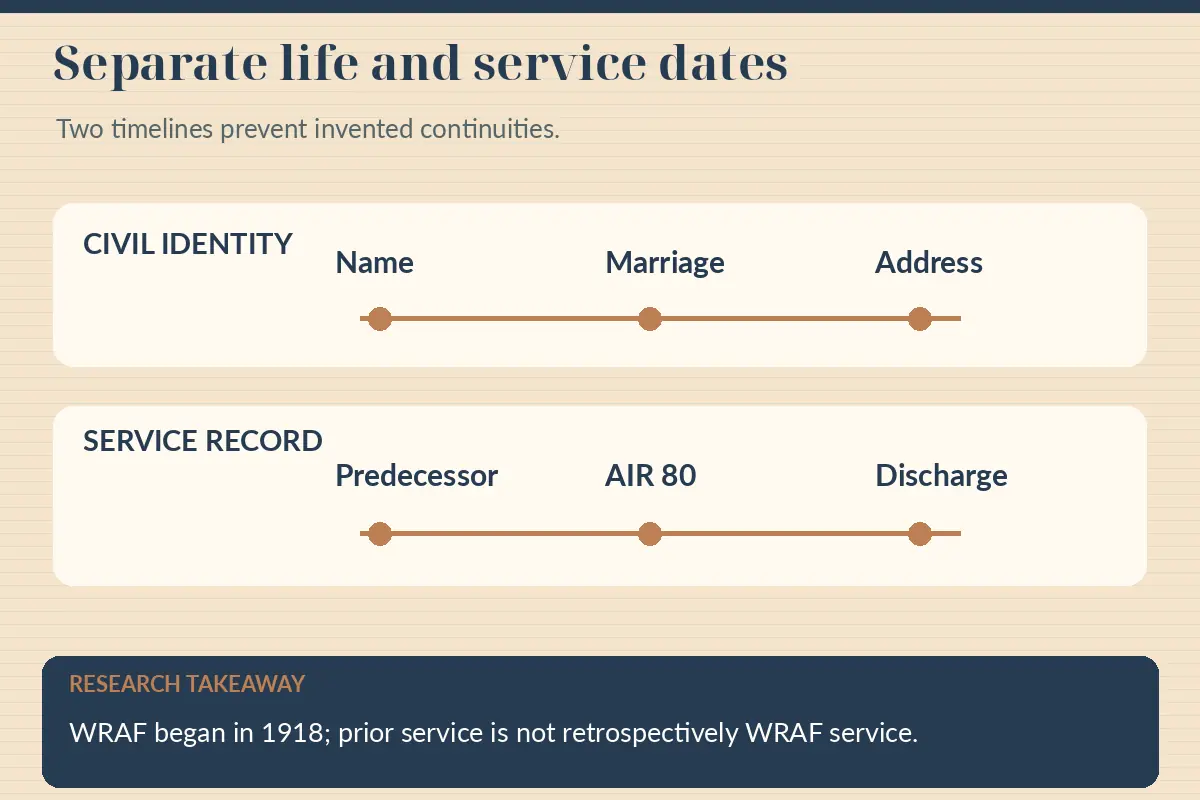
Set up two linked timelines for a candidate: one for identity (name changes, age, spouse, residence) and one for service (enrollment, predecessor organization, transfer, posting, discharge). These may overlap but should not be merged into a fictional continuous service story. A record noting a promotion dated June and a discharge dated November establishes two documented administrative points, not service on every day between them. If the file is missing, search independent civilian certificates, electoral rolls, family letters or regional press without claiming the substitute is equivalent to the original service file.
Imagine a fictional Eleanor Brown in a 1919 family portrait marked ‘WRAF.’ A catalogue hit under Eleanor Brown records a 1918 enrollment and a sister as next of kin, but the address lies hundreds of miles away from the family. Another hit under Eleanor Mason names the known home town. Before choosing, compare the original ages, addresses and any marriage date, and identify which name the family woman used in 1918. Record whether an earlier line refers to Women’s Legion driving and whether a later one documents WRAF transfer. Do not turn a plausible surname change into fact until a separate document supports it.
Worked Example: A Transfer in 1918
A reproducible citation identifies The National Archives, AIR 80 piece, named service file, specific form and page or image, and the date of consultation. Quote an occupational entry or relationship field with its date. Save a search ledger that records alternate surnames, failed queries, candidate matches and which AIR 80 piece was actually opened. If using a provider’s transcript, distinguish it from the archive’s underlying paperwork. Names appearing in an official record are not all equally authoritative: a clerk’s posting stamp, the recruit’s stated religion and a household relationship supplied at enrollment have different origins.
More Records and Archives Guides
How We Research Women’s RAF Service
We consult the WRAF service-record guide for the collection boundary, then classify a search as airwoman, officer, predecessor-body or later-period research before naming the correct custodian. We inspect enrollment, service and discharge forms as separate dated evidence, test any family connection using independently documented names and locations, and retain explicit uncertainty for missing officers’ files. Our central limit is simple: a WRAF file documents administration of one person’s service; it cannot alone prove every family relationship, daily assignment or recollection attached to a portrait.
The WRAF formed in 1918; AIR 80 may mention predecessor organizations and earlier background without making that earlier period WRAF service.
No. The National Archives says no First World War WRAF officers’ service records are known to survive.
It documents the stated contact or role; use independent records to verify the particular relationship.
AIR 79 concerns RAF airmen and is not a direct replacement for AIR 80 airwomen’s records.
Follow the later WAAF/WRAF personnel guidance and relevant access rules, rather than assuming AIR 80 coverage.