
Search a Royal Marine in ADM 159 by name and enlistment period, then compare the original service register with division, ships and a second independent record. The online date range is not a complete roll of everyone who served. Review the site’s affiliate disclosure before following any research-service links.
Why the ADM 159 Register Begins With an 1884 Test
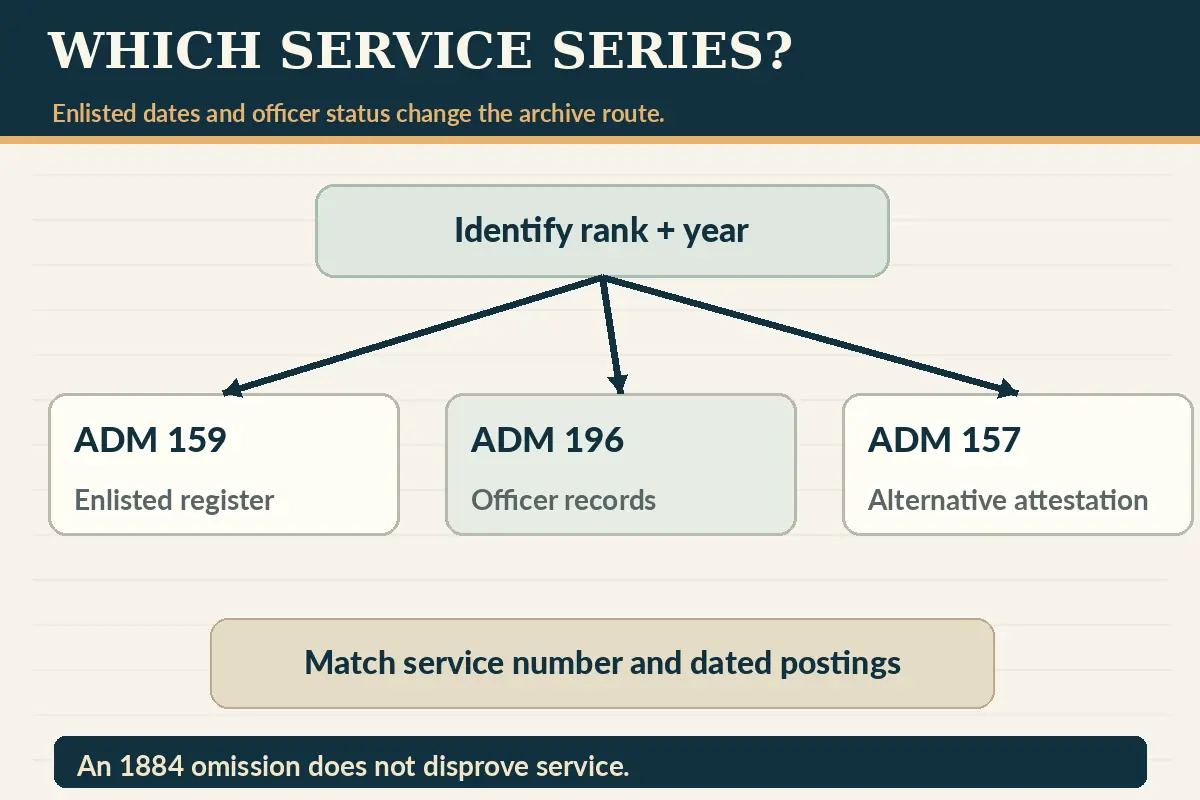
The National Archives describes ADM 159 as service registers for roughly 110,000 men who joined the Royal Marines between 1842 and 1925. These books were created in 1884, with retrospective entries for earlier joiners who remained in service. That administrative detail changes how you interpret a failed name search.
A Marine who enlisted in 1860 and departed in 1870 might never have received a retrospective ADM 159 entry, even though he served. Begin with the earliest documented enlistment or discharge date and whether the man was serving in 1884. The catalogue date range describes the surviving series, not a promise that all men who ever enlisted in the stated years are present.
Distinguish Other Ranks From Royal Marine Officers
Before searching, determine whether the person was a Royal Marine other rank or a commissioned officer. The official other-ranks guide identifies ADM 159 for enlisted marines and points to ADM 196 for officer service papers. A later family account may promote a private to an officer or use the generic phrase naval officer for anyone wearing uniform.
Do not let that inherited wording choose the record series without verification. Seek a dated rank in an official muster, a birth or marriage record that states occupation, or a contemporary newspaper reference. If the man changed status, investigate the relevant sets separately rather than forcing one register to represent his whole career.
Search Discovery With Names, Numbers and Date Variants
Use the ADM 159 series catalogue or its search form, starting with a full name and then relaxing the date filter if no result appears. Namesakes are common and a birthplace entry can be more useful than initials alone. Transcribe the precise register number, piece reference and identity data from the result.
An item description is only a finding aid; whenever access permits, inspect the image of the register for revisions, crossed-out entries and ship names not reproduced in an index. A search that yields nothing should be logged with exact name variants and filters, not described as proof that a person never joined the corps.
Read Service Register Fields in Their Original Order
The official record guide lists date and place of birth, civilian occupation, religion, enlistment, physical description, ship and shore-station postings, conduct, promotion and medal entitlement among the information that may appear. These fields do not have the same weight in every entry. A birthplace recorded at enlistment could be self-reported, while a ship posting written by a clerk is an administrative record of an assignment.
Copy both the wording and date of each statement. Distinguish an appointment date from an actual joining date, and avoid assigning a battle or overseas campaign solely from a unit association. Look for the next chronological line rather than assuming every blank means discharge.

Route Missing Men to ADM 157 and the Correct Division
If ADM 159 remains empty, try attestation and discharge papers in ADM 157. The other-ranks guidance notes that these forms cover earlier years and may be arranged by division, with ADM 313/1–26 supplying an index to attestation papers for 1914–1925. Chatham, Plymouth and Portsmouth are useful administrative clues, not automatic birthplaces.
Find a division from an attestation, a contemporary muster or a dated station reference. Also check whether a pre-1884 man left service too soon to be captured retrospectively. Use these alternative paths conditionally: an absent ADM 159 result should not send an officer to an enlisted-man form merely because the surname matches.
Reconcile Service Numbers and Ship Assignments
Treat a service number as a strong linking clue only after confirming that the number belongs to the same administrative system and person. A ship name can recur, or a marine can move between vessel and shore establishment. Create a chronological grid with recorded rank, division, joining date, leaving date, ship or station and archival reference.
If the same name appears in a Navy rating record, do not assume the occupations are identical: Royal Marines and naval ratings have different service registers. Medal rolls such as ADM 171 may support an award assertion but cannot substitute for the full career register. Compare at least two independent anchors before merging two similarly named records.

Test a Namesake and Preserve Conflicting Birth Details
Imagine two fictional recruits called Thomas Mercer, one associated with Plymouth and the other with Portsmouth. A family letter naming Plymouth makes the first plausible, but not proven. Compare dates of birth, the enlistment place, original occupations, height or distinctive features and subsequent ships, as far as the particular source actually records them.
If one entry gives an inconsistent birthplace, do not silently repair it from a family tree. Record the contradiction and seek a parish or civil certificate that directly concerns the target person. A later pension statement could be a third witness but should not be treated as independent if copied from the same initial attestation.
More Records and Archives Guides
How We Research ADM 159 Coverage and Identity
We begin with the official ADM 159 research guide, noting its 1884 creation mechanism before any name lookup. Next we test whether the subject was an enlisted marine, an officer, or a different naval worker. Every retained hit receives a register reference, literal birth and enlistment details, dated postings and an access note.
We use ADM 157 or ADM 196 only where the person’s rank and dates justify that route. A separate line logs gaps, rejected namesakes and contradictory facts. This process produces a reproducible service hypothesis; it does not confer medals, battles, kinship or continuous duty without supporting entries.
When reviewing original pages, scan both sides and adjacent register entries because clerical symbols may refer to a shared heading. Note if a document is a later copy, since an administrative reconstruction can repeat an earlier mistake. The Royal Marine Light Infantry and Royal Marine Artillery were separate arms before their 1923 amalgamation; that historical wording belongs in the search log. Ask which branch appears on the document rather than normalizing every label to a modern unit. Record which dates are derived from the original register and which are computed from a stated age. If a medal list and service paper differ, preserve both citations and test whether they describe separate administrative events. The cautious result may be a partly reconstructed career with an explicitly unknown final discharge.
No. Registers were created in 1884 and retrospectively include earlier entrants still serving then; men discharged before that may be absent.
The National Archives directs researchers to the commissioned-officer records in ADM 196, not simply to ADM 159.
Remove restrictive date filters, test spelling variants, then assess ADM 157 attestation papers and the relevant division.
Not by itself. Verify operational context, posting dates and ship movements in independent sources.
Record ADM 159 piece and item, register number, page or image, name, entry dates and the Discovery access point.