
Find a Scottish sheriff court case by identifying the historic court, approximate date and legal action before looking for a name. Most SC records are not uniformly indexed, and some categories have 100-year restrictions. Review the site’s affiliate disclosure before following any research-service links.
Start With the Court That Had Jurisdiction Then
The National Records of Scotland groups sheriff court records under reference SC, covering many local jurisdictions and a wide range of civil, criminal and administrative activities. A county address alone does not prove which court handled a dispute; court boundaries changed as jurisdictions merged and some closed. The NRS sheriff court guide specifically warns that historical overlap can occur, citing Argyll and Inverness-shire areas around Fort William.
Write down the place at the event date, the approximate year and the kind of legal proceeding. Only then identify the court and search its catalogue branches. Treat modern court districts as a clue, not as automatic historical custody.
Tell a Court Book From an Original Process Bundle
The official SC catalogue distinguishes court books and registers, which often summarize actions, from processes, the surviving papers used in a case. A register might name parties, a date and an order without preserving every statement made in proceedings. A bundle may contain petitions, pleadings, witness material and correspondence. Neither format automatically establishes that allegations were upheld.
Copy the label from the catalogue and verify whether an entry describes an application, an intermediate order or final determination. If only a register survives, note that the evidentiary basis of the decision may be unavailable. One court action can generate several documents filed under different subdivisions.

Recognize Testament and Deed Registers as Separate Routes
Sheriff court records include commissary testaments, registered deeds, small-debt matters, sequestration and other administrative material. Testament registers are relatively searchable: NRS says some digital images are available through ScotlandsPeople up to 1925. That does not make the entire SC body a digitized name database.
If a user needs an executor or inventory, the NRS wills guide is more efficient than a broad civil-actions browse. A recorded deed preserves an instrument for particular legal purposes; it need not prove continuous residence or the whole history of a property. Route each question to the correct series and do not mix its catalogue limitations with another series.
Use Dates and Action Type Where Names Are Unindexed
For many historical cases there is no individual name index. NRS notes that civil actions from after 1860 are being progressively listed, while many other records remain arranged chiefly by court, date or case type. A failed general catalogue query may therefore mean only that names were never indexed. Use an approximate event date and the most likely court, then inspect the available register descriptions, volume spans and on-site access notes.
Preserve unsuccessful search parameters in a log. If a case is known from a newspaper, distinguish the report’s publication date from the actual hearing or judgment and extend the search window on both sides. If a surname is common, locate both parties rather than searching one in isolation.

Respect the One-Hundred-Year Access Restrictions
The current NRS guide explains 100-year closures for adoption records, family consistorial actions and material about criminal trials. Some other papers may be restricted under personal-information rules. A catalogued reference is not an automatic right to inspect its contents. Check access details before scheduling a visit or writing an article about a named person.
Do not use third-party extracts to circumvent a closure or publish details concerning living individuals. When documents are closed, say they are restricted instead of calling them lost. A legitimate historical family question may be approached through older open records, but such alternatives must be evaluated on their own rather than treated as a substitute for undisclosed testimony.
Compare Two People in Different Sheriffdoms
Imagine a fictional creditor named Margaret Fraser who appears in an Edinburgh register and a person of the same name mentioned in a Stirling newspaper notice. Date, debtor, residence, occupation, family context and action type must all be compared. There may have been a transfer, two separate actions or two different women. A legal order can name an agent acting for a party; that agent is not necessarily related to the party.
Preserve exact names and roles as written. If a second court’s papers overlap in time, examine both jurisdictions separately before merging identities. A simple same-name connection is too weak to bridge the legal and genealogical records.
Cite a Court, Subseries, Book and Page
A proper citation starts with National Records of Scotland, SC reference, court name, case or register title, exact volume and page, event date and the access method. Record whether the original bundle, indexed testament image, register or catalogue description was seen. When a document lacks a final outcome, say precisely which stage is documented.
Also keep a record of gaps in surviving books, since an apparent missing year is not evidence that a particular person avoided court. Where an index points to more than one volume, open the correct item and compare the headings rather than copying an index reference without verification.
More Records and Archives Guides
How We Research Sheriff Court Claims
We use the NRS series description to classify the record as a register, a process, an instrument or a testament. We then route it by historical court and date, recording all search filters and any announced closures. Before drawing family conclusions, we compare the court statement against a second dated record that actually concerns identity or kinship.
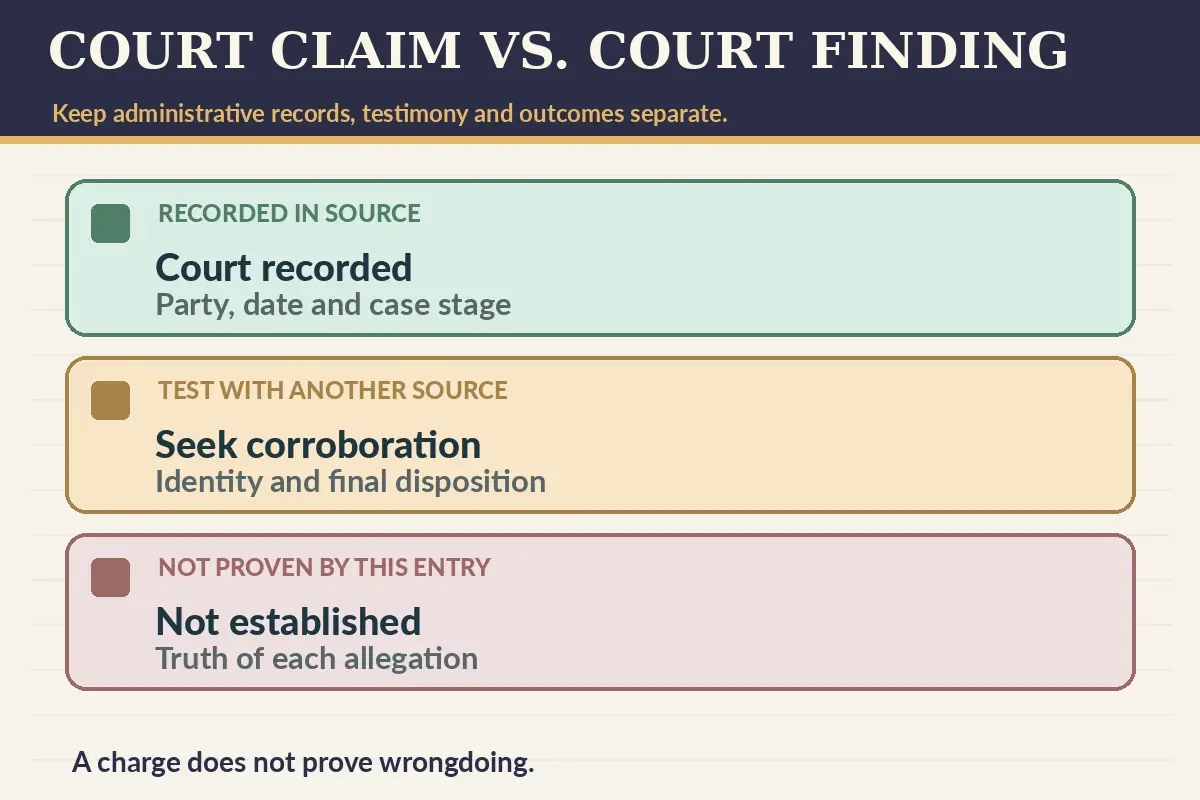
We label a claim made by a litigant as testimony and a signed judgment as a court decision; neither becomes evidence of a family relationship solely because names recur. The result is a court-specific citation and a list of unresolved identity questions, rather than an invented story about the supposed cause or outcome of a dispute.
A good research request to NRS names the former sheriff court, known locality, case category, approximate hearing date and the exact reference found in the catalogue. A request reading only ‘all information on John Smith’ is unlikely to be productive where books lack name indexes. When a newspaper says a sheriff ‘decided’ a matter, compare its wording with the official minute: journalistic language can collapse interim rulings and final decrees. For land-related cases, consult a cadastral map or deeds independently and avoid equating a litigated tenancy with legal ownership. For family actions, account for changes in historical law and for modern access restrictions. The research conclusion may be limited to ‘a person of this name was recorded as a party,’ which is still a useful sourced discovery.
No. Many SC books are organized by historical court and date; some civil-action listings are still being expanded.
A register summarizes proceedings or decisions; a process contains original case papers when they survive.
Many adoption, family consistorial and criminal records are restricted for 100 years; check the NRS conditions.
Yes, some commissary testament records are within SC; consult the specialized NRS wills and testaments guide.
No. Preserve the distinction between a claim, testimony, interim order and final recorded finding.