
Use ADM 194 year-and-division registers and ADM 156 court-martial case papers to identify a Royal Navy or Royal Marine proceeding and distinguish allegations, decisions, and later service. The key is to read the specific original, not assume that an index result is the same thing. Start with The National Archives’ official guidance and see the site’s affiliate disclosure before following further research links.
Use a Court-Martial Record to Research a Proceeding
A Royal Navy or Royal Marine court-martial record concerns a disciplinary legal process. Its presence does not prove that the accused committed the offence alleged. The National Archives describes case files in ADM 156 and registers in ADM 194, with different search routes. Begin with the person, ship or marine division, a dated reference to a proceeding and any stated rank. A family story about punishment is a lead that must be tested against the final disposition, not treated as a verdict.
Historical jurisdiction matters. The guide lists case files from 1890–1965 in ADM 156 and court-martial registers covering 1812–1978 in ADM 194. Those spans are not a promise that an individually named file survives for every allegation. Earlier indexed registers in ADM 13/103–104 cover 1803–1856 and involve yet another research path. Choose by actual date and record type, and distinguish service in the Royal Marines from being a naval rating or officer.
Search ADM 194 by Year and Division
The archive advises searching the ADM 194 court-martial registers by year and division. Where the person’s name is common, time and division can narrow the right register without guessing at an offence. Record every relevant entry’s heading and page, including the case date, ship or division, rank and any explicit outcome text. A chronological register may summarize or point toward further proceedings rather than reproducing every witness statement.
Before linking a register entry to an ancestor, compare service postings against a separate personnel record. A sailor could move between ships; a ship named in a file may not have been the person’s lifelong posting. If the entry includes an abbreviation you cannot read, retain the original text and mark the interpretation uncertain. Avoid substituting modern legal language for period terminology unless you explain that it is a paraphrase.

Find an ADM 156 Case File by Ship or Marine
The National Archives specifically describes searching ADM 156 case files using a marine’s name or a Royal Navy ship. A file may preserve procedural documents that a register does not, but every dossier’s content depends on what survives. Record the piece reference and inspect the first and last portions of the file before summarizing its apparent outcome. Do not assume a charge sheet is identical to a conviction, or that witness statements were necessarily accepted as accurate.
If an ADM 194 register refers to a case but no matching ADM 156 piece is found, investigate date scope, ship names and catalogue coverage. Note what was searched and how. A missing file leaves the evidence incomplete: do not fill the gap using newspaper speculation or a similarly named sailor. Where a newspaper reported the case, compare its publication date and claimed result with the archival proceeding, since early reports may predate a final decision.
Separate Charges, Findings and Punishment
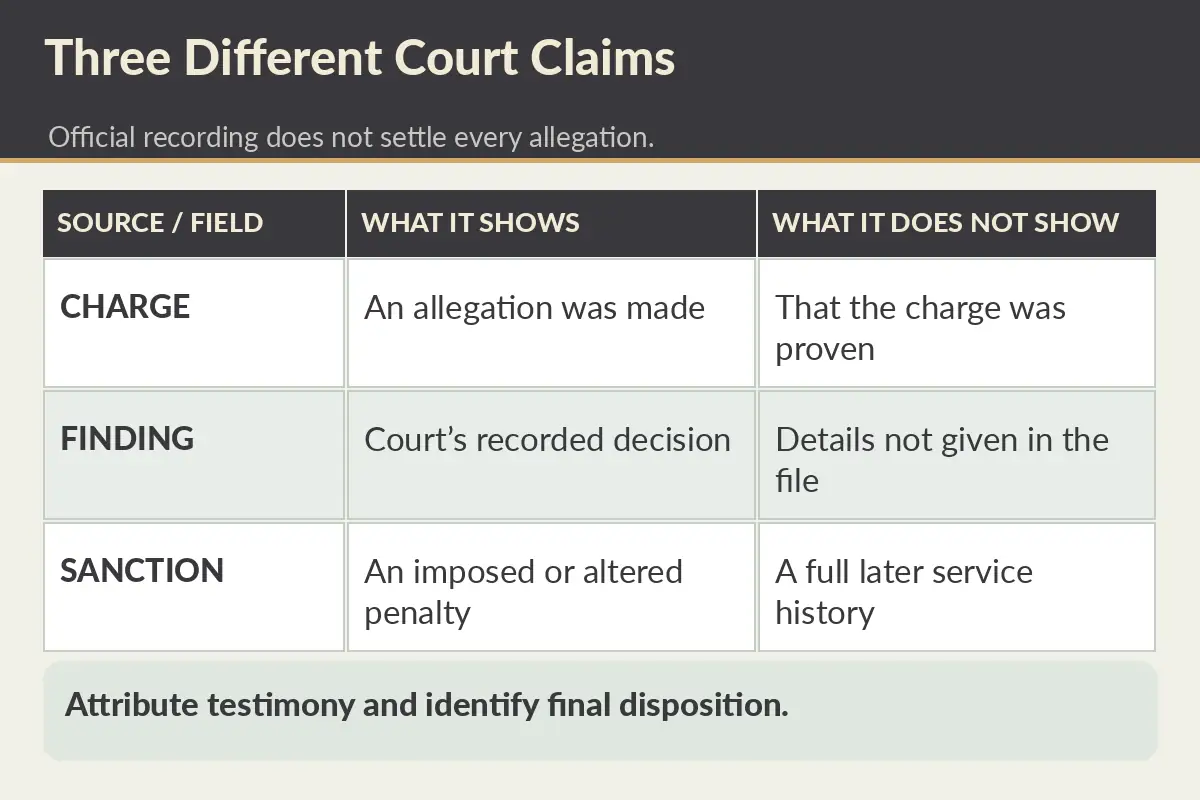
Three distinct assertions often appear in court records: a charge was made, a decision was reached and a penalty may have been imposed or modified. Read the verbs and dates carefully. An allegation or testimony may be recorded in a contemporary official file without being proven. Any later appeal, alteration or remission is a further event. Create a legal-event worksheet that preserves what the document explicitly states and does not silently collapse all stages into “he was guilty.”
For sensitive cases, quote minimally, attribute statements to the correct witness or authority, and do not infer family misconduct, hereditary traits or unrecorded victims. These are important archival responsibilities even when the proceeding is old. A register may identify legal administration; it is not a reliable source for every private detail mentioned in an accusation. Include record context in any public account to avoid portraying disputed or rejected assertions as established fact.
Use Service Records for Identity and the Aftermath
Compare the naval or marine’s service number, rank, division, ship and date with an appropriate service register. A case record can document a disciplinary event but not an entire career. A separate discharge or pension document may show that service continued after the event, ended for another reason or belonged to a different person. If service records disagree with a case index, leave the identity unresolved while checking original names and dates.
Keep individual witnesses distinct from the defendant and from the person reporting a judgment. A witness might have served on the same ship without being a relative. Similarly, a court location can be a procedural location rather than the subject’s residence. Map geographic facts by their recorded role. The value of ADM 156 and ADM 194 lies in a traceable procedural sequence, not a character judgment about an ancestor.
Cite a Proceeding Without Repeating an Unproven Story
A usable citation identifies ADM 194 register year, division and page, or ADM 156 file and catalogue piece, plus the date and name exactly as written. In the narrative distinguish the source’s statements from later interpretation: “the register records a court-martial involving X” is different from “X was convicted of Y.” State a verdict or sanction only where a reliable final record explicitly confirms it. Avoid exposing unrelated private people named in a case unnecessarily.
Finally list what would change the conclusion: the full case file, a subsequent order, a service record proving identity, or a separate official disposition. An archival index alone may support the location of a file but not any substantive conclusion about guilt or punishment. A methodical search can explain a family mystery while also protecting individuals from unsupported accusations and identifying where the surviving record remains silent.
How We Research Adm 156 Adm 194 Courts Martial
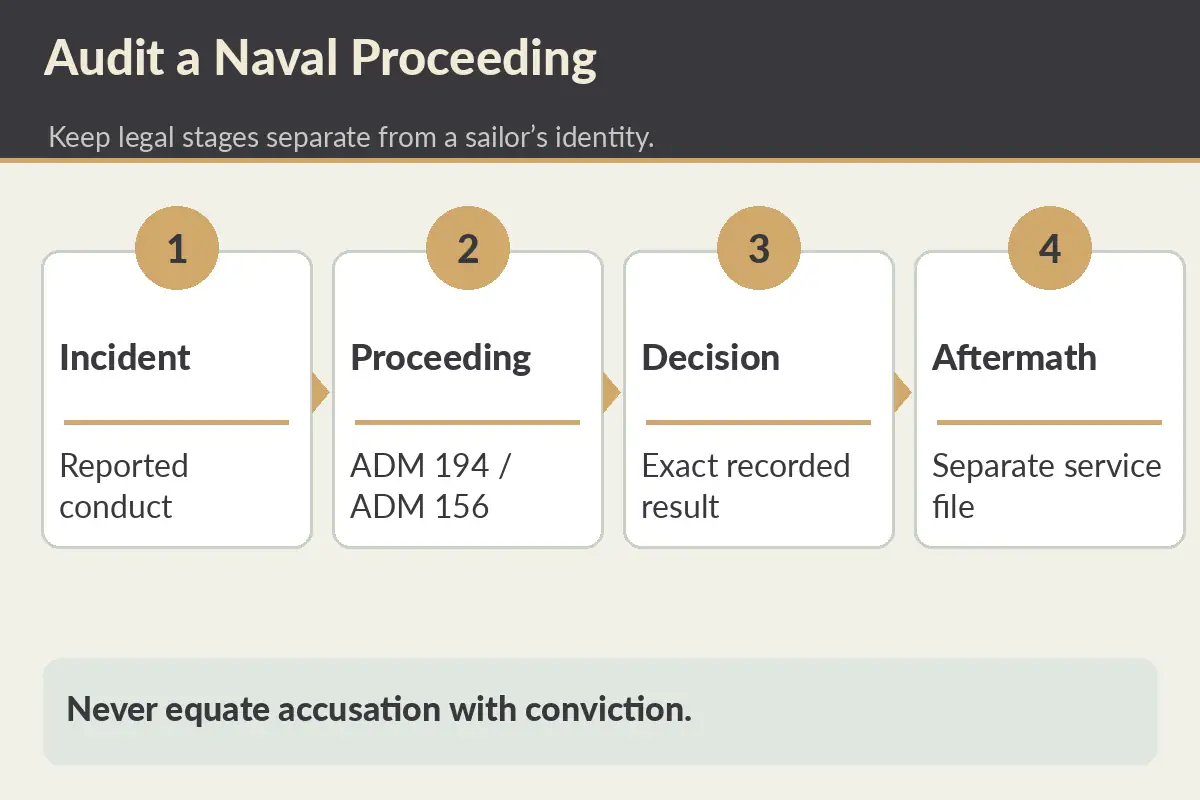
We start with ADM 194 year-and-division register references or an ADM 156 ship/marine name search, document the original piece, and compare procedural stages with independent service identity. We do not elevate the existence of an allegation to a conviction.
More Records and Archives Guides
Primary Archive Guidance and Reference Limits
These two official descriptions identify the appropriate documents, series and key survival caveats. The National Archives source 1 describes describes ADM 156 court-martial case files 1890–1965, ADM 194 registers by year/division and older ADM 13 indexed registers. The National Archives source 2 describes separately confirms the courts-martial record route for marines and the different archive series.
No. An entry can record a proceeding or allegation; check the recorded final decision.
The National Archives identifies ADM 156 for these court-martial case papers.
The archive recommends year and marine division, following the relevant original register.
No. Confirm a name with service number, rank, date and independent service records.
Preserve the register citation and log the gap; do not invent a verdict or use an unrelated namesake file.