
Trace a woman serving in the WAAC or QMAAC through surviving WO 398 forms. Learn what a personnel file really records and why missing files do not disprove wartime service. The key is to read the specific original, not assume that an index result is the same thing. Start with The National Archives’ official guidance and see the site’s affiliate disclosure before following further research links.
Locate the Correct Wartime Women’s Corps
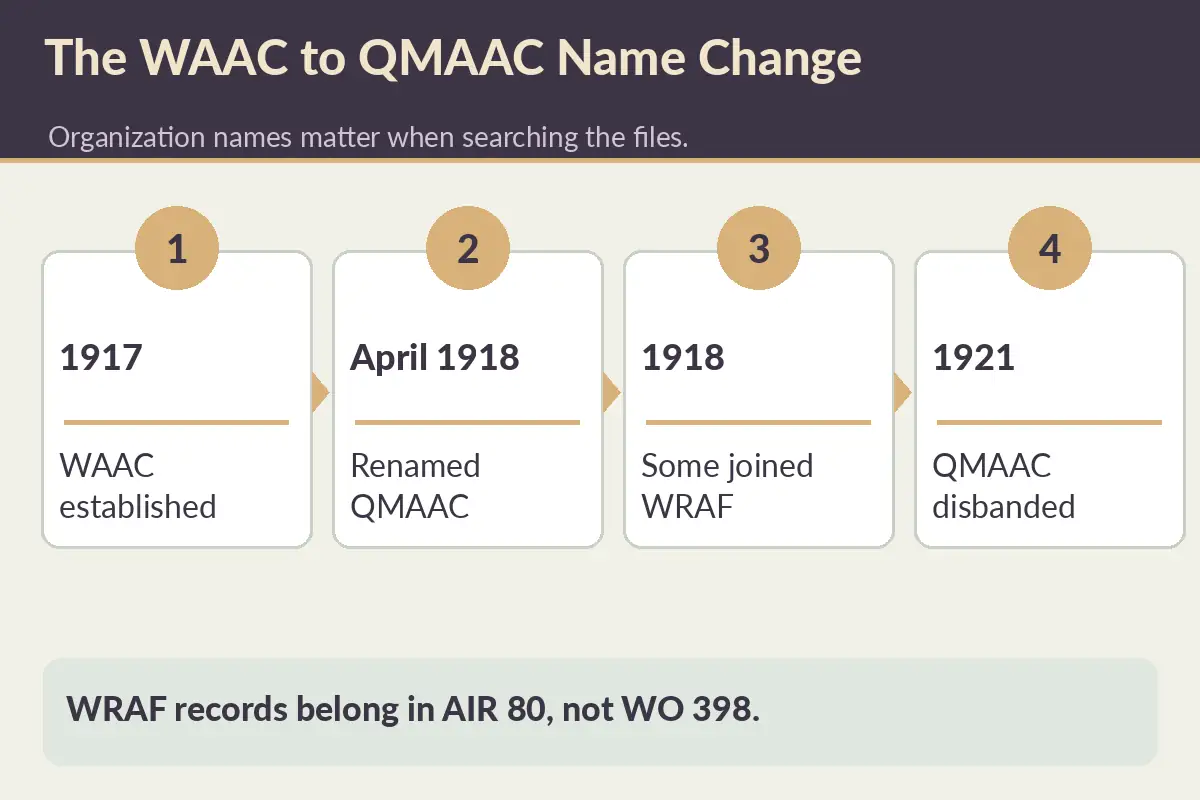
The Women’s Army Auxiliary Corps was formed in 1917 for non-combatant work and became the Queen Mary’s Army Auxiliary Corps in April 1918. WO 398 holds surviving service records associated with these organizations. It is not an umbrella collection for all women who worked in wartime hospitals, the RAF or civilian factories. Start with the employer, service period and any word written on a surviving photograph or letter: WAAC, QMAAC, unit location and service grade can each guide the search.
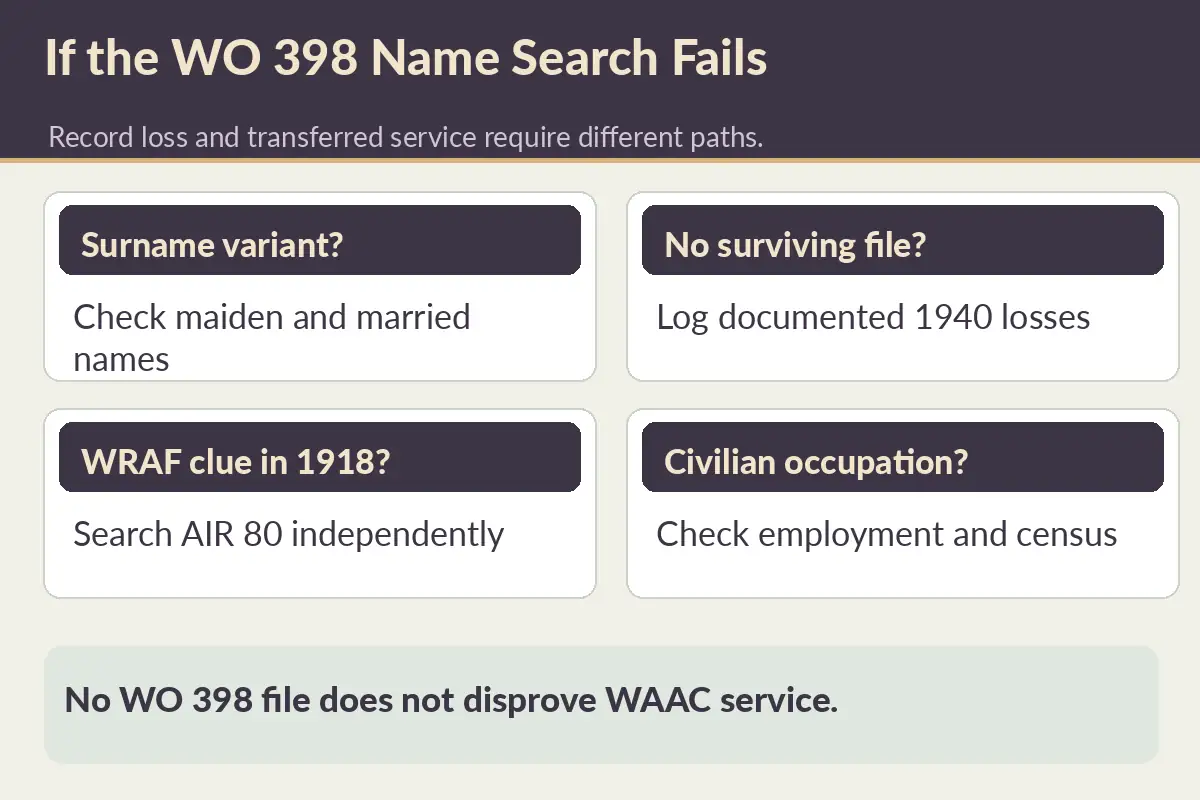
The National Archives reports that roughly 57,000 women joined, while only about 7,000 service records survive, partly because of wartime damage to archives in 1940. That disparity is central to interpreting a negative result. A missing WO 398 file cannot prove that an ancestor never joined. Keep the original family claim as a hypothesis until an enrolment form, statement of service or independent contemporary record ties the name to the organization.
Search WO 398 Before Assuming a Full Service File
Search the National Archives Discovery service-record collection using exact name and then variant surname forms. Consider a birth or married name where supported by known documents. Search results can be purchased or downloaded under the website’s current terms, but record access is not the same as survival completeness. Compare the identity in the result with age, address, recorded family contact or occupational history before assigning the document to an ancestor.
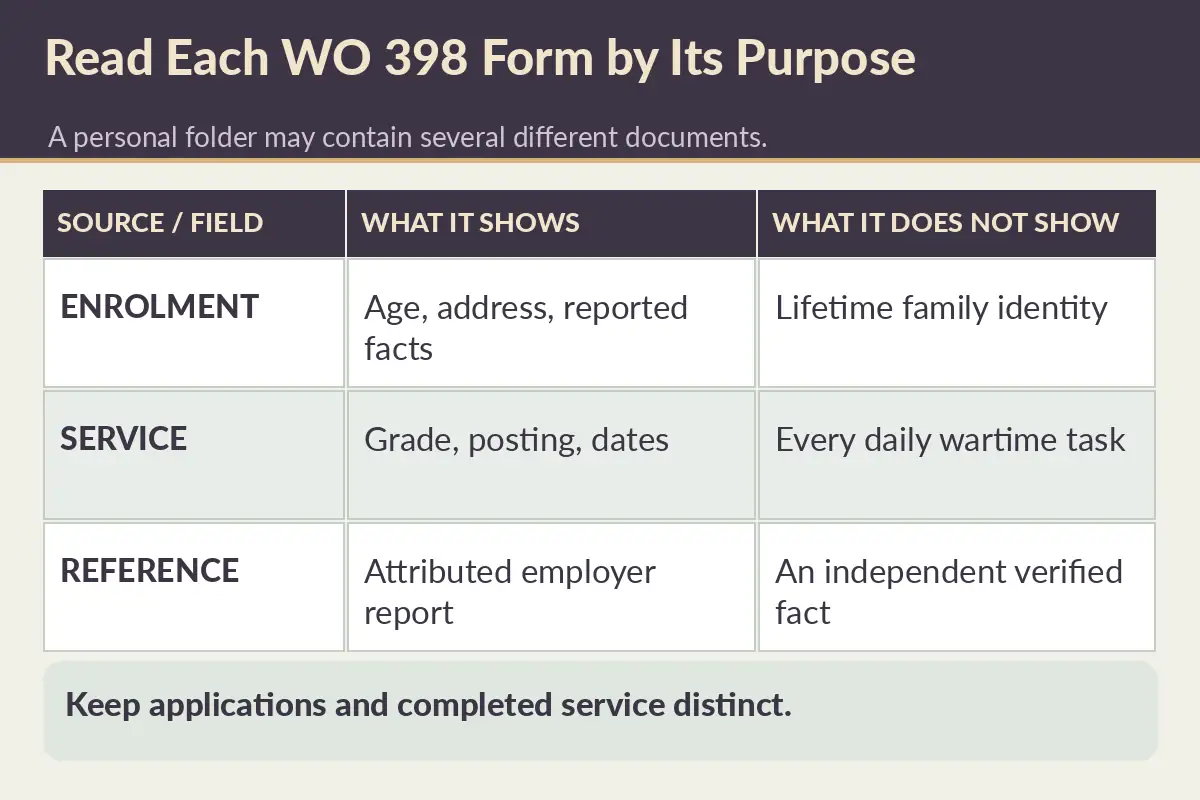
A WO 398 folder can contain quite different forms from another person’s file. Enrolment details may include age, address, parents’ nationality and marital status; a statement of service may record grade, location, promotions and next-of-kin details. Other pages can include employer references, application material, identification papers, casualty forms or clothing records. Never write that a particular field must exist until you inspect the actual pages.
Understand Grade, Posting and Work Without Inventing a Role
The archives guide calls the rank recorded in this corps a “grade.” Copy the grade exactly, along with the section of the form, dates, and any place or employing department. A clerk’s job title may describe work done on one occasion, whereas a promotion or posting entry may describe a later appointment. Distinguish a request to be transferred from evidence that the transfer took effect. The administrative trail is not necessarily a day-by-day diary.
If a file includes clothing issue sheets, compare issue dates to the recorded place and occupation but do not treat an item of uniform as proof of specific operational activity. Likewise, an employer reference may report suitability, previous employment or character; its evidence is supplied by the referee, not directly certified by the corps. Preserve exact wording about health or discipline without dramatizing it. When information is delicate, decide whether a public family narrative needs to reproduce the full detail.
Keep WRAF and Other Women’s Services Separate
After the Royal Air Force was formed in 1918, some WAAC women transferred into the Women’s Royal Air Force. The National Archives holds WRAF airwomen’s records in AIR 80, not WO 398. A name in both series may document a genuine transfer, but similarity of name alone is not enough. Compare dates, addresses, service numbers when present, next-of-kin and service notations. Avoid retroactively assigning an RAF posting to an earlier WAAC employment period.
Another possible confusion is between WAAC and later British women’s army organizations: the Auxiliary Territorial Service began in 1938. WO 398 is not its personnel series. Make a service chronology with period, organization, evidence type and reference. If you encounter a medal card in WO 372, remember that an entitlement index is an entirely different administrative artifact from the personal forms in WO 398. Each source has a different proof limit.
Check Kin and Civilian Identity Carefully
The next-of-kin name and address in a service record can be valuable, yet it identifies the stated contact at that time, not necessarily a spouse or parent. Transcribe the label next to the person and compare it with an independent marriage, birth or census document. An address can indicate a contact location without proving home ownership or even that the woman herself lived there at every period. Employer references may suggest earlier occupations, but should be cross-checked against directories and civil records.
For common surnames, build an identity matrix including name variants, age bracket, place, occupational clue and document date. Weigh internal consistency across all pages, not just an index hit. If a name changed on marriage or appears in a later professional record, document the connection rather than silently merging two entries. Preserve alternative candidates when the evidence points to more than one possible woman.
Cite Surviving Paperwork and Record the Gaps
Use the original archival reference, page order, exact form type and date when describing WO 398. A service statement can prove a recorded appointment or grade; an application records a request; a signed reference records an attributed assessment. Those statements should not be compressed into one unsourced biography. The archive guide’s estimate of survival explains why no-result searches are relatively common and why another organization’s holdings may be required.
Finish by listing proven events in chronological order and marking inferred transfers, inferred relationships and unknown intervals as such. Follow up through the woman’s own correspondence, civilian employment, contemporaneous newspapers, marriage documents or a separate military archive if the clues justify it. The research goal is a traceable account of documented service, not a complete reconstruction manufactured to fill the gaps left by destroyed files.
How We Research Wo 398 Waac Service Records
We begin with the 1917–1918 organizational boundary, search WO 398 in Discovery and inventory each surviving form. We score identity by independent age, address and kin details, then separate applications, grades and completed postings; possible WRAF transfers go to AIR 80 for independent comparison.
More Records and Archives Guides
Primary Archive Guidance and Reference Limits
These two official descriptions identify the appropriate documents, series and key survival caveats. The National Archives source 1 describes explains WO 398 collection and surviving numbers, 1918 renaming, and the varied types of service forms. The National Archives source 2 describes provides the wider women’s army chronology and distinguishes WAAC from later organizations and medal sources.
They are consecutive names of the organization; the WAAC became QMAAC in April 1918.
Only about 7,000 files survive from roughly 57,000 women who served; many files were damaged or lost.
Some forms list grade or posting, but a complete day-by-day work record is not guaranteed.
No. It records a stated contact; confirm the relationship and residence independently.
Search AIR 80 separately and require matching identity details before linking the records.