
MH 106 preserves selected First World War military medical registers and case papers. Choose the right access route and distinguish hospital entries from complete treatment histories. The key is to read the specific original, not assume that an index result is the same thing. Start with The National Archives’ official guidance and see the site’s affiliate disclosure before following further research links.
A Hospital Admission Is One Dated Event, Not a Service Biography
MH 106 is a representative selection of First World War military medical material assembled for research rather than a complete medical file for every serviceperson. The National Archives describes material from military hospitals, casualty clearing stations, field ambulances, an ambulance train and a hospital ship. A person mentioned in one of these records was recorded in a particular medical setting; the record does not by itself establish every injury sustained or every unit served. Begin with a narrow question, such as where an identified soldier was treated on a specified date.
Write down name variants, service or regimental number, rank and known unit as recorded in independent documents. Note the difference between the war years and the broader 1912–1921 coverage indicated in the archive guide. Capture an approximate treatment date, if you have one, but do not use a family story to replace a missing admission date. The purpose of the first search is a document-level match, not an explanation of what happened throughout the war.
Choose a Register Search or an Original Case Sheet
The archive describes 2,078 boxes of admission and discharge registers and another 306 boxes of selected case sheets and cards. The first group can be searched by name or regimental number through a named commercial collection at Findmypast; access terms may involve charges. The second group is searched through the MH 106 catalogue using name, number, unit or medical condition. Those original sheets and cards are held at Kew and are not downloadable from the archive catalogue.
Do not assume the two interfaces cover the same people or fields. Register entries may offer admission and discharge events, service number, rank and sometimes an estimated birth year. A case sheet may contain much more about a specific treatment, while a card may be shorter and administrative. Check what kind of item is actually catalogued before treating a database hit as a complete clinical history. Note an image reference or original piece reference rather than only a search-result URL.

Read Dates, Transfers and Medical Terms Separately
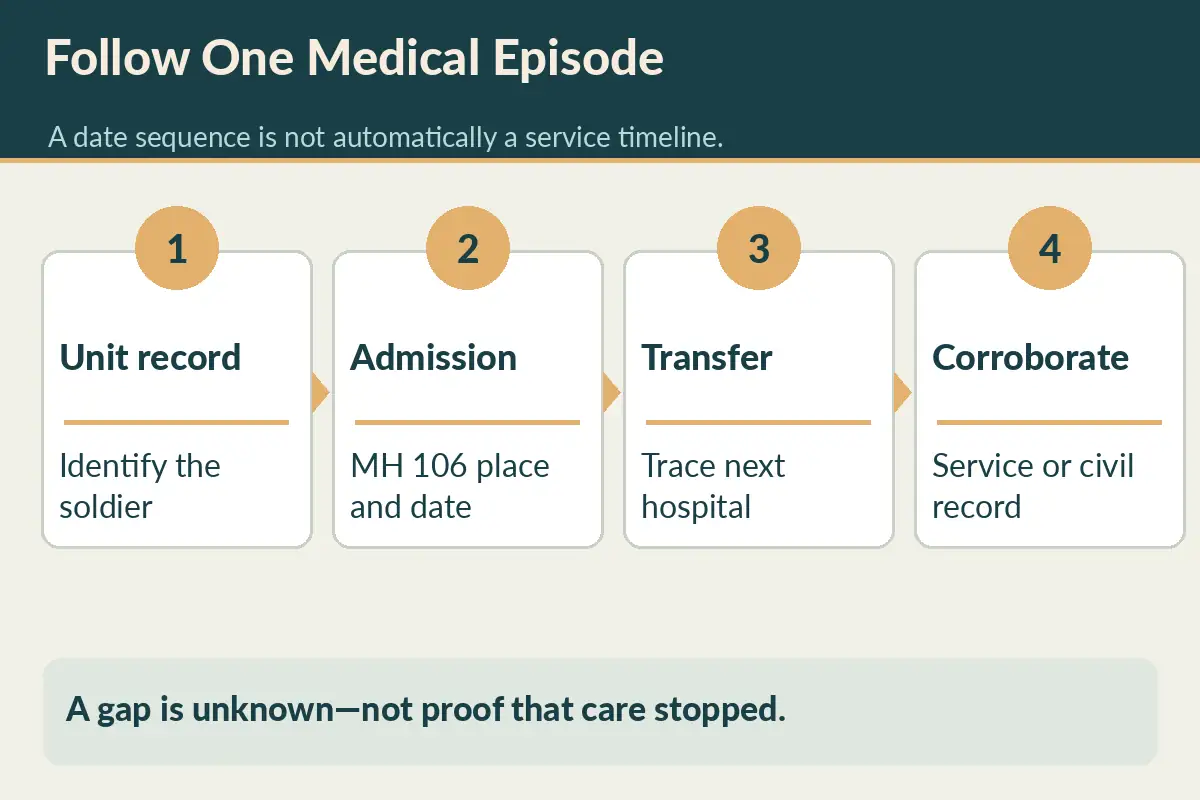
Transcribe the hospital name, admission date, transfer or discharge date, service number and any stated diagnosis exactly as written. Historical abbreviations and shorthand may vary by medical establishment. A hospital transfer is not the same administrative event as the end of military service. An admission can follow an earlier treatment elsewhere, and a discharge may mean transfer to another facility rather than return to active duty. Keep explicit wording separate from inference in the research log.
Use a table with columns for date of event, place or establishment, source reference, recorded condition, quoted action and remaining uncertainty. If a later record gives a different spelling of a diagnosis, preserve both statements without turning either into a modern medical opinion. The medical information pertains to an identifiable historical record and should be handled respectfully, especially where it might affect a living family member. A historic treatment record cannot answer every modern medical question.
Correlate an MH 106 Entry With the Soldier’s Unit
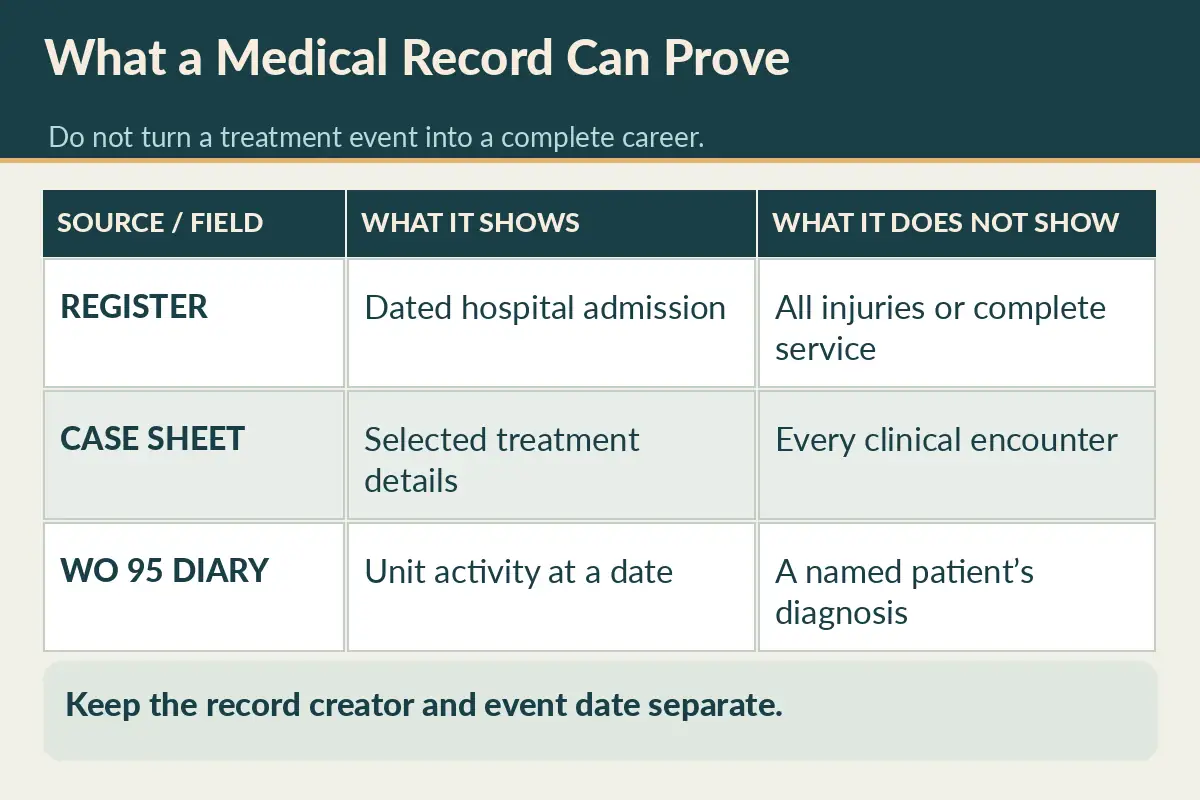
A service number can be a stronger identifier than a common name, but numbers may change after transfers. Compare rank, unit, dates and age estimate against a surviving service record, medal card or the unit war diary in WO 95 where appropriate. A unit diary records the activities of a formation and is not a personal clinical chart. The correct question is whether these sources refer to the same serviceperson and are chronologically compatible, not whether two collections contain matching words.
If the hospital register and an independent unit record conflict, investigate whether a transfer, number reuse or different man explains the discrepancy. Search the original image for an adjacent heading that an index may omit. Record negative searches together with specific date ranges and search fields so another researcher can repeat them. Absence from a sampled medical collection is not evidence that the soldier was never wounded, hospitalized or ill.
Decide When a Kew Visit Is Needed
For case sheets and medical cards, search the catalogue within MH 106 using alternative name spellings and numbers, then preserve the exact piece identifier. The Archives guide says these originals cannot be downloaded. Plan consultation or a copy enquiry according to the current archive instructions rather than assuming a commercial transcript provides every page. For registers, verify the page behind a search hit and record the institution shown in the original heading.
Before spending money or time, decide what question a missing item could answer. A case sheet may elaborate on treatment; a register may fix an admission date; neither guarantees a fully connected family history. If only an index entry is available, label your claim as index-derived and postpone stronger conclusions. The most useful result can be a clearly documented failed search that tells you which record class or establishment to try next.
Build a Claim That Can Be Rechecked
Your final note should state only the specific serviceperson, hospital, dated event and medical term that the original or accurately identified register actually records. Cite MH 106 with the catalogue piece and, when available, page or image reference. Keep the source of a later transcription separate from the wartime creation of the document. The medical report may contain observations from different dates or people, so do not treat all words as an eyewitness statement from the patient.
The evidence ceiling matters: MH 106 can document a treatment or evacuation episode without demonstrating the cause of a condition, the complete sequence of postings or the family’s broader wartime narrative. Compare the episode with independent military and civil records, explicitly state what remains unproved, and stop short of projecting a modern clinical diagnosis onto a brief historical description. The research remains useful even when the sample contains no matching entry.
How We Research Wwi Medical Records Mh 106
We verify the record class against The National Archives guide, decide between selected online admission/discharge books and original-only case sheets, and capture the precise MH 106 item. We then align date, number and unit with a separate source while retaining the incompleteness of the sample.
More Records and Archives Guides
Primary Archive Guidance and Reference Limits
These two official descriptions identify the appropriate documents, series and key survival caveats. The National Archives source 1 describes explains the representative MH 106 selection, 2,078 register boxes, 306 case-sheet and card boxes, and distinct search/access routes. The National Archives source 2 describes describes the origin and varied medical records in MH 106 and illustrates a wartime register.
No. It is a representative selection, not a complete record of all wartime treatment.
The National Archives identifies the original case sheets and cards as available to consult at Kew, not as downloads.
The described Findmypast collection allows searches by name or regimental number; verify any hit on the register.
Not necessarily. A hospital discharge can precede transfer or further service.
Record the exact search and use other service and unit records; missing sampled coverage is not negative proof.