
Royal Navy Medical Officers ADM 104 can answer a precise archival question, but it must be read for the purpose for which the office created the record. The practical answer is to identify the relevant series and custodian, select the original item and its dates, then separate the explicit entry from every unverified biographical inference. This guide gives a source-specific search route and the evidence limits that prevent false family-history conclusions.
Begin With the Medical Officer, Not the Sick Sailor
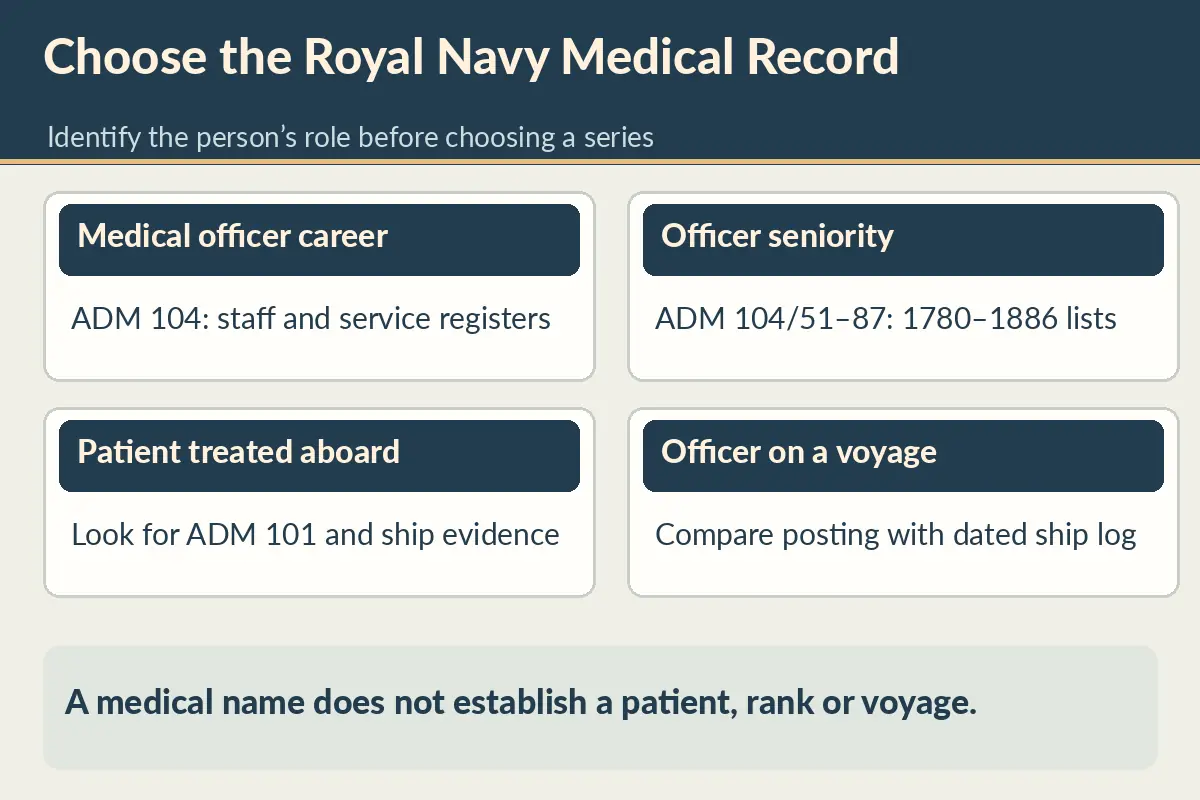
If the ancestor was a surgeon or assistant surgeon serving the Royal Navy, ADM 104 is a promising set of administrative records. If the ancestor was an ordinary sailor treated by a surgeon, begin with the ship, service and relevant patients’ medical documentation instead. The archive series describes records of a medical establishment; its existence does not mean every person who received treatment has a separate service entry. Define the role before searching the name.
Write down the person’s name variants, any stated medical rank, approximate working dates, known ships and naval hospitals. Identify the evidence for each clue. A directory entry might supply a rank and date, while a family letter might supply a ship. Neither alone proves that an ADM 104 reference is the same individual. This separation helps avoid attaching a striking medical anecdote to the wrong namesake.
Choose the ADM 104 Subseries That Fits the Question
The National Archives describes ADM 104 as including surgeons’ and assistant surgeons’ service records, medical department registers, establishment books, pay-related lists, reports of deaths and killed or wounded personnel, and certain hospital records. It is a mixed administrative collection rather than one alphabetically organized biography index. A year range associated with a subseries is not a guarantee that an individual appears in every book.
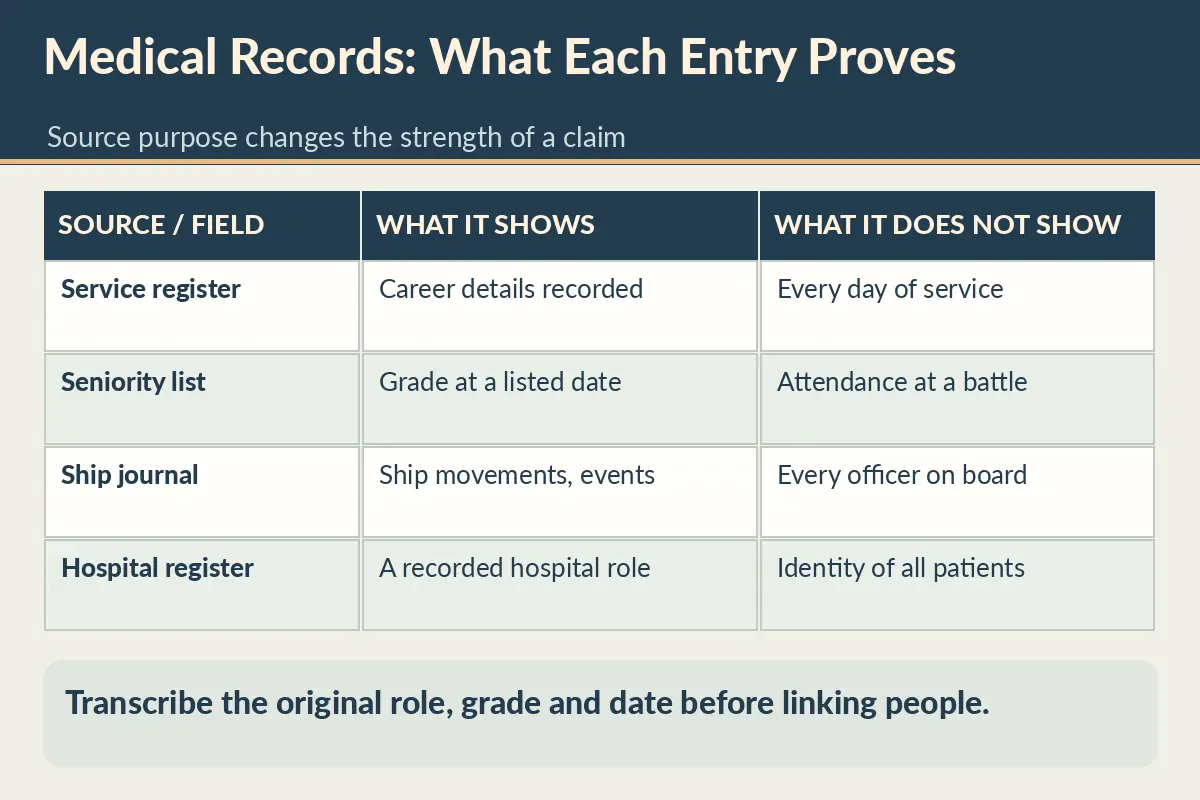
For officer seniority, the Archives specifically points to ADM 104/51–87, covering surgeons and other medical officers from 1780 to 1886. Use these lists to test relative standing and rank as of the list date. For a sequence of appointments or a medical career, look at the appropriate service-register descriptions instead. A seniority list alone does not prove attendance at a particular battle or illness.
Treat the Catalogue Reference as a Locator
Search Discovery first with the person’s full name and variants, then browse ADM 104 by relevant period and record type. Inspect whether the result is an individual entry, a volume title or a name in an archival description. Some medical departmental volumes are presented as digital microfilm; this may require page-by-page browsing and may not support reliable full-text name searches. Check access for the selected item, not for the series in general.
Record the series, piece number, page, image position, entry heading and date. When viewing a scanned bound book, capture both the entry and the column headers; otherwise a number may be mistaken for an age when it represents service time or precedence. A catalogue search returning nothing is a failed lookup under tested criteria, not proof that the man never practiced naval medicine.
Compare Appointment, Seniority, and Ship Evidence
Create separate rows for professional status, initial appointment, later promotion, a ship or hospital posting, and reported departure from the service. Only fill a cell with a record that actually states that event. An entry in a seniority list can support standing at its publication date; it does not automatically provide a continuous day-by-day itinerary. Rank changes and ships’ names should be transcribed as found.
If a surgeon appears on one vessel in a dated list and on another in a later document, the intervening period remains unknown unless another posting record fills it. Compare the naval officer guides, Navy Lists where relevant, and contemporary ship logs with the service-register evidence. Distinguish a ship’s documented voyage from the officer’s independently established presence on board.
Do Not Reclassify Hospital Patients as Medical Staff
Royal Navy surgical evidence has several creators and purposes. Hospital staff pay, establishment and service lists may be in ADM 104. Surgeons’ medical journals concerning sick and wounded sailors belong to a different documentary task, notably ADM 101. One account is about the careers of medical workers; the other may describe treatments received by named patients. Mixing the two can yield confident but false family statements.
Similarly, a report that someone was wounded on board is not automatically a surgeon’s personal injury. Identify the original headings, person’s role and ship or institution before deciding who was patient, attendant or administrative reporter. Where the record is a later compilation, note its distance from the event and seek contemporary confirmation for precise circumstances.
Read Medical Ranks in Their Historical Context
Surgeon, assistant surgeon, staff surgeon and other medical designations changed over time. A later family biography might collapse these into the modern term “doctor,” but the contemporary grade matters when connecting records. Avoid using an identical surname plus a medical title to combine two careers, particularly across a long service span or different stations. Keep original rank wording in the evidence table.
Consider a hypothetical William Carter named in an 1820 medical officer list and another William Carter in an 1840 hospital document. A matching name is insufficient: examine rank, advancement sequence, station, dates and any independent personal identifiers. Record the second entry as a candidate until the career continuity can be shown rather than merging the two biographies by default.

Separate Service, Death, and Entitlement Claims
Records of naval medical administration can include lists of officers entitled to half pay, reports of deaths, or registers of killed and wounded. These terms describe different administrative outcomes. A name on a half-pay list need not establish active duty on a given ship. A death notice may report an incident while leaving identity or its cause to other evidence. None of these is a universal substitute for a civil death certificate.
For a death claim, compare the literal naval report to any civil or local burial registration and other contemporary notice. For a financial entitlement, identify the exact list, the relevant period and whose right it records. For a named event, look for a ship log or correspondence corroborating that the same officer participated. State gaps plainly.
Build a Reproducible Career Evidence Sheet
Create one line per documentary mention with date, rank, ship or establishment, reference, page and what the document directly says. Add a column for alternate same-name candidates and for the next corroborating record. Keep versions of the working table if you amend an identification: an abandoned candidate may become relevant when new service dates emerge.
The finished answer should be narrow: “This ADM 104 seniority entry lists a surgeon of this name in this year,” followed by the independent evidence connecting it to the ancestor. Do not claim complete naval service from one list, or a voyage from a vessel association that was never dated. This disciplined approach can produce an honest, helpful result even when service gaps remain.
How We Research the Original Series and Source Limits
Our research begins with the custodian’s official guidance and the related archival description. We check series titles, date ranges, administrative purpose, historical jurisdictions and the named person’s role before converting a finding aid into a claim. An online index, a digitized item and a scholarly transcription are described separately. When two names may refer to different people, we preserve both candidates, compare original documents and record which independent detail could settle the question. These diagrams show research logic, not facsimiles of authentic documents.
More Records and Archives Guides
Citations, Access Limits, and Affiliate Disclosure
The official archival sources establish the following specific scope: Officers guide directs surgeon and assistant surgeon researchers to ADM 104; ADM 104/51–87 medical officer seniority lists, 1780–1886. Check individual item access and current copying rules; a catalogue entry is not a promise that every leaf is digitized or name searchable. Record the repository, series, item, date, folio or page, original headings, and exact retrieval path. Log missing results by the years and places actually searched rather than inferring that no event occurred. See the site’s affiliate disclosure before using commercial links.
No. It is a mixed set of naval medical administrative records; seek patient journals and service sources for sick sailors.
The National Archives identifies ADM 104/51–87 for surgeons and other medical officers, 1780–1886.
No. Determine whether the result is a volume description, an index, a register or the relevant page.
No. Establish the ship and dates from a posting record or independent naval evidence.
Compare dated grades, assignments, establishments and independent personal details without merging candidates prematurely.