
WO 315/13–15 offers a narrow but useful starting point for researching Polish medical personnel connected with the Polish Land Forces and the Polish Resettlement Corps during 1940–1949. The National Archives specifically identifies these records for medical officers, pharmacists, dentists and field ambulance officers, and notes that they are in Polish. They may help identify an individual within a military-medical context; they do not automatically establish where that person lived after the war, what hospital employed them, or whether every similar name belongs to the same person.
Treat the research as two connected but separate questions: first identify the person in the Polish-language record, then check a specific posting, transfer or later British residence from other evidence. The postwar Polish resettlement scheme is important context but it is not a universal personal outcome. Names, ranks, occupations and administrative dates must be transcribed exactly, including the original language where legible.
Start with the documented three-piece medical route
The National Archives doctors-and-nurses guide names WO 315/13, /14 and /15 as the relevant pieces for medical personnel in Polish forces and the Resettlement Corps. The guidance identifies several occupations, not just physicians. Therefore a family description of a pharmacist or dentist should not be excluded from the route. Search the catalogue by the full reference and inspect descriptions before requesting copies; do not assume every piece is digitized or indexed by individual name.
Prepare the name as it might appear in Polish, including Polish diacritics if known, alternative transliterations and changes in surname or given name. An English-language family letter may standardize a spelling that differs from a military form. Copy the name, any rank or specialty, the internal page or entry, and the whole piece reference before deciding whether two records agree. Do not guess a translation of an unfamiliar abbreviation; mark it unresolved and consult an appropriate specialist reference.
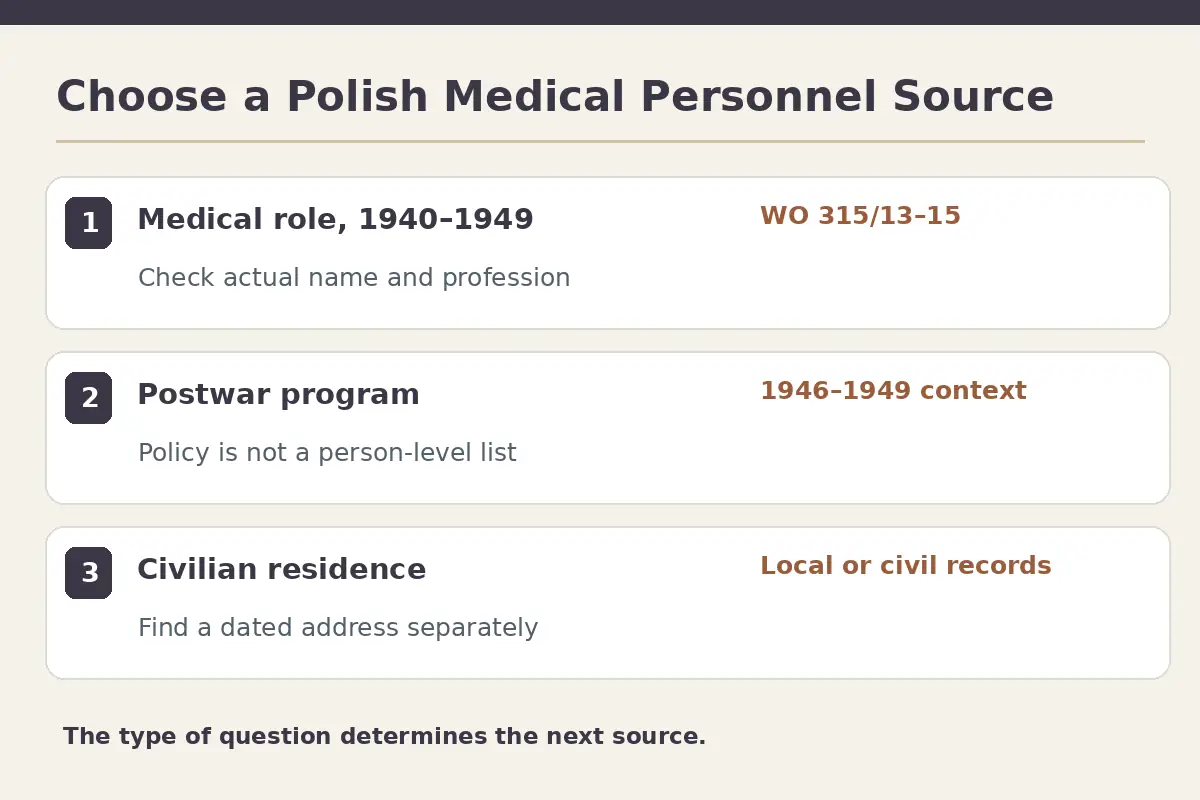
Distinguish Polish Land Forces from resettlement administration
The Polish Resettlement Corps emerged in the postwar context, with its formation announced in 1946 and relevant UK legislation passed in 1947. The National Archives educational material describes the broad policy and the corps’ later disbandment in 1949. Those dates are useful to sort an item as wartime Polish forces material, resettlement administration or later civilian context; they do not transform a wartime listing into proof of permanent British migration.
A person might have been serving in one administrative setting and later mentioned in another. Build a timeline with separate columns for the date written on the record, the date of the event described and the organization that created the document. If a file contains retrospective notes, those dates may not match. Record what an entry actually says before linking it to a residence or a later occupation. A surname in a general resettlement policy paper is not equivalent to an individual discharge or address entry.
Transcribe rank, specialty and language cautiously
Historical Polish military terms can be mistaken for place names or job titles when copied into English. Preserve a verbatim transcription as well as your working translation. Note which words are uncertain, whether the page was written by a clerk or completed by the individual, and whether abbreviations repeat elsewhere. A neat English summary is helpful for relatives but cannot replace the original Polish wording when testing identity, specialty or administrative status.
Where two candidates share a common surname, compare initials, full forenames, rank, specialty, year and any independently recorded details. Avoid assigning a birth year if the record does not contain one. A document naming a medical role can support that role within the source’s scope, but a specific hospital, field ambulance station or civilian practice requires its own evidence. Do not treat a command’s general location as proof that every listed person was present there on a particular date.

Find a separate record for a UK address or posting
The National Archives holds policy material about accommodation and dependents of Polish personnel, including a 1947 example in its educational collection. Such sources explain the administrative environment but do not normally identify the full career path of an unrelated individual. To establish an address, look for a dated personal document, appropriate registration or civil record, employment evidence, or a personnel item explicitly describing the location. State its creator and date, rather than inferring residence from the presence of a corps in the region.
For a hypothetical dentist remembered as living near Salisbury in 1947, WO 315 may help test professional identity, while a separate contemporary address source would be needed for Salisbury residence. An institutional policy document that names Salisbury as a correspondence point does not put that dentist there. The strongest conclusion might be a qualified candidate in Polish medical records with a plausible postwar connection, subject to checking a named posting or household record.
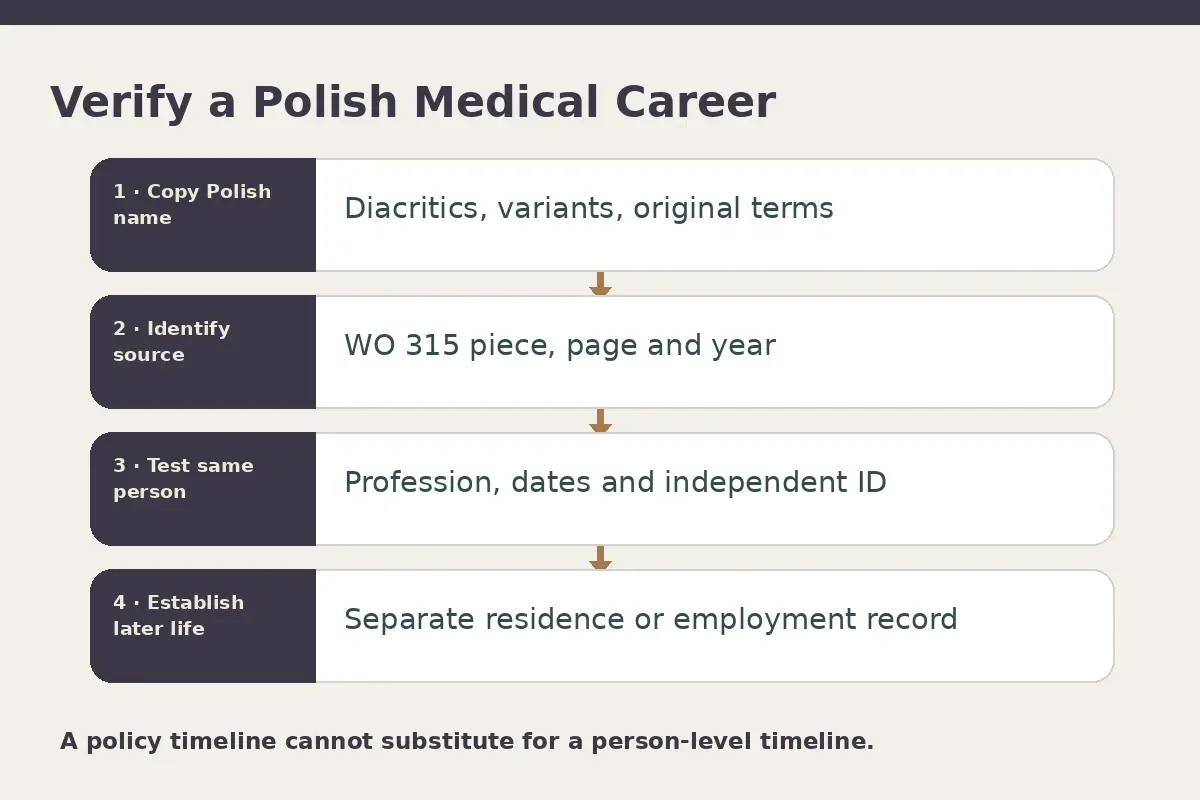
Document negative searches and privacy boundaries
Write down each WO 315 piece checked, whether it was an image or physical volume, the language of the text, the range inspected and the candidate spellings. An absent search result from a piece-level catalogue is not proof that no entry exists inside the piece. Some access or interpretation may require consultation at an archive and help reading Polish; make that an explicit research need rather than claiming the collection is fully online.
Later postwar family and employment records can involve living people or sensitive details. Use lawful access procedures and avoid publishing personal addresses, medical information or assumptions about someone’s citizenship. A military medical role, participation in a resettlement program, discharge and subsequent naturalization are separate administrative questions. Even when the wider history is well documented, only a properly matched source chain can establish an individual’s actions and movements.
More Records and Archives Guides
How We Research This Historical Record Series
We based the documented series, chronology and available search method on official archive guidance and the custodian’s complementary reference. Each source was reviewed for the particular claim it supports; it is not a claim that we inspected every item within the series. We compared the subject, archive codes and search intent with the GenHis historical topic catalog and prepared images as original explanatory artwork, not scans or reproductions of real records. Actual dates, names and roles in an individual family case must be taken from a cited original or reliable derivative, with uncertainty preserved.
When using this guide, cite the repository, complete record reference, document title or creator, date, page or internal entry and method of inspection. Keep separate notes for an index description, a viewed source and a conclusion; an absent catalogue result does not establish an absent historical event. Compare namesakes and contradicting accounts rather than discarding them. The affiliate disclosure describes the site policy. No sponsorship, purchase recommendation or partner relationship is assumed by these archive pathways.
The National Archives points to WO 315/13, WO 315/14 and WO 315/15.
The guide names medical officers, pharmacists, dentists and field ambulance officers.
No. The National Archives explicitly says the relevant records are in Polish.
No. A separate residence or resettlement record is needed for an individual settlement claim.
They help distinguish the creation and legal context of the postwar Polish Resettlement Corps from earlier military service.