
If a relative was called a nurse in a family letter, the first question is not which hospital employed her: it is whether she appears in the historical professional registration system and which register applied to her. At The National Archives, DT 10 and DT 11 describe distinct categories of nurses in England and Wales. A matching name supports a registration history, but it does not, by itself, prove ward duties, an employer, a continuous career or even that a namesake is your relative.
The practical task is to take an approximate training or practice date, choose the right register, retain the exact entry and compare it with independent evidence. Registration began in 1921, and the assistant-nurse roll belongs to a later administrative phase. An unsuccessful name search needs a spelling, name-change, category and date audit before it can become meaningful evidence. This guide uses the documented difference between DT 10 and DT 11 as its central decision.
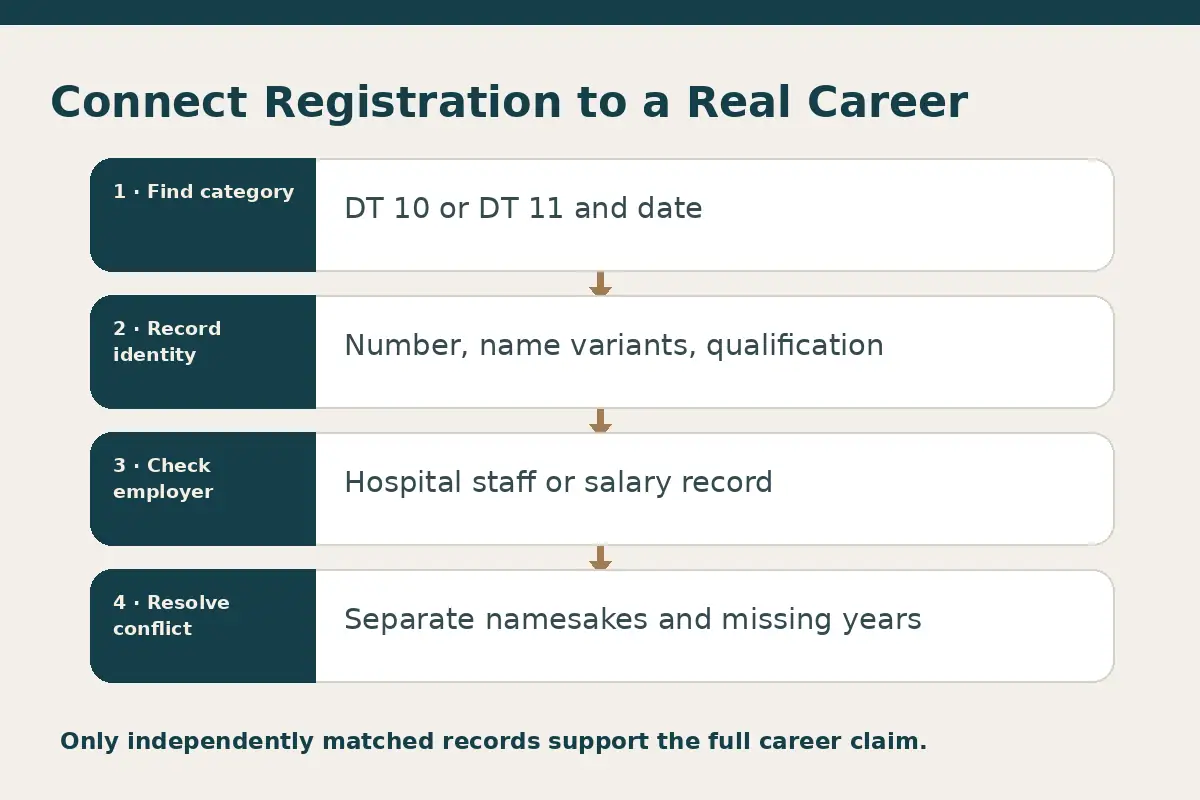
Choose DT 10 or DT 11 from the qualification clue
The General Nursing Council maintained a register of qualified nurses. The National Archives describes DT 10 as the Register of Nurses for 1921–1973, arranged by registration number and year, with printed nominal indexes in DT 10/1–56. An entry can help establish a name, registration date, number and qualification information. Start here when a certificate, newspaper notice or family account points to State Registered Nurse status, but avoid assuming every nurse joined immediately upon qualification.
DT 11 covers the Roll of Nurses from 1944–1973, with printed nominal indexes in DT 11/1–9. The roll recognized a different training route from the three-year qualified-nurse register; the label assistant nurse later became State Enrolled Nurse in 1961. A person missing from DT 10 may properly belong in DT 11, or in a separate nursing organization or earlier hospital register. Make two searches when the qualification is uncertain; do not merge the resulting identities merely because the surname matches.

Build a registration-ledger before claiming identity
Copy the surname exactly as printed, forenames or initials, registration number, part of the register, relevant year, date and stated qualification. Add the archive volume and page or entry identifier. For a married or renamed nurse, build a separate row for each documented form of the name and cite the record that connects those forms. A register can reproduce information carried forward from an earlier edition, so distinguish the first registration event from later appearance or updating.
Ask what combinations would separate two nurses sharing a common name. Birth year from a separate civil record, recorded address, qualification location, local nursing school and an independently dated marriage can each help. No single comparison is infallible: addresses change, qualifications can be reported inconsistently and initials may hide several possible candidates. Mark each concordance or conflict in a working table rather than deciding that a single digitized name hit proves the whole family story.
Know what a printed register actually establishes
The Royal College of Nursing describes historical printed registers and several types of information they may contain. Some entries include a registration date or number and sometimes an address or training institution. Those details document a professional-administrative status at the relevant time; they do not function as a complete payroll, duty roster, residence census or patient record. A nurse recorded in London could have trained elsewhere, taken private work or moved later without the entry settling those separate questions.
The register was structured into parts reflecting nursing specialties and professional categories, with rules changing over time. When interpreting a particular label, consult an explanation appropriate to the edition in hand rather than applying a modern title retroactively. A year printed on the cover may indicate the publication cycle, not the date the nurse started working. If a statement concerns hospital service, seek hospital staff records, annual reports, local directories or other independent evidence from that institution.

Use missing entries as a better search plan
If no match appears, record which index was searched and which date span was actually covered. Check alternative forenames, phonetic variants, transpositions, maiden and married surnames, and the supplementary sections of DT 10. Some historic nurse records belong to Scotland, Ireland, military nursing, district nursing or a separate professional body. The RCN guidance expressly notes that name variation and different registration categories explain many failed searches. Absence from one edition is not proof that the person never practiced.
Look for a chronology in which training, registration and employment are separate events. A person described as nursing in 1915 cannot automatically be expected in a council register opened in 1921. Someone called a nurse after 1944 might be on the enrolled roll rather than the registered list. A dated newspaper notice could supply a training hospital, while a marriage certificate might supply the missing surname. Use the next search to resolve one precise gap, not to accumulate lookalikes.
Confirm hospital work from independent records
To establish a specific appointment, identify the hospital and its archival custodian before looking for staff books, salary lists, nursing-school records or local authority employment documentation. A professional registration number may help track a person across records, but do not expect it to appear in every employment source. Record whether your second document names the person, describes a post, shows a payment or merely mentions the institution. Those are different degrees of evidence for a career claim.
For a hypothetical family letter naming a trained nurse in Bristol in the late 1940s, the first test is whether the name belongs to DT 10 or DT 11. The second test is whether an identified Bristol hospital employed that same person in the relevant year. Until an employer-specific record has been read, the accurate conclusion is that a candidate professional registration was found, not that the family member worked at a particular ward or cared for named patients.
More Records and Archives Guides
How We Research This Historical Record Series
We based the documented series, chronology and available search method on official archive guidance and the custodian’s complementary reference. Each source was reviewed for the particular claim it supports; it is not a claim that we inspected every item within the series. We compared the subject, archive codes and search intent with the GenHis historical topic catalog and prepared images as original explanatory artwork, not scans or reproductions of real records. Actual dates, names and roles in an individual family case must be taken from a cited original or reliable derivative, with uncertainty preserved.
When using this guide, cite the repository, complete record reference, document title or creator, date, page or internal entry and method of inspection. Keep separate notes for an index description, a viewed source and a conclusion; an absent catalogue result does not establish an absent historical event. Compare namesakes and contradicting accounts rather than discarding them. The affiliate disclosure describes the site policy. No sponsorship, purchase recommendation or partner relationship is assumed by these archive pathways.
No. DT 10 is the qualified-nurse Register; other routes, including the later assistant-nurse roll, require different sources.
The National Archives describes the Roll of Nurses in DT 11 for 1944–1973.
No. The roll originated with assistant nurses; the State Enrolled Nurse title was adopted in 1961.
No. A professional register must be supplemented by independent hospital or employment evidence.
Recheck surname changes, edition coverage, register category and other nursing organizations before drawing a conclusion.