
DT 27 at The National Archives contains preliminary and intermediate nursing examination results lists, dated 1924–1972. This guide identifies the original record path, shows exactly which claims the source supports, and explains which separate evidence is still needed.
Read the Examination Stage Before Reading the Name
DT 27 at The National Archives contains preliminary and intermediate nursing examination results lists, dated 1924–1972. That makes it a valuable clue for researching a nurse or a student nurse, but not a guarantee of professional registration or employment. The Archives’ guide to doctors and nurses names DT 27 alongside other examination and registration series; the distinction between an examination stage and a professional credential is the central safeguard in using it.
Start with the person’s known surname at the relevant time, approximate examination year and any independently known nursing school or hospital. Record name variants, including married and birth surnames, without assuming they refer to one person. A surname appearing on a pass list needs the examination type, date and original reference before it can become evidence for this candidate. Similar names are particularly hazardous in a national professional record.
Choose DT 27, DT 28, or the Registration Route
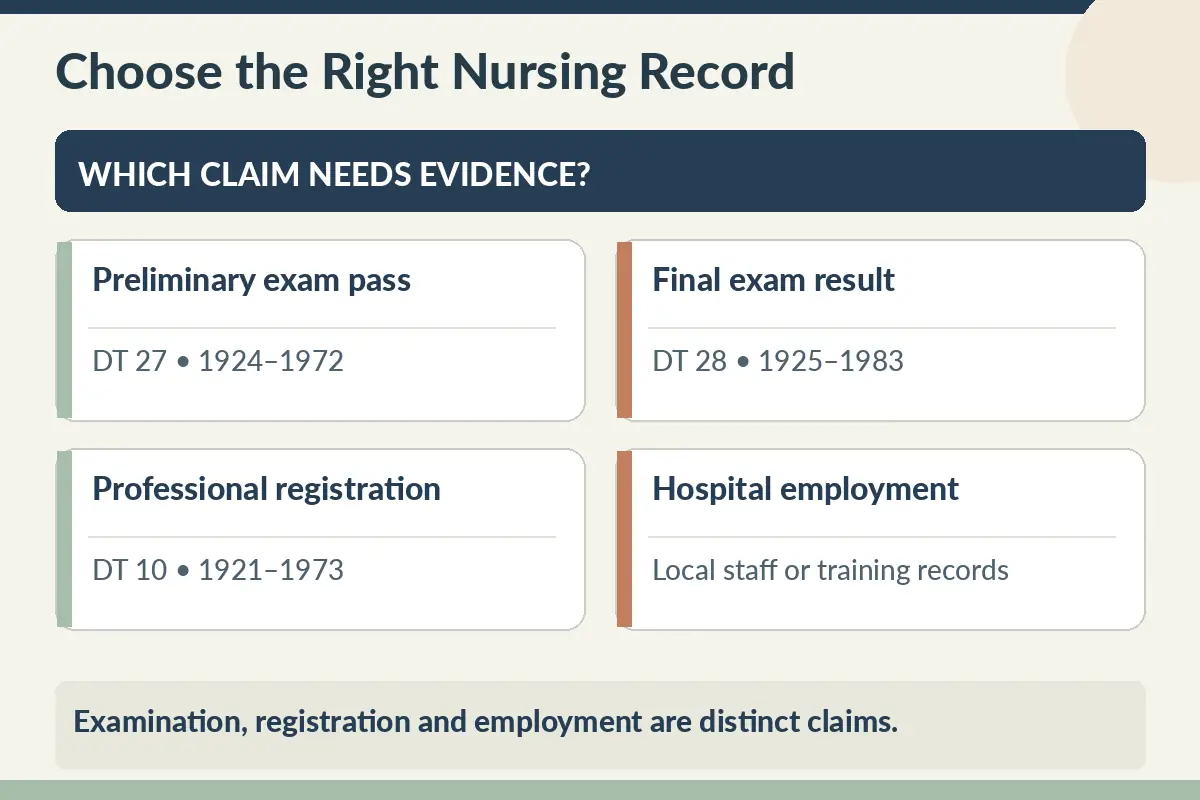
The National Archives places preliminary and intermediate results in DT 27 for 1924–1972. It describes DT 28 as final examination pass and fail lists for 1925–1983 and DT 25 as assessment pass lists and hospital results from 1949–1983. DT 26 holds examination papers rather than the same kind of candidate outcome evidence. Do not use a question paper to assert that a student sat, passed or failed an examination.
For registration status, the Archives directs readers to the printed registration indexes and DT 10, the register of nurses for 1921–1973, plus separate records for assistant or enrolled nurses in DT 11. Those records answer different questions from a preliminary result. Someone might pass one stage but take another route, defer further exams or change surname. Keep registration number, type and date separate from the exam result rather than merging them into an imagined career.
Extract a Result Without Inflating Its Meaning
The research guide explains that examination records list surnames of candidates who passed and are organized chronologically by examination type. Transcribe the name exactly as printed, along with stage, examination date, sequence or page, and the archival reference. Do not assume extra fields such as full birth dates or hospital assignments exist in each list. If a person appears in a result whose class is unclear, examine the heading, surrounding pages and catalogue context before labeling it a qualification.
An intermediate pass in DT 27 is evidence for the listed examination outcome under the conditions of that list. It does not prove the person completed a three-year course, appeared on a later register, worked at a particular hospital or kept a professional title throughout life. A certificate of examination, an employer’s staff register and a later professional registration are separate documents; when available, each should be cited separately.

Use the Registration and Hospital Checks
The Archives points researchers to DT 10 by registration number and year, using printed nominal indexes, and to DT 11 for the roll of assistant nurses established following the 1943 legislation. It also notes that the names of nurses in 1983 may appear in computerized DT 12 records. These alternatives matter because “nurse,” “registered nurse,” “assistant nurse” and “student nurse” are not interchangeable descriptions across the twentieth century.
For a claim of employment at a named institution, ask its archive or surviving successor about appointment records, staff publications, training school registers, photographs or local directories. The National Archives warns that many hospital holdings are local and that it generally does not possess patient records. Do not use a patient chart to construct a staff career. When records contain private information, follow current repository access rules rather than assuming a historical topic makes all material open.
Resolve Common Names and Mismatched Dates
Create a candidate comparison with the same four fields for each possible match: exact name form, result date, examination stage, and independent identifier such as registration number or training institution. Two people with a common surname can pass different stages in adjacent years. A later married surname can obscure an otherwise continuous training trail. A family photograph in uniform may provide context but cannot substitute for a dated professional source.
If DT 27 and a later registration disagree, examine whether the result belongs to a different person, whether a new surname was used, or whether you are comparing preliminary with final qualification dates. Avoid forcing an “exam date = employment start date” equation. Build a small timeline: reported training, preliminary/intermediate result, final result if located, registration, and employer record. Leave unknown intervals unfilled.

Record a Carefully Bounded Nursing Finding
A defensible statement might say: “A DT 27 preliminary examination list records this surname in a specified year; additional evidence is needed to identify the candidate and establish registration.” If an independent registration record connects the person, explain how, and cite the two items. A later award or newspaper biography may be useful but should not be retrofitted to change the literal meaning of the examination heading.
Preserve the catalogue terms and reference, the result date, the name exactly transcribed and the independently checked identifiers. Then decide the next question: was this person registered, where did training take place, or did the named hospital employ them? One verifiable stage per source is stronger family history than a polished career narrative inferred from a single name in a list.
More Records and Archives Guides
How We Research, Cite Sources, and Test Limits
The record families, dates, historical jurisdiction, index methods, and evidence limitations above were checked against these source pages: The National Archives guide; The National Archives citation guidance; Discovery catalogue guidance. A series description explains what a collection is and where to begin; it does not establish that a particular unseen item contains a given person or that a reported event occurred. We distinguish source transcription from reasonable historical inference, with no invented sample cases presented as real discoveries.
For every claimed match, retain the archive series, precise piece and item where available, the date as written, an access note and the independent source used for identification. Do not interpret a failed name search as proof that an event did not occur when records may be unindexed, missing or organized by place. See our affiliate disclosure; this method requires no paid relationship or endorsement.
No. It documents preliminary or intermediate examination results; registration must be tested in appropriate registers such as DT 10.
The National Archives research guide lists preliminary and intermediate examination results for 1924–1972.
The guide identifies DT 28 for final examination pass and fail lists, 1925–1983.
Do not assume so. Hospital employment and training-school records are often kept separately, frequently in local archives.
Record each contemporary spelling and connect identities using independent dates, institution details and registration evidence.