
The most useful first question about CO 850 is not whose name might appear, but what the record was created to document. CO 850 is a Colonial Office series recommended by The National Archives for investigating the Colonial Nursing Service, particularly files dated 1940–1955. This guide turns that archival description into a reproducible search and evidence test. Record the historical place, original wording, document date, and reference before connecting an institution or policy to a particular person. The distinction between official intention, recorded administration, and independently demonstrated results matters at every stage.
Identify the Territory and Employment Question
CO 850 is a Colonial Office series recommended by The National Archives for investigating the Colonial Nursing Service, particularly files dated 1940–1955. Its usefulness lies in understanding official service arrangements, recruitment, or policy for particular territories and periods. It is not necessarily a complete personnel series for every nurse employed overseas. Before searching, decide whether you need the terms of an appointment, government discussion of staffing, or proof that a named person actually held a post.
Record the territory name used in the document, the period, employer or colonial administration, and the position claimed. Historical territories and their governing institutions changed over time; do not apply present-day national borders retroactively without checking the relevant date. A nursing sister, matron, trainee, local recruit, and temporary employee might have occupied different administrative categories. Preserve the terminology of the source while describing people respectfully in contemporary prose.
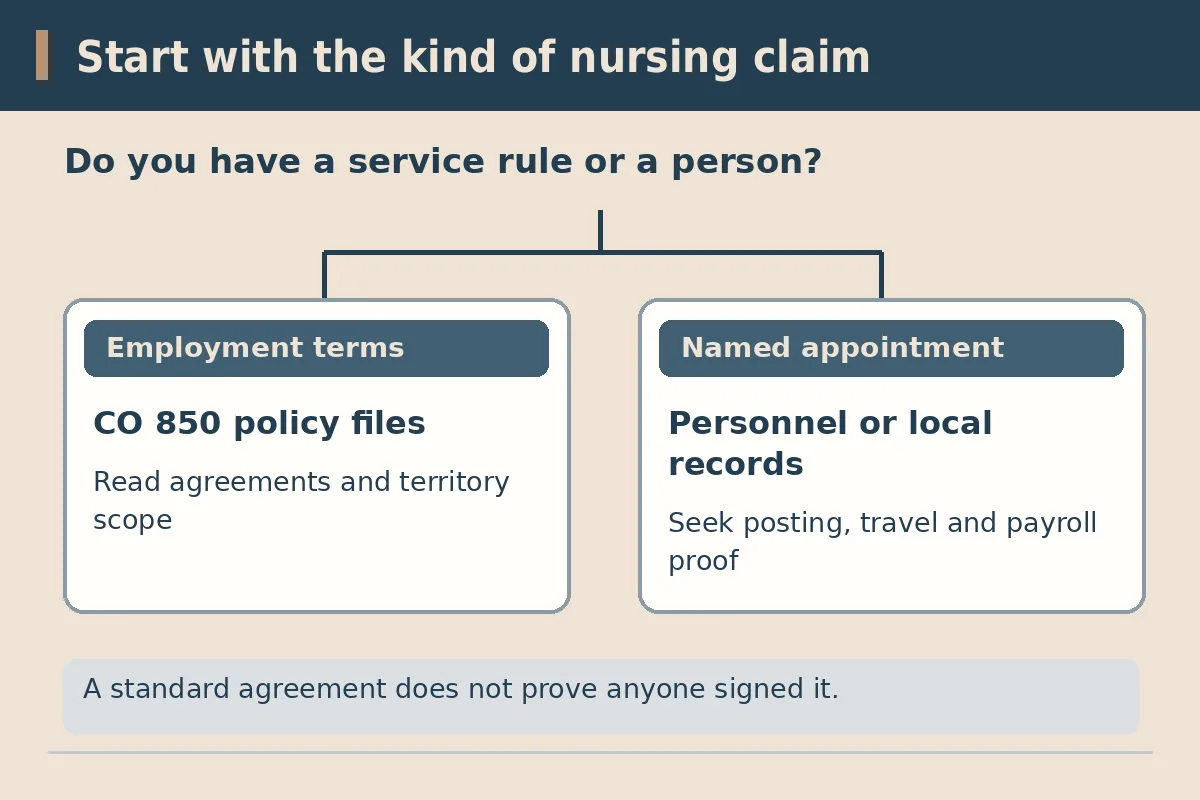
Read a Policy or Standard Agreement Precisely
A file about model employment terms may discuss leave, pay, travel, qualifications, transfers, pensions, or recruitment arrangements. That is important evidence of the rules officials considered or adopted, but not proof that any individual signed the model agreement. Mark every document by status: discussion paper, draft, approved circular, form, correspondence about a case, or signed instrument. Even “approved” conditions may not apply to all territories or appointment dates.
If one document mentions a passage allowance or return travel after service, do not translate that into a claim that a nurse made a particular journey. A right, request, or entitlement is distinct from a completed payment or voyage. Seek the final applicable agreement and evidence of performance. If the file contains correspondence about exceptions, note the exception’s scope rather than treat it as the normal rule everywhere in the service.
A standard circular and a locally signed agreement may conflict because of amendments, exceptions, or different implementation dates. Enter both as sources, with the territory and issuing office noted. Never merge them into one universal set of conditions without showing the authoritative link. A pension entitlement, official recommendation, and pension payment are three separate administrative events, each potentially needing its own record.
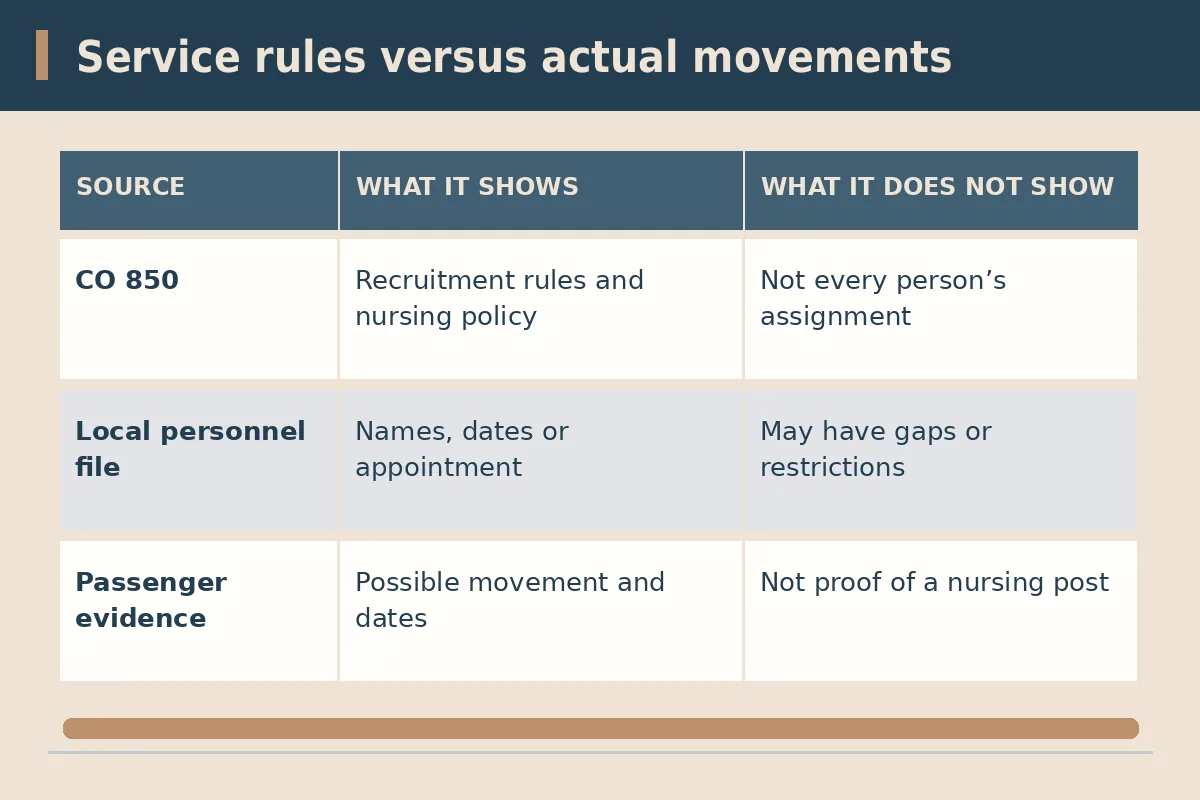
Trace the Correct Office and Local Custodian
The National Archives’ public-health guide points specifically to CO 850 for Colonial Nursing Service files and distinguishes it from British domestic recruitment-policy series such as LAB 12 and MH 55. A search should therefore start with the office and territory relevant to the historical question. Search both service-wide terms and local place names. A single catalogue result may cover several years or subjects, and a narrow personal-name search may miss relevant correspondence indexed by topic.
For individual careers, local colonial administrative reports, government gazettes, hospital registers, and later national archives may be more directly informative than metropolitan policy files. Determine what archives hold records created by the local authority at that date. The absence of a name in CO 850 does not establish nonemployment, especially where central files discuss policy in aggregate. Never assume one surviving collection represents the full colonial administrative apparatus.
Prove a Posting Without Treating Travel as Service
A family photograph at an overseas hospital may be a useful lead, but the caption could have been added decades later. Test a claimed posting with an appointment notice, named staff roster, salary record, dated hospital report, or correspondence identifying the nurse’s role. A passenger manifest or residence listing may support travel or presence; neither alone establishes the occupational appointment. A roster also requires careful matching where names are abbreviated or spouses share a surname.
Build a sequence with distinct dates for application, selection, contract, departure, arrival, start of duties, leave, transfer, and termination. Many entries will remain unknown. Do not fill them from a general service regulation. Where papers contain sensitive information about living persons or private medical history, comply with repository access rules and do not publish personal details merely because a catalogue entry is visible.
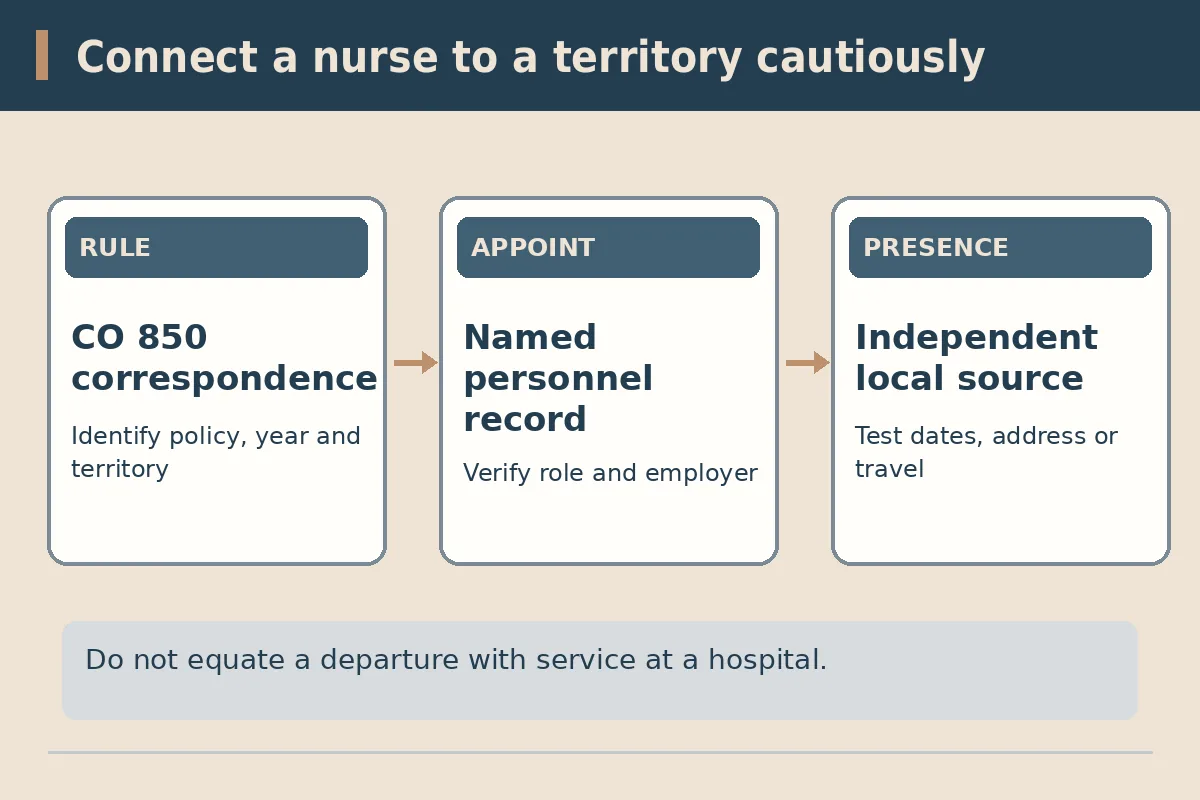
Avoid a Single Narrative for Different Nurses
The history of a centralized service should not erase local recruitment, different training pathways, or unequal working conditions. Separate what officials said should happen from what local records show happened. Colonial correspondence may contain historical racialized classifications and assumptions; describe their context and do not repeat them as objective categories. Quoting a prejudice from a file requires clear attribution, not endorsement. This critical reading makes the family history more accurate and humane.
Imagine a hypothetical nurse listed in a 1951 local gazette and an undated CO 850 memorandum describing transfers. The memorandum may explain possible procedures, but only an individually linked transfer notice or service record would establish that this person moved. Record the connection as “context only” until the precise name, dates, and destination are established independently. The same method protects against unsupported claims about marriage, resignation, or pension eligibility based solely on a policy note.
Check whether a person appears under initials, a married name, or a variant transliteration, but avoid linking two entries from name alone. The same occupational title can appear in different colonial hospitals and successive years. A stronger match has at least two independent identifiers, such as professional qualification and dated appointment place. The research question is a particular career, not whether a plausible name appears somewhere in the Colonial Office catalogue.
More Records and Archives Guides
How We Research This Record Series
We start with the official series description and keep three things apart: the catalogue summary, the surviving document, and our interpretation of it. The National Archives’ research guide identifies the relevant CO 850 record route and its limits. Its Discovery search instructions explain how to move from a catalogue result to a properly identified record. Every example on this page is a research exercise unless it cites a specific piece; none represents a newly discovered ancestor or institution.
For each candidate we log search query, historical place, date interval, record creator, full series and piece reference, access status, exact useful words, and a reason to accept or reject the claim. The National Archives’ citation guidance helps make this trail reproducible. If the item cannot be inspected, we write ‘catalogue only’ and do not invent its contents. Missing material is handled as a coverage question, not as proof that the event did not happen. For legal and commercial transparency, read the affiliate disclosure; this guide does not assert a sponsorship or paid relationship.
Use the final checklist before citing a result: have you identified the original creator and repository, established the applicable period and jurisdiction, separated a proposal or summary from a completed action, matched the necessary person or site independently, and preserved the precise reference for another researcher? An answer of “not yet” is a legitimate outcome. A carefully dated uncertainty makes a stronger history than a plausible story assembled from unrelated archive descriptions.
No. The series is a route to Colonial Nursing Service policy and correspondence, not a guaranteed comprehensive personal register.
The National Archives highlights Colonial Nursing Service files dated 1940–1955 in CO 850.
No. You need a signed agreement or independently identifying appointment and service evidence.
No. It may support a journey or presence, but not the employer, role or duties without corroboration.
Preserve accurate quotations where necessary with attribution, explain the historical context, and avoid using outdated official categories as unquestioned descriptions of people.