
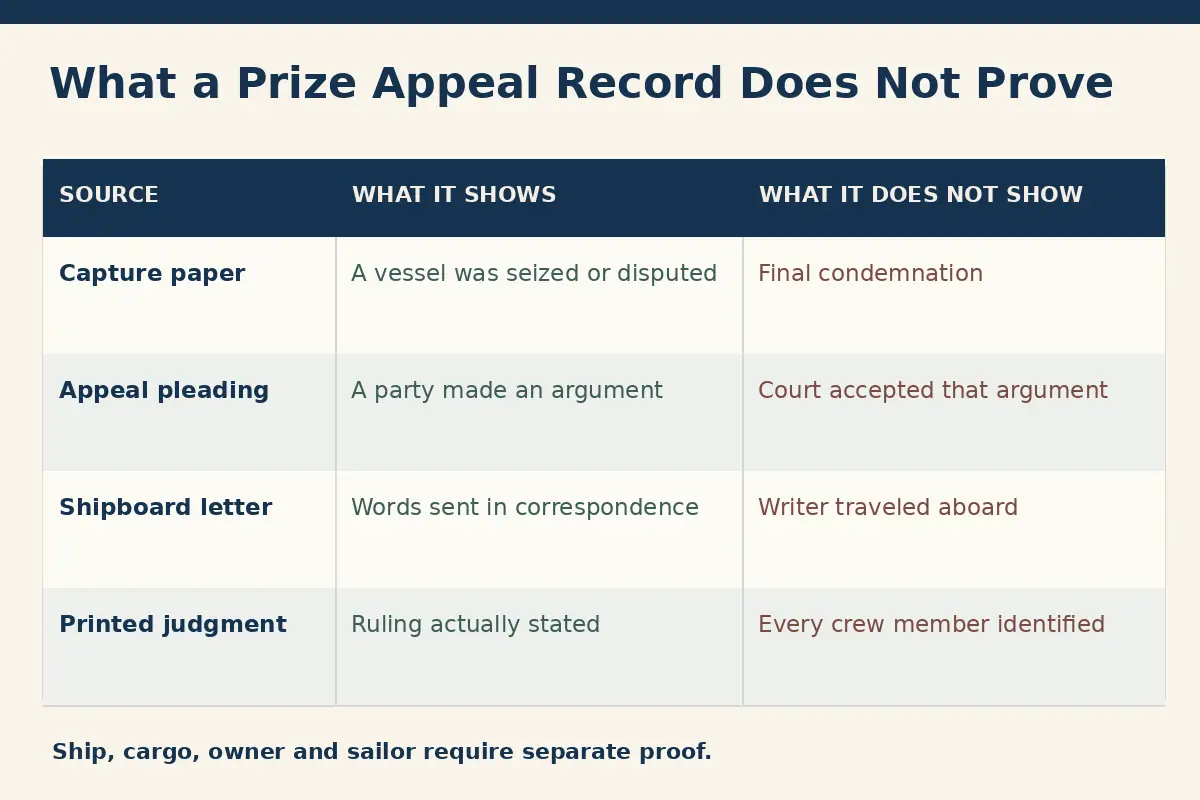
HCA 42 holds papers in prize appeals relating to captured ships, arranged by the initial letters of ships’ names. That arrangement supplies an unusually concrete starting point: identify the ship rather than searching first for an ancestor’s surname. In wartime a vessel could be seized and disputed in the prize jurisdiction of the High Court of Admiralty. The existence of papers about the capture, however, does not prove that condemnation was upheld, that cargo became lawful prize, or that a particular sailor belonged to the crew.
The National Archives places HCA 42 beside HCA 41 act books, HCA 43–44 assignation books and HCA 45 printed case books in its guidance on appeals. The key research skill is to distinguish the initial seizure, each party’s legal account and the outcome recorded by the appellate court. A ship-name match can initiate that work, but changing spellings and duplicate vessel names must be managed before any personal identity claim is made.
Start with the ship-name initial, then verify identity
The National Archives specifically describes HCA 42 as papers arranged alphabetically by initial letter of the ship’s name. Assemble spelling variants, nationality, master, approximate seizure date, captor or route if they are independently known. A ship could be recorded under a translated name, an abbreviated name or a title used by the capturing power. Keep candidate vessels separate until the date, master and other identifying details resolve them. Do not assume that alphabetization means a complete modern surname-style index exists.
Locate the full archive reference at piece level and inspect the file’s own contents or inventory. A document may refer to a ship in one dispute without necessarily being the decisive judgment in that case. Record which participants were captors, neutral owners, insurers or cargo claimants. A named master and a named owner are not interchangeable. The papers may explain commercial interests while giving little or no reliable list of ordinary seamen.

Understand capture, condemnation and appeal as different events
Prize jurisdiction considered whether a vessel or cargo captured in wartime could lawfully be treated as prize. A seizure is an event; condemnation is a legal judgment; an appeal is another proceeding that may affirm, reverse or modify a prior decision. Write a separate date and source for each stage. If your document is merely a notice, petition or allegation, use words such as claimed or applied rather than was adjudged. A government record can preserve a contested assertion without endorsing it.
The National Archives explains the distinction between prize and instance jurisdiction, the latter concerning commercial matters such as wages, salvage or collisions. Do not automatically send a wage dispute to the HCA 42 prize appeal sequence because it involves a ship. First identify the court’s jurisdiction and the legal character of the underlying action. A ship may appear in more than one type of case, and one sailor might have interests separate from the shipowner’s claim about the cargo.
Use HCA 41 and HCA 45 as complementary sources
HCA 41 contains act books, minutes and drafts of prize appeals; HCA 45 contains printed case books, with those for 1793–1815 digitized by the Prize Papers Project according to the National Archives guide. HCA 42 may supply papers from the dispute, while these companion records can clarify stages or how the case was presented. The three series are alternatives to be checked for the exact type of evidence needed, not a guaranteed sequence that survives for every capture.
When a printed case is located, distinguish counsel’s narrative from the appellate decision, just as with other historic litigation. Compare case captions, vessel spellings, dates, nationality and parties. A printed abstract might omit an attachment retained among earlier court papers. Record the page of every statement and seek a separate judgment source for the final disposition. If no disposition is found, do not fill the silence with a presumed victory for the captors.
Treat shipboard papers as exhibits, not passenger lists
The National Archives describes the wider Prize Papers collection as containing trading documents, navigation records, passengers’ and mariners’ personal archives, intercepted correspondence and legal proceedings retained as exhibits. An envelope or manifest can be invaluable family-history evidence, but the reason for preservation was litigation over seizure, not systematic recording of all people on every vessel. A document carried aboard a ship does not automatically prove that its writer or recipient sailed on it.
A letter found in the collection may have been mail in transit. It can document correspondence and sometimes a place or commercial link, while the ship’s crew must be proved from a muster, agreement or other named personnel record. A cargo invoice may identify consignors but does not establish that they traveled on the vessel. Capture may have brought together papers from multiple persons and places. For each name, state the person’s role in the specific document.

Write a defensible maritime case conclusion
Imagine a family story saying a ship was condemned and a relative lost all property. The first step is to identify the actual vessel in HCA 42 and determine whether the named relative appears as owner, master, passenger, correspondent or not at all. The second is to identify the court disposition, if a reliable record of it survives. The third is to connect any property loss or voyage to that particular person through accounts, correspondence or independent records.
Finish with a citation ledger listing the ship-name variant, date, HCA 42 piece, document type, participants and any HCA 41 or HCA 45 companion references. State uncertainty explicitly if the result of the appeal remains unknown. A file concerning a capture is enough to prove the existence of a dispute but not necessarily a judgment, payment or sailor’s personal experience. This limited conclusion is much stronger than an attractive but unsupported maritime legend.
More Records and Archives Guides
How We Research This Historical Record Series
We based the documented series, chronology and available search method on official archive guidance and the custodian’s complementary reference. Each source was reviewed for the particular claim it supports; it is not a claim that we inspected every item within the series. We compared the subject, archive codes and search intent with the GenHis historical topic catalog and prepared images as original explanatory artwork, not scans or reproductions of real records. Actual dates, names and roles in an individual family case must be taken from a cited original or reliable derivative, with uncertainty preserved.
When using this guide, cite the repository, complete record reference, document title or creator, date, page or internal entry and method of inspection. Keep separate notes for an index description, a viewed source and a conclusion; an absent catalogue result does not establish an absent historical event. Compare namesakes and contradicting accounts rather than discarding them. The affiliate disclosure describes the site policy. No sponsorship, purchase recommendation or partner relationship is assumed by these archive pathways.
By the initial letter of ships’ names, according to The National Archives.
No. Seizure, legal argument, condemnation and appeal outcome must be established separately.
Printed case books for prize appeals; The National Archives notes digitization for 1793–1815.
No. A prize case concerns the legal status of ship or cargo and may not document every crew member.
No. Mail in transit may have been carried independently of its writer and recipient.