
Letters of marque are evidence of privateering authority, not proof that the vessel captured a prize or that a particular sailor joined its crew. The National Archives identifies an HCA 26/13 document involving the Jamaica Gally in 1708, providing a useful example of a commission-related record. Start with the ship’s period spelling, commander, owners or backers, date and the exact document type. Follow any commission or declaration into voyage accounts and Admiralty prize proceedings only where these exist. A lawful authorization and a successful capture are separate historical claims. For official series scope, consult The National Archives research guide.
Identify the declared ship and its people
A declaration for a letter of marque may mention a ship, intended commander and those seeking authority. Read exactly how the participants are described: a master, a backer, a claimant and a crew member have different relationships to the vessel. One person can occupy more than one role, but the document must demonstrate it rather than the researcher assuming it. The National Archives’ teaching example names John Jelfe’s Jamaica Gally and gives a precise HCA 26/13 folio reference. Use such a reference to reach the record, not as a template for all privateers.
Ships were renamed, names reused and spellings inconsistent. Make a ship identity sheet with ship name as written, year, commander, registration port if known and any dimensions or ownership details. Do not join two records by vessel name alone. A ship in a 1708 commission and one in a later prize case might be different vessels. Equally, a person financing an expedition was not necessarily present at sea. For genealogy, seek a muster, pay entry or contemporary crew record for direct evidence of service.

Distinguish legal authority from activity
A letter of marque was connected to authorization for maritime seizure under specified wartime conditions; it was not a blanket proof of naval command or a record of every action taken afterward. Identify the date, issuing authority, stated restrictions and named vessel. An application or declaration may precede formal issuance. Do not collapse these into one event unless the document itself establishes a completed grant of authority. Conditions may matter for later claims about whether a seizure was lawful.
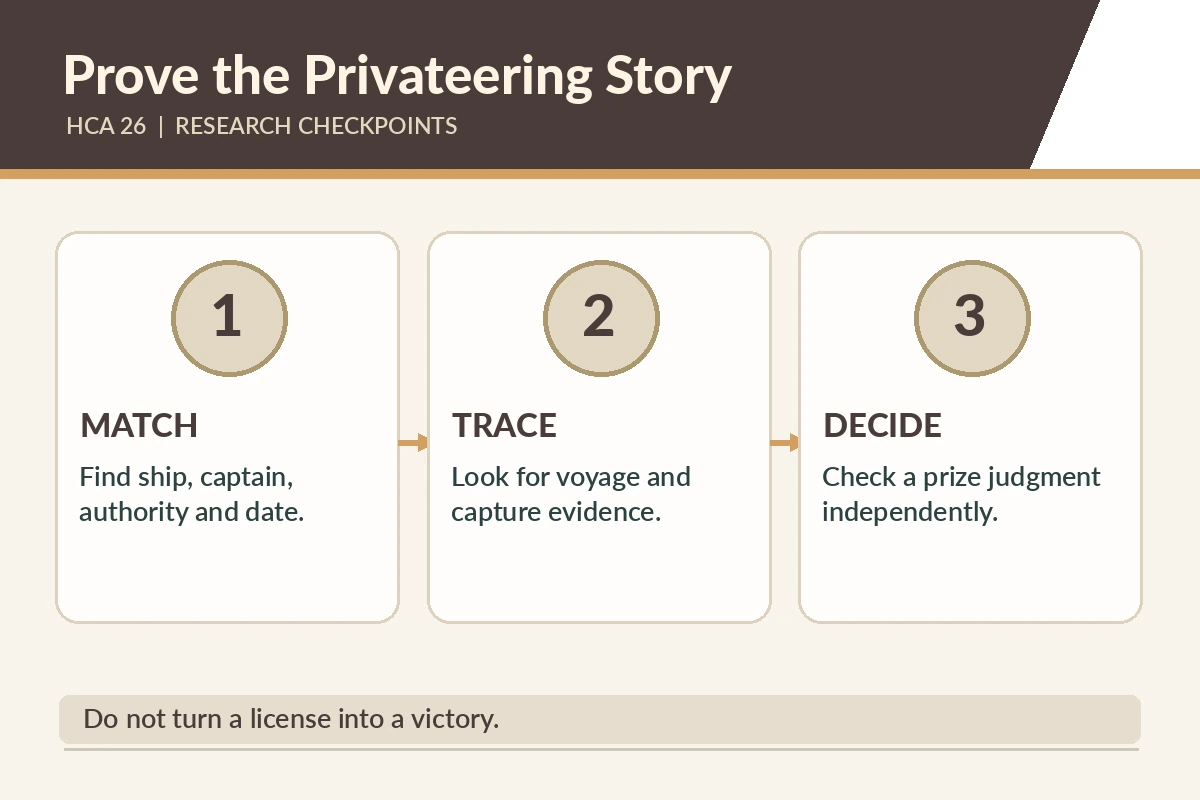
If the record lists people planning to sail, distinguish intention from embarkation. A ship could prepare for privateering without departing; a later voyage could have a different captain or crew. An issued authority may have been superseded, challenged or used only for part of a campaign. Create separate fields for commission requested, granted, sailing evidenced, capture alleged and capture adjudicated. Mark unknown stages as unknown, not as implicit steps in a dramatic adventure.
Search the prize papers for a separate event
The National Archives’ Prize Papers collection arose from ships captured in wartime and used as evidence in courts deciding whether a vessel had been lawfully taken. This material can include shipping documents, cargo papers and private letters. Its existence does not prove the capture by every privateer that appears in an HCA 26 entry. Search prize cases by the captured vessel, the privateering ship, date and names of claimants, then check the form of the surviving papers and actual decision.
A captured merchant’s letters or cargo record may be extraordinarily rich evidence of correspondence, but their seizure and filing do not show that the intended recipient received them. Likewise, the present location of captured papers may reflect an Admiralty legal process rather than the vessel’s intended port of arrival. Keep provenance visible. If a prize document discusses enslaved people, use precise language about trafficking and forced confinement rather than adopting clerks’ dehumanizing classifications as neutral descriptions.

Read the court outcome, not merely an allegation
The High Court of Admiralty guide distinguishes allegations, pleadings, acts and other parts of proceedings. A libel may present one side’s claim; a deposition may capture a witness’s account; an act book or final decree may address what the court decided. Each should be labeled with its procedural role. An accusation of illegal trade is not itself a finding of guilt. A claim to prize money is not evidence of payment until the relevant order or accounts are found.
Follow the case chronologically while resisting the assumption that every named privateer was a winner in court. Ships could be recaptured, condemned, released or disputed among multiple parties. Determine which vessel is the subject of the judgment and whether the judgment was final or appealed. If the only available record is an affidavit, use language such as ‘the witness stated’ and identify the witness rather than narrating the statement as certain fact.
Avoid inventing a full crew or family link
The same surname may occur among owners, commissioners, masters and sailors across several ports. A commission naming a ship commander is not a roster of its crew or proof that the commander’s son accompanied him. To reconstruct a sailor’s career, compare dated crew records, wage accounts, port documents or contemporaneous personal evidence. A later family history may preserve a plausible tradition, but use it as a lead until documentary identifiers connect the person to this particular expedition.
A death during a voyage requires independent evidence, such as a dated report or burial entry, not merely absence from later commission papers. An owner may sign a declaration without boarding the vessel. A captured person named in prize papers is not necessarily a member of the captor’s crew. Distinguish who wrote a document, who it describes, whose property was seized and who was legally represented. These separate roles prevent one archival mention from becoming a fictional biography.
Keep a ship-centered citation ledger
For each item, record the exact HCA piece and folio or page, ship spelling, issuing authority, date, commander, source category and what it proves. Add separate references for any voyage or prize material. Use one column for the event asserted and another for the evidentiary stage: application, commission, embarkation, seizure, legal proceeding or final disposition. A named person may appear in several stages, but do not infer continuity through a gap without independent identifiers.
Before publication, verify the wording and document status against the original or a reliable transcription; catalog entries can condense procedure. Preserve a consistent ship identity across record types. If the commission is the last certain record, the useful conclusion is limited but real: an authority or proposed authorization is documented, while the voyage’s outcome remains unverified. That protects an ancestor’s story from false heroics and makes the next archival search much clearer.
More Records and Archives Guides
How We Research HCA 26 Records
We anchor HCA 26 research to the National Archives’ documented letter-of-marque example, then consult the High Court of Admiralty research guidance and prize papers to separate authorization, voyage and judicial proceedings. We verify whether each person is named as owner, commander, witness or crew member, and do not treat captured papers as an automatic verdict. The citation records the actual document layer consulted. For disclosure about linked resources, see our affiliate disclosure.
No. It concerns authority or a declaration; a capture and prize adjudication require separate records.
The National Archives identifies a 1708 commission-related document at HCA 26/13, folio 76.
No. Owners and financial backers were not necessarily shipboard crew.
Not generally. They are captured documents and court-related evidence with different provenance and scope.
Look for the corresponding High Court of Admiralty proceedings and a final decision, not just an allegation.