
Search The National Archives’ MH 47 guide for Middlesex military-service appeal cases, 1916–1918. An appeal application can document an occupation, address and claimed hardship; it is neither proof of an exemption being granted nor proof that the applicant ever served in the army.
Start With Middlesex Rather Than a National Name Search
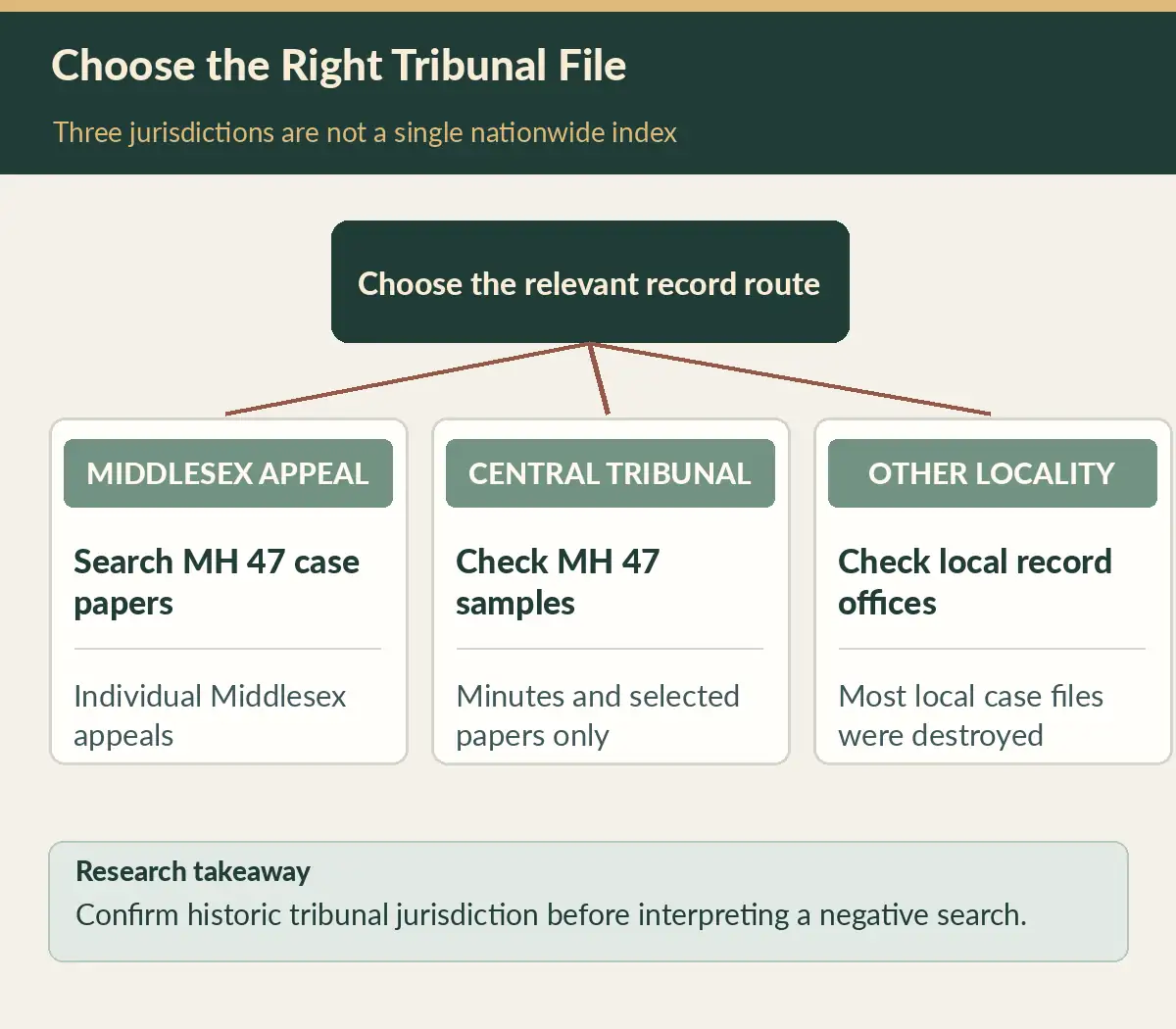
The substantial case-paper survival in MH 47 comes from the Middlesex Appeal Tribunal, not a complete national archive of all appeals. Confirm that the relevant applicant lived or worked in the tribunal’s jurisdiction at the date of a hearing. A London address alone does not always resolve the historical county or local-board boundary.
Collect the person’s known address, occupation, age and approximate year from directories, civil records or electoral material before searching. The custodian’s guide describes searching the Discovery catalogue by name, place and occupation. Keep variants in spelling rather than assuming modern street labels reproduce the original papers.
Choose the Correct Level of Tribunal
An applicant normally approached a local tribunal and could challenge a decision at a county appeal tribunal; certain further appeals reached a central tribunal. Those are administrative stages, not interchangeable collections. The rich MH 47 individual case survival primarily concerns Middlesex county appeals.
Central Tribunal material in the same series is much smaller, while most other local cases disappeared after the war. If a family lived outside Middlesex, first consult the National Archives’ conscientious objectors guide for survival and regional alternatives. Do not move an unsuccessful name search into a different jurisdiction and silently treat the resulting namesake as the target.
Distinguish Grounds Claimed From Grounds Accepted
The appeal form could state health, hardship, business duties, employment or a conscientious position. A recorded reason belongs to the applicant’s argument or supporting evidence; it need not be the tribunal’s finding. The archive describes seven principal exemption grounds, so calling all appellants conscientious objectors is a serious classification error.
Transcribe each request as a claim, then search the hearing record for the decision and any expiry or conditions. Where the decision page is missing, the proper conclusion is that the result has not been established by the inspected file. A petition to avoid or postpone service is not, by itself, a conviction or a desertion record.
Read Every Leaf and Each Endorsement
Case papers may combine a formal application, correspondence, statements by employers, medical certificates, a hearing note and subsequent communications. They may also consist of only a few sheets. Photograph or capture both sides and keep the order found in the archival item.
Make a source table with columns for document date, author, event or claim, and independent check. An employer’s assertion about an essential worker deserves different evidentiary weight from an official tribunal endorsement. A later document can alter an earlier recommendation. Neither the first page nor a modern catalogue snippet necessarily represents the final disposition of the case.
Work From Address and Occupation Clues
A name shared by several wartime London workers is insufficient to identify the right applicant. An address can be checked against contemporary street directories, electoral registers, marriage certificates or employer records where available. Occupations may use historic titles or be abbreviated; search both the manuscript form and a modern equivalent without overwriting the original.
If a case mentions dependents, list precisely who is named and how they are described. Dependency was an argument in a claim, not an independent birth or marriage record. Evaluate the timing: an address in 1917 may be consistent with an earlier 1911 census household without proving that everyone at the premises was related.

Place an Appeal in Its Wartime Timeline
The Military Service Acts changed eligibility during 1916 and beyond; an applicant’s circumstances and the route to exemption could change. Record the date the application was made, the decision date, any postponement period and a later order separately. An exemption at one hearing might be temporary rather than permanent.
The tribunal records should not be used as an isolated proxy for an entire 1914–1918 career. To answer whether someone joined a unit later, consult a specific service, medal or pension record and compare names, dates, ranks and addresses. Do not back-project the fact of a later uniformed photograph onto an earlier exemption hearing.
Search Again When an Individual File Is Missing
The UK government ordered the destruction of most local tribunal papers after the war, so missing personal files are a preservation issue rather than reliable negative evidence. MH 47 also contains registers, indexes and administrative correspondence whose references can survive when a file does not. Search the relevant locality’s record office holdings before abandoning the question.
Note exactly which archive, collection, years and spellings you tried. A surviving regional minute may summarize a ruling but omit the applicant’s detailed evidence; cite it as a minute. No-result searches should preserve the known coverage limit instead of claiming that the man never applied.
Construct a Two-Applicant Identity Test
Suppose two men called Arthur Brown were employed in clerical work in London during 1917. One file mentions a married man supporting children; the other records a bachelor working at a different address. Do not equate either file with a named relative because the surname and occupation sound right.
Put a documented marriage, birth of children and contemporary city-directory entry alongside the tribunal statements. Allow an unresolved candidate when the dates or districts remain close. All names in this example are illustrative, not genuine entries from MH 47. This comparison is especially important when a transcript drops a middle initial or workplace address.

How We Research Middlesex Appeal Evidence
We begin by verifying the archive’s jurisdiction and what type of MH 47 document survives, then distinguish application, witness statement, hearing minute and final order. We read the individual leaves before extracting names, dates or social circumstances, and we test every identity link against records created independently of the appeal. We log failed searches by locality and source survival.
We keep conscientious objection distinct from hardship and occupational reasons. The affiliate disclosure describes site relationships; no paid research route is required to interpret a tribunal file. Unverified family ties and military outcomes remain labeled as unknown.
More Records and Archives Guides
Cite an Actual Appeal, Not Merely MH 47
For a reusable citation, record the series and complete item reference, applicant as written, exact document title and date, image or folio numbers and the holding institution, The National Archives (UK). Add the digital catalogue address only after you have opened the item record, because a series page alone does not identify a particular man.
If the image is unavailable, cite the catalogue as a catalogue and clearly state that the original manuscript was not read. Store conflicting transcriptions and updates to the hearing outcome as separately dated notes. This makes it possible for a second researcher to repeat the search and disagree constructively.
No. The substantial individual case files concern the Middlesex Appeal Tribunal; the central and other local survival is very different.
No. Read the decision and any later conditions or orders.
No. Applications also used health, employment, dependency and other grounds.
Not alone. Confirm later service in an independent military record.
Most local tribunal case papers were destroyed; check surviving registers and local collections before interpreting a missing result.