
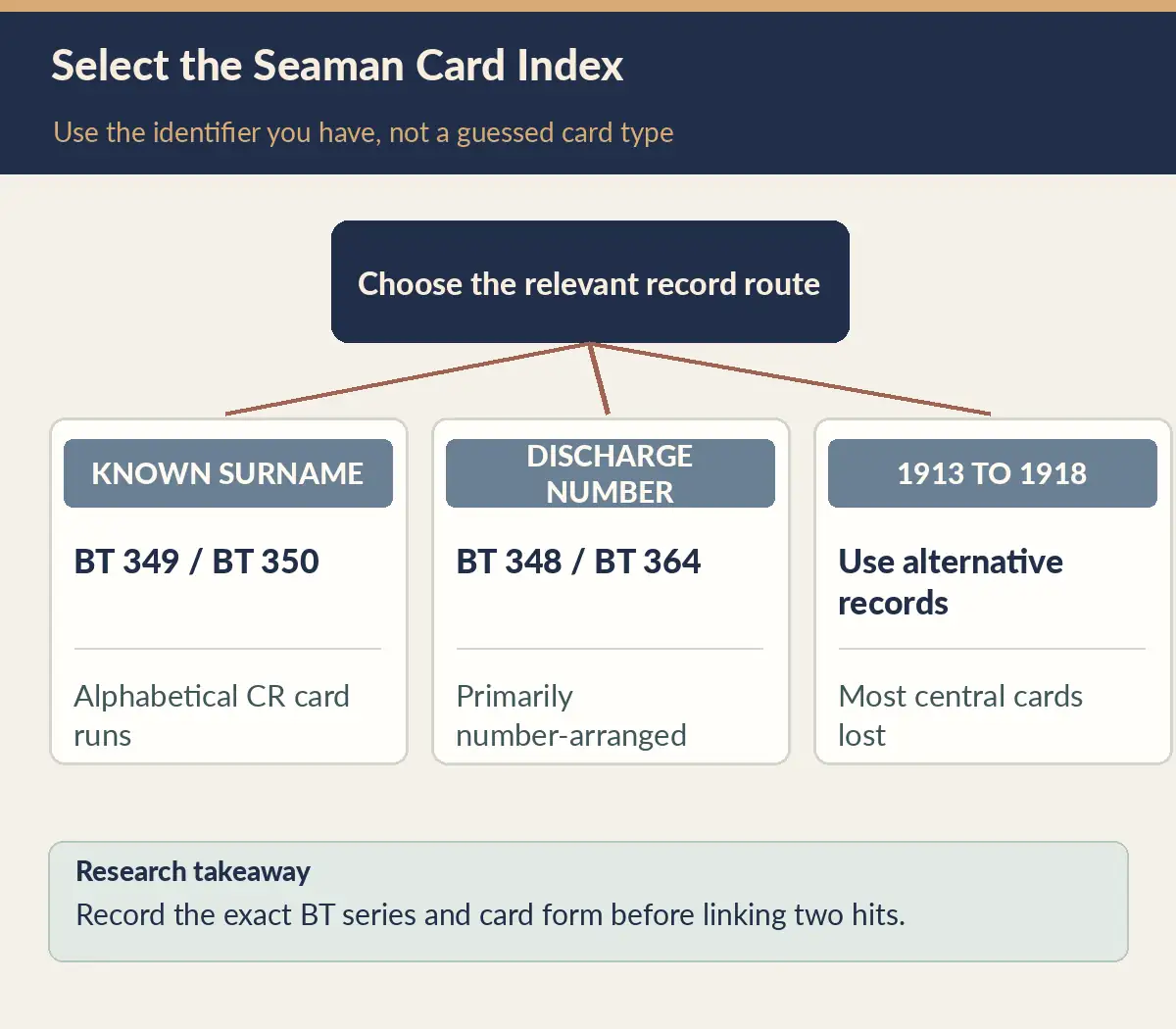
For a British merchant seaman active from late 1918 to 1941, search the Fourth Register’s CR cards using the named person and any discharge “A” number. The National Archives identifies BT 348, 349, 350 and 364; the earlier 1913–1918 central entries do not survive in the expected form.
Start With the Time Gap, Not a Card Search
The central seamen register restarted in 1913, but its cards for 1913 through 1917 and almost all of 1918 were destroyed. What can be found in the Fourth Register principally begins with the last two months of 1918 and continues to 1941.
A marine worker whose only known voyage was in 1916 is not a reasonable expected hit in this register. Use the First World War seamen guidance to route that question instead to surviving crew agreements, medal material, or other suitable sources. Place the voyage year in your log before selecting an alphabetical database.
Know Which BT Series Uses Which Key
The Fourth Register is not a single alphabetical ledger. BT 349 and BT 350 are generally alphabetical card sequences, while BT 348 and BT 364 are primarily arranged by discharge-book numbers. The official BT series guide names CR 2 as a numerical register and CR 10 as an alphabetical form.
Note the exact BT series on every hit, then preserve the card identification and discharge number rather than transcribing only a surname. A number can lead between card types, but an absence in one index does not establish absence from the others. Never infer a shared family name from similar discharge-book numbers.
Treat CR 1, CR 2 and CR 10 as Different Documents
The cards were maintained for different administrative tasks and can carry different identifiers, dates and ship information. What is legible varies by card design, date and later annotation. Record whether an image is CR 1, CR 2 or CR 10; capture front and reverse where available.
Copy all identifiers exactly, including prefixes and overwritten letters. A date on an entry may reflect a signing-on or voyage event rather than departure from the occupation forever. Index summaries can suppress the distinguishing card type and make two administrative records look like duplicates. The safest result is a linked card set, not an overconfident one-line biography.
Use Ship Numbers to Build a Second Search Route
A ship may be identified by name, an official number or a number referenced on the seaman’s card. The official number is useful when ships share a name or a vessel is renamed. Look up that vessel separately and compare the documented service period with the card’s chronology.
The National Archives suggests the Crew List Index Project as a way to identify ships by name, port of registration and official number. An individual’s appearance in an index associated with a vessel supports a specific administrative record, not necessarily every voyage listed in a modern ship history. Keep ship data and personal biographical data in distinct columns.
Understand Southampton Originals and Paid Search Access
The archive’s guide states that originals of the Fourth Register cards are held by Southampton Archives; searchable digitized copies are offered through Findmypast on a paid basis. Catalogue descriptions at The National Archives are useful for understanding the BT series, but they are not a guarantee that every personal card is directly viewable on that site.
Note the access platform and what you actually consulted. If you have only an indexed name and date, say so and avoid citing fields not inspected. Do not invent free access, and do not confuse a transcription licence with permission to republish an original archive photograph.

Separate the 1941 Transition From Earlier Cards
For service continuing after 1941, The National Archives directs researchers toward the Fifth Register, 1941–1972, and related seamen’s pouches rather than assuming that BT 348–350 describe all later events. Pouches may contain supporting applications and are not equivalent to an exhaustive chronological log.
A sailor active both before and after the transition may have entries in more than one system. Always check whether the question concerns joining one ship, the duration of a career or proof of nationality; different records are needed. Full details for seamen born less than 100 years ago may be restricted, so avoid treating limited access as evidence of nonservice.
Deal With Unissued Discharge Numbers
Temporary workers and apprentices were not always issued a discharge “A” number or seaman identity card. The existence of a numerical arrangement therefore does not mean every possible sailor can be reached by a number. If a family letter mentions merchant shipping but supplies no discharge book, use names with variants, birthplace or approximate age, and trace known ships and crew lists.
Record the coverage reason for each search. A partial alphabetical run or a missing number is not proof that the person never worked afloat. Do not fill a blank identifier from a different seaman merely because names and ports resemble one another.
Test a Two-Seaman Match With Independent Evidence
Imagine two men named William Davies on coastal and overseas vessels in the 1930s. One card has a later date of birth and a different discharge number. A family photo shows a man beside a freighter but does not record the card ID.
Keep each candidate separate, compare spouse and birthplace from independent civil records, then look for a ship-related document connecting the photograph’s approximate date with the card. Nothing about a common surname or nearby home port establishes a family link. The two candidates here are fictional and illustrate how to reject an attractive but unsupported identification.

How We Research Fourth Register Cards
We first check whether a target falls after the late-1918 survival boundary, then distinguish name-arranged and discharge-number-arranged card series. We record the exact BT reference and original card type, seek the reverse and cross-check the ship identifier and dated voyage evidence.
We separate occupation from citizenship, birthplace and family relationships, and follow the post-1941 record system only when the chronology requires it. Read the affiliate disclosure before choosing an external paid provider. We never claim a negative result is conclusive when card coverage, identification or access are uncertain.
More Records and Archives Guides
Preserve the Full Card Citation
A precise source citation states the Fourth Register of Seamen, actual BT series (348, 349, 350 or 364), card or image identifier, person as inscribed, and the repository or digital image provider used. Include the date accessed and specify whether a card image, a transcript or a catalogue entry was read.
Pair it with a ship’s official number only when that field is truly visible and its identity separately checked. Where several cards apparently concern one sailor, list them individually and explain the linkage. Keeping the complete reference allows someone else to recover the entry without guessing a spelling or discharge-book number.
No. Most 1913–1918 register entries were destroyed; surviving coverage principally begins late in 1918.
BT 348 is principally number-arranged CR 2 material, whereas BT 350 is an alphabetical CR 10 sequence.
No. The archive identifies paid partner access for digitized cards and Southampton custody of the originals.
No. Merchant service on a British-registered vessel does not require British nationality.
Check Fifth Register and pouch sources for the later period; do not assume the earlier cards form a full career history.