
Start with the Correct Seaman Register, Not a Ship Guess
To find a British merchant sailor active between 1835 and 1857, begin with the person-oriented registers described by The National Archives. A name search may return several entries because the record system changed repeatedly. Identify the period, series, index reference and actual register page before treating a hit as your ancestor. A sailor’s occupation in a census is useful supporting evidence, but it does not select the right merchant-seaman register by itself.
The four principal original-register series are BT 120 for 1835–1836, BT 112 for 1835–1844, BT 113 for 1845–1854, and BT 116 for 1853–1857. Their dates overlap, so a person might be documented more than once. The National Archives directs researchers to digitized records at Findmypast, which normally involves a charge; its guide explains the series without promising free access to every image.
Use the Year-to-Series Crosswalk Before Searching
For an 1836 sailor, check both BT 120 and BT 112 rather than assuming one replaces the other. For 1842, consult BT 112 and its associated name index, BT 119. During 1845–1854 the registration-ticket system is in BT 113, with surnames indexed in BT 114. During 1853–1857 a separate series, BT 116, can be relevant. Record the exact years a person is actually documented, not just the printed collection range.
Start with a broad surname, then add birthplace, likely birth decade and occupation or vessel clues. An index entry is a pointer; the original must be examined for an accurate spelling, service details and the reference that lets another researcher retrieve it. If an index gives a ticket number, carry it through to its corresponding register rather than quoting the number as if it were a voyage record.

Read Tickets, Voyage Abbreviations and Ships Carefully
Names and birthplaces are often more reliable identity tests than a single ship name. Registers can include age, date of birth, a rank or job, vessels and departure details, but the exact fields depend on the series. BT 113 may record physical appearance; BT 116 can name ports and dates without the same rank information. Preserve blank fields as blank instead of treating them as statements that a sailor never travelled or held a particular post.
The archives warn that home-trade entries may summarize a half-year rather than one voyage; foreign-trade entries can describe a journey spanning more than one calendar year. A departure and arrival pair therefore needs interpreting in context. Copy the ship name as written, the dates and the whole register reference, then test whether a ship with that name was active at the relevant time.
Understand the Important Record Gaps and Exceptions
The 1845–1854 ticket index contains numbers beyond 546,000 that do not appear in the surviving BT 113 registers. The national guide also cautions that reported voyages seem absent in that ticket series for 1849, 1850 and 1854. Neither situation establishes that the named sailor was unemployed. It identifies a limitation in surviving material or how a particular register was kept.
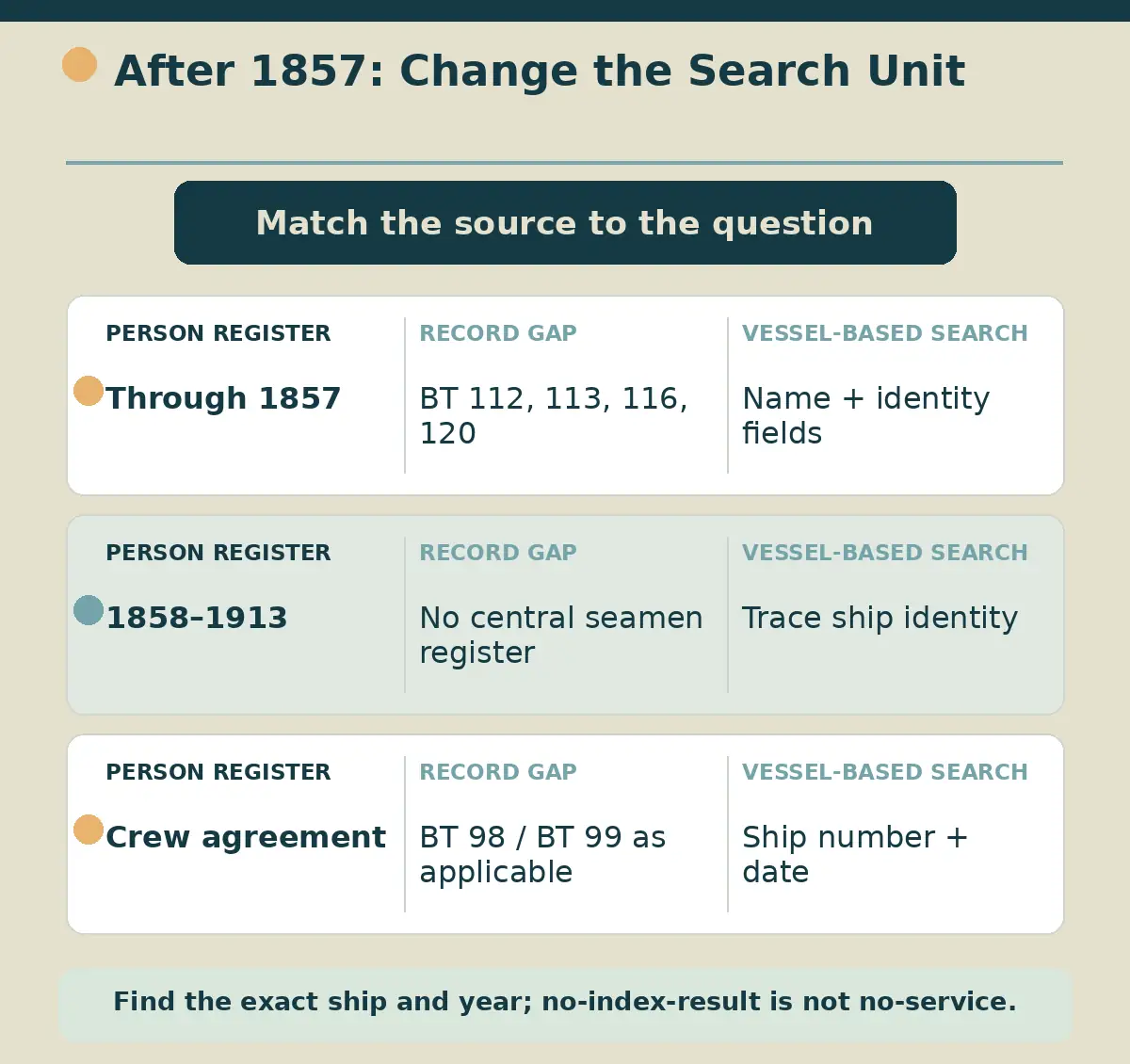
The largest trap comes after 1857: there was no continuous central register of individual merchant seamen between 1858 and the First World War. Do not infer a sailor died or emigrated because an online person-name result ends in 1857. Change the research question from “which personal register?” to “on which ship did this person serve?” and locate that vessel’s agreements and crew lists.

Use the Ship-Based Route for Missing Years
For 1835–1860 The National Archives points to BT 98 agreements and crew lists. Early items were arranged by port of registry and vessel name; from 1857 the official ship number becomes essential. The separate guidance for 1861–1938 describes a sample of crew lists in BT 99, and relevant holdings can also be at other archives. Search a ship name, registered port and official number using ship registers or the Crew List Index Project where applicable.
A ship named on a register entry is a lead rather than permanent proof of employment for every voyage. Compare the original crew list for the particular date. Ask whether the sailor is actually named, whether the birthplace and age fit, whether joining and discharge dates agree, and whether the ship’s identity can be independently fixed. Record unsuccessful ship searches with the exact archive scope.
Build a Namesake-Resistant Maritime Identity Test
Make two separate candidate rows when you see two seamen with the same surname. Give each row an exact BT reference, birthplace, estimated year of birth, service dates and ship names. Then add the census household, marriage or parish evidence that supports the proposed identification. A common sailor name in a single result is weak support; several mutually consistent details across independent records are stronger.
A reported address or destination on a voyage paper is evidence of what was written about a sailor, not proof he lived there indefinitely. An unfamiliar abbreviation may be an administrative mark, not a life event. For a conflict, keep the competing interpretations visible and seek a later ship record or civil entry before deciding who the sailor was.
More Records and Archives Guides
How We Research a British Merchant Seaman Record
Our method starts with the official BT-series chronology, then checks the named person in the correct original register rather than stopping at a commercial index. We transcribe the title of the series, piece, page or image locator, reported identity fields, ships and any uncertainty about handwriting. We keep the registration period separate from the span of maritime employment, especially at the 1857 changeover.
Only then do we test the proposed link to a household or family line. A source citation should distinguish The National Archives’ original register from the service website displaying a digital copy. The record route is reproducible only when someone else can use that citation to open the same page. Our affiliate disclosure explains site-level policies; this article does not assume any booking, download or subscription partnership.
No. BT 120 and BT 112 cover early years; BT 113 is the ticket series from 1845, while BT 116 covers 1853–1857.
BT 114 is an alphabetical surname index to seamen’s tickets recorded in BT 113. Follow any referenced number to the underlying record.
No. The official guide notes missing reported voyage information for 1849, 1850 and 1854 in BT 113.
Identify his ship and search crew agreements or lists, using the official vessel number and the appropriate archive holdings.
No. Compare birthplace, age, service dates and independent parish or civil records before accepting a match.