
Ask Whether You Need Employment or a Rescue
The National Archives identifies articles of engagement for surfmen, 1878–1914, within the records of the U.S. Life-Saving Service in Record Group 26. That statement is a strong starting point for identifying someone who served at a coastal station. It is not a guarantee that an article records the rescues in which the individual participated. Before searching, decide whether the family question concerns employment, transfer between stations, injury, an award, or a particular wreck. Each claim calls for a different source.
Make a one-line research question containing a person, an approximate year, a coastline or station, and the claim to be tested. Retain the original spelling of a surname and note later variants separately. A newspaper may call someone a “lifesaver” without distinguishing a paid surfman from a volunteer or a person who assisted during a single emergency. Record the wording exactly; treat the occupational label as a hypothesis until a contemporary service document clarifies the role.
Use 1878–1914 as a Record-Type Boundary
NARA section 26.4.4 dates the surfmen articles of engagement to 1878–1914. This range describes the cited records, not the entire history of coastal rescue work. The Life-Saving Service merged with the Revenue Cutter Service to form the Coast Guard in 1915. Consequently, the job title and the federal creating office matter as much as the date. An alleged station appointment in 1922 should not be forced into an article series whose described endpoint is 1914.
The guide also identifies employee registers dating 1866–1913, application files from 1878–1897, and registers or lists of station keepers from 1852–1878. Those may be alternative leads, not sequential stages that every surfman necessarily completed. Decide whether the person was said to be a keeper, surfman, or other employee. If the source uses a different designation, preserve that designation rather than silently harmonizing early records with later Coast Guard terminology.

Match the Station Before Matching a Name
Station names and district assignments are practical search keys. Record the historic station name, state, nearby harbor, and district if a contemporary source supplies them. NARA describes regional holdings of life-saving station logbooks covering 1873–1941, with particular sets held in different archival locations. A state alone may point to several repositories, so avoid treating a broad Catalog search for a common surname as an exhaustive search of all station records.
When a photograph shows a crew beside a station, look for a legible building name, beach geography, boat markings, or a dated caption. Those details help narrow the station, but a similar-looking building is not a secure identification. Compare a dated photograph with a station log or official district reference only where the original pages permit. Keep a separate column for visual clues whose connection to a specific station remains tentative.
Read What an Engagement Actually States
Obtain the article or register page rather than depending on a family transcription. Copy the exact name, date, term, station, signatures, and any pay or role notations that are actually visible. The NARA guide confirms the series name but does not publish a standard page template; do not assert that every article contains age, next of kin, residence, or an entire career history. If a column is blank or illegible, say so instead of reconstructing it from later biographies.
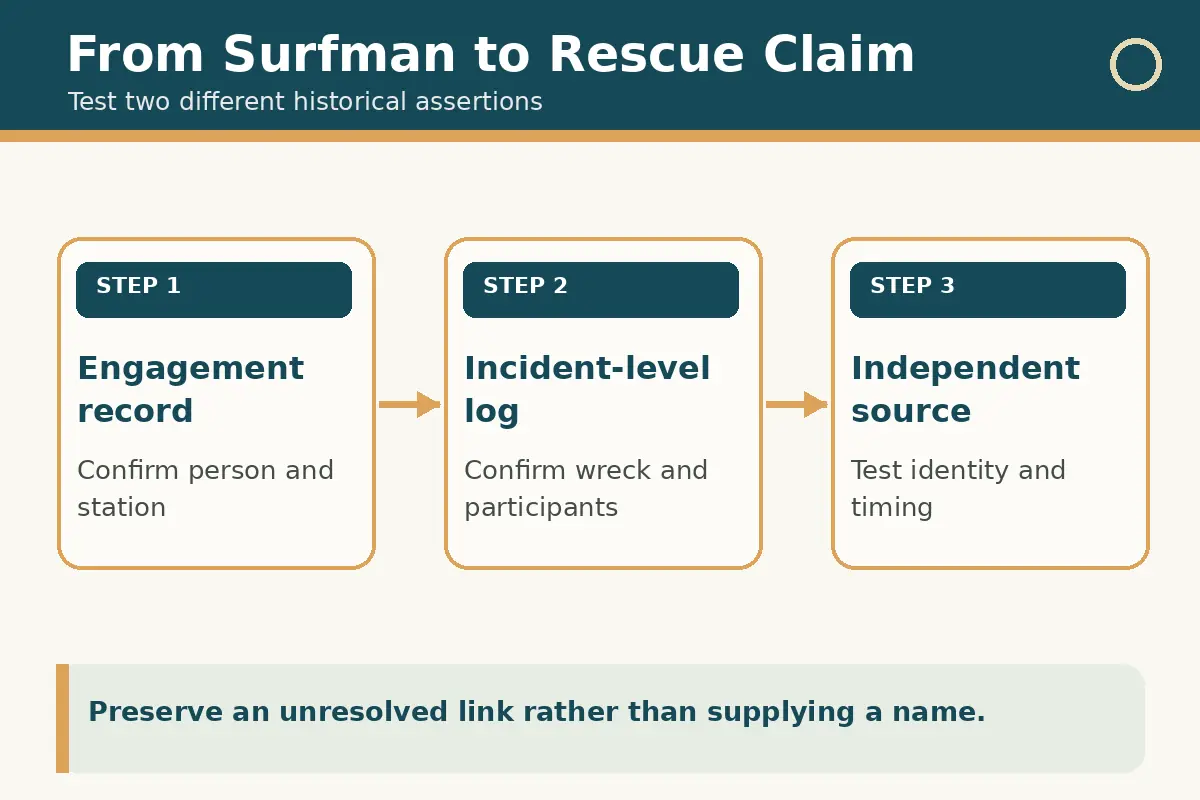
A signed engagement can support an employment transaction or agreed term when the page and context demonstrate it. It does not by itself show whether the individual appeared for every watch, took part in a specific wreck response, or remained employed without interruption. A discharge, later re-engagement, payroll, or dated log may establish further parts of the timeline. Keep the source statement and your inference in different fields of the research notes.

Use Rescue Logs and Awards as Independent Tests
The RG 26 guide separately describes station logbooks, correspondence on lifesaving medals from 1894–1924, and records of medals awarded from 1876–1944. These answer different questions. A station log may describe daily activity or a rescue; an awards record addresses recognition. Neither should be assumed to include every person who participated in a rescue. A medal nomination does not guarantee a medal was issued, and a crew roster does not prove the individual entered the surf during one event.
For a claimed rescue, build an incident key: vessel name if known, wreck date, location, station, and source of the claim. Search a narrow date interval in the appropriate logs and compare contemporary newspapers or reports cautiously. Vessel names could be misspelled and dates may differ between a nighttime incident and the next-day report. Document the exact divergence instead of changing one source to agree with another. This is especially important when a family story attributes a medal to the wrong relative.
Build a Person-and-Incident Evidence Ledger
Create two linked tables. In the personnel table record name, role, station, engagement date, document series, and archive citation. In the incident table record a specific wreck or rescue date, vessel, station, people explicitly named, and a link to each original page. A shared station name is not enough to join the tables automatically; the dates, actual wording, and distinct identities must be tested. Record each same-name candidate separately before combining careers.
A negative search needs a precise scope. “No entry found in station logs for the first week of October 1903” is reproducible; “he never helped rescue anyone” is not. Loss, incomplete coverage, a neighboring station, and variant names can explain missing evidence. If the event was reported in a newspaper, preserve that article as a separate source rather than replacing the absent federal entry with an unqualified assertion that the wreck occurred exactly as remembered.
Locate the Surviving Record and Request It
Start with NARA RG 26 sections 26.4.1 and 26.4.4, then use the Catalog search guidance to look for “surfmen,” “articles of engagement,” a station, and the relevant district. Search for the creating service, not just the modern Coast Guard. The guide provides group-level descriptions and regional clues; it does not mean every original volume is online or searchable by surname.
When requesting help, provide a short packet: known spelling variants, likely station and years, the exact RG 26 series terminology, and the source of your place clue. Ask for arrangement details, available indexes, preservation gaps, current repository, and copying arrangements. Do not quote an obsolete office location as a guarantee of current retrieval. Include folder, volume, page, and image identifiers when eventually citing the original.
More Records and Archives Guides
How We Research Surfman Service Claims
This guide separates the 1878–1914 engagement series from logbooks and awards because NARA identifies them separately. We check the institutional change in 1915 and avoid equating a person’s contract with an event they may never have attended. The safest conclusion begins with an exact transcription, a dated source citation, and a narrowly stated personnel claim. Incident claims remain open until incident-level evidence is examined.
Keep all original images and a dated search log alongside your narrative, especially where two surfmen share a surname. Our affiliate disclosure describes editorial relationships; no commercial link is needed to access the archival steps here. If your research cannot establish a rescue, say which station records and incident dates were searched, then preserve the unresolved question without inventing a heroic biography.
The NARA RG 26 guide identifies articles of engagement for surfmen from 1878 through 1914; it is a series date range, not a guarantee of complete coverage.
No. It may support employment, while a dated station log, incident record, or another independent source must test participation in a particular rescue.
Not as the only route. The described articles end in 1914 and the Coast Guard was formed in 1915; search the creating office and the later record type.
No. Correspondence and medal records concern recognition and are not automatically complete crew or rescue participation lists.
Use a dated residence, employment reference, photograph caption, or coastal newspaper first to narrow the historic station and district.