
Identify the 1930s Visit You Are Trying to Prove
If a family photo says “Scotts Bluff, 1938,” begin with the date and the monument, not an assumption about an Oregon Trail ancestor. The National Archives lists visitor registers for Scotts Bluff National Monument for 1936–1940 in Record Group 79. These are records of visits in the twentieth century. Even a clear signature cannot turn that person into an emigrant who passed the bluff during the nineteenth-century overland migration.
Record what is known separately: caption on the photograph, approximate season, traveling companions, vehicle or postcard, and any visitor-book signature recalled by relatives. A caption added years after a trip is a family claim to test; the visitor register, if found, is an independent kind of source. A single dated name in a visitor book may help establish presence, but it does not automatically identify the entire travel party.
Use the NARA 79.8.11 Dates as a Search Gate
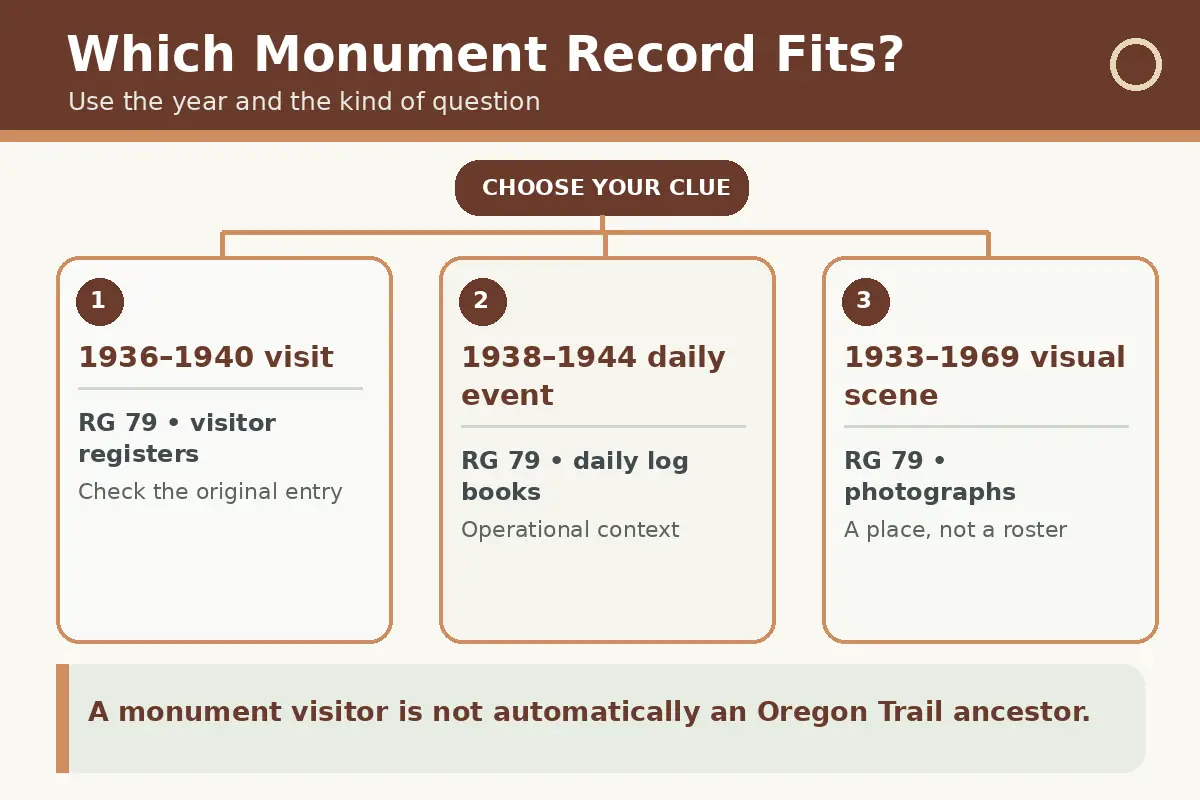
The NARA Guide to Record Group 79 specifies Scotts Bluff visitor registers, 1936–40, and daily log books, 1938–44. That gives two different starting points. A proposed 1937 visit belongs in the published visitor-register span, but outside the daily-log span. A claimed 1942 visit can be investigated using daily logs, yet the published register description alone does not promise a visitor signature for that year.
Do not stretch inclusive dates into a day-by-day survival guarantee. A guide may name a set of books without describing missing pages, closed volumes, indexing, or individual signatures. Before concluding that a person did not visit, ask for the actual register arrangement and whether volumes survive for the precise month. If only a year is known, use a dated itinerary or postcard cancellation to make the request more specific.
Tell the Visitor Book From the Daily Log
A visitor register and a monument daily log are different genres of record. The register may be the best place to look for visitors’ written names, if the volumes include signatures. A daily log is primarily an operational record; it may describe weather, staffing, work, events, or unusual activity, depending on the original book. NARA’s guide does not publish the exact columns of either series, so verify the pages before claiming they contain any particular field.
If the monument hosted a public event on the date of a family photo, a daily log might contextualize the scene even if it cannot name every attendee. Conversely, a name in a visitor book is not necessarily proof of attendance at a specific event. Keep the page citation and the document’s wording visible beside your interpretation. Do not silently transform “visit recorded” into “participated in a ceremony.”
Match a Signature Without Forcing an Identity
Compare the complete signature, handwriting context, date, residence if the register actually provides one, and neighboring entries that might identify traveling companions. Do not assume every visitor wrote a home address; that is a page-level fact requiring direct inspection. Similar surnames in a visitor book are especially weak evidence when they occur in a tourist destination with visitors from many places.
Check the possible visitor against a contemporary census household, a 1930s city directory, a trip diary, a dated postcard, or a road map annotated by the family. Note whether each independent source was written at the time or recalled decades later. When two plausible people share a name, retain both hypotheses until an age, address, companion, or independently dated itinerary resolves them.

Use Photographs as Context, Not Name Lists
The NARA guide also describes thousands of photographs of monument development and activities, dated approximately 1933–1969. It mentions construction, special events, CCC activity, and historical representations. These records can help establish the appearance of the monument and identify a photographed feature, but they are not a universal roster of people who visited Scotts Bluff.
A photograph of the ridge taken near the claimed trip date can test a family picture’s setting. Compare the angle of the bluff, signs, paths, buildings, and visible work. Those comparisons can strengthen a location attribution but rarely identify an unknown person by themselves. Keep photo captions, archival identifiers, and later annotations separate, especially where a historic scene was deliberately staged or represented in a monument display.
Respect the Difference Between Trail History and Tourism
Scotts Bluff is associated with overland migration, and family stories often jump from a twentieth-century stop to a nineteenth-century ancestor. The records are not interchangeable. A 1938 visitor could have gone to learn about an ancestor, yet a visitor register does not establish that the ancestor passed through the same place. To research an overland emigrant, seek contemporaneous migration diaries, wagon-train accounts, land records, or other period-specific evidence.
Date every claim in a timeline. Place nineteenth-century events in one column and twentieth-century commemorative travel in another. A photo of a descendant at a historic site may document family memory and historical interest, both valuable facts. It does not independently validate the event being remembered. This distinction is particularly important when a family caption describes someone as “returning to the ancestral trail.”

Request the Register From the Holding Repository
Start with NARA RG 79, section 79.8.11. The guide locates Scotts Bluff textual records in Kansas City, so record that custody statement when preparing the inquiry. Search the National Archives Catalog by monument name and series title, not just the ancestor’s surname. A catalog listing may describe a volume without a transcript of all its signatures.
Give the requested date range, variant family names, and the specific kind of item you need: visitor register versus daily log. Ask whether the page can be checked or reproduced and how to cite it. If the archive cannot search names for you, request the finding aid or available access procedure rather than treating the absence of a staff lookup as a missing historical visit.
Prepare a Reusable Family-History Citation
A sound citation identifies the original volume title, dates, page or folio where available, Record Group 79, repository, and the date of access or reproduction. Transcribe the entry exactly, including spelling and abbreviations. If an image was supplied by a relative, note whether it is a photograph of the register, a later transcription, or an unrelated keepsake with the name written on it.
The final claim should be proportionate: “a person signing this name appears in a 1938 Scotts Bluff visitor register” is not identical to “our grandfather visited in 1938.” The latter needs an identity bridge. Where the register proves only a name and date, record that conclusion honestly and list the next independent source that could connect the entry to the family.
More Family Story and Preservation Guides
How We Research Monument Visitor Records
We take the date spans and record types directly from NARA’s Scotts Bluff description, keep visitor registers separate from administrative logs and photographic holdings, and use catalog guidance to locate an original rather than treating a search result as an image of the page. We do not assume every volume survives, every signature is indexed, or every namesake is the right relative.
The family evidence and historical interpretation remain separate in our notes. See the affiliate disclosure for site-wide transparency. Preserve the entry’s context so another researcher can review the identification without relying solely on your family narrative.
No. The RG 79 registers described by NARA cover visitors in 1936–1940, not emigrants traveling the trail in the nineteenth century.
The described register series ends in 1940. Daily logs extend through 1944, but they do not necessarily list ordinary visitors.
Not by itself. Connect the entry to independent period evidence such as a travel diary, address, companion, or dated postcard.
NARA’s Record Group 79 guide, section 79.8.11, identifies the visitor registers and states that textual records are held in Kansas City.
Not necessarily. A series or volume can have an archival description without item-level names or digitized pages.