
Start With What Was Assayed, Not a Miner’s Biography
The Philadelphia Mint’s nineteenth-century records in RG 104 contain assays, bullion-deposit books, coinage accounts and correspondence. These are operational records of metal, money and government work. A named bullion depositor may be an agent, merchant, broker or other person with an interest in a transaction, but the name alone cannot prove that individual dug the gold or owned a particular mine. Begin with the document’s exact transaction date, quantity, metal, name or account number, and the particular Mint office that produced the record.
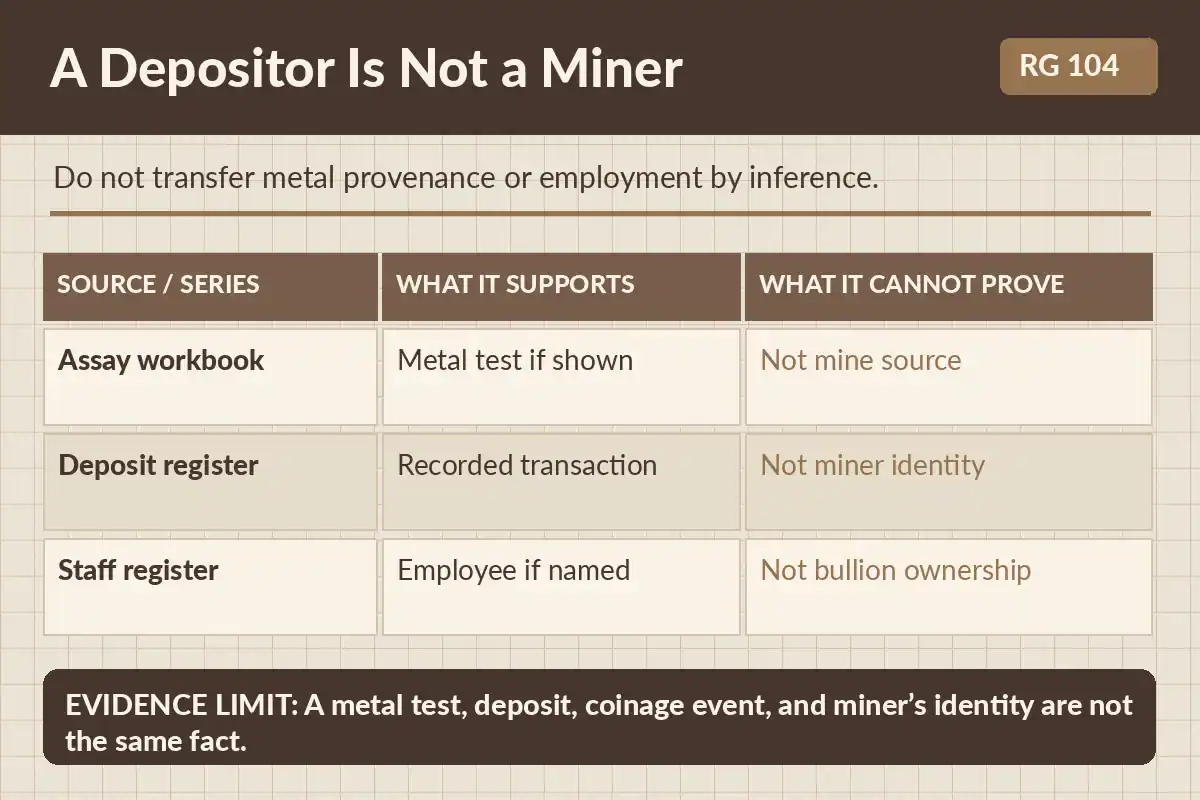
An assay measures properties of metal; a deposit is a transaction; a coinage book follows a separate stage of manufacturing or accounting. A family story that a gold-rush ancestor “took his gold to the Mint” can refer to any of these events, and not necessarily to an original mining discovery. Distinguish a stated depositor from the alleged source of the ore or bullion. If the entry contains an agent’s name, record the relationship as written instead of assigning agency or family ties to a convenient surname.
Choose Assay Workbooks, Registers, or Deposit Books
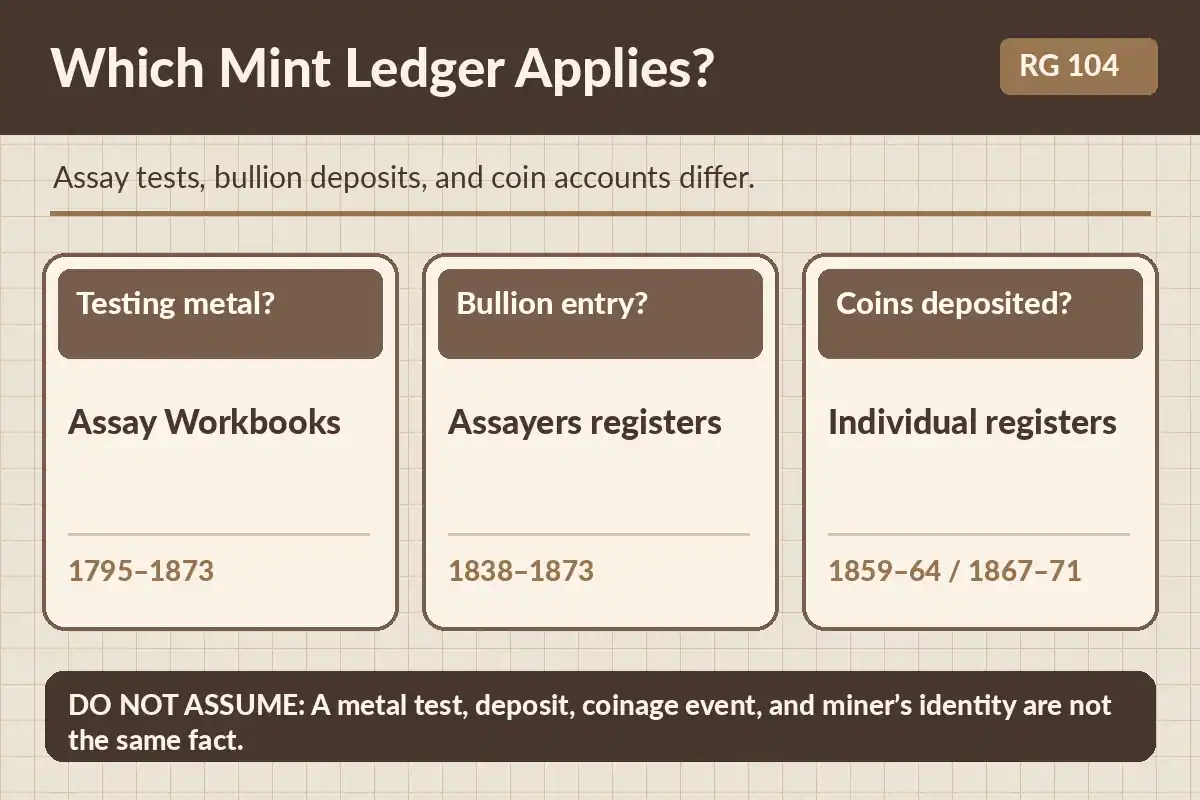
NARA section 104.2.3 lists Assay Workbooks for 1795–1873, assayers’ registers of gold and silver deposits and bullion for 1838–1873, and a separate record of gold assay slips for 1854–1873. Section 104.2.2 describes registers of coins deposited by individuals and firms during 1859–1864 and 1867–1871. These are not interchangeable sources; one concerns an assay, another metal received, and another coin deposits. If you know only the account date and a claimed substance, begin with the record type most closely matching the original wording.
Section 104.2.4 also identifies registers of gold and silver deposits and purchases for 1794–1873, plus refining, melting, weighing and bullion-fund accounts. A transaction may leave traces in more than one book, but there is no guarantee that every step can be joined by a stable number. Record column headings and annotations before pairing entries. Two people of the same surname in nearby volumes may be unrelated, and a repeated number may be a batch or ledger sequence rather than a personal identifier.
Understand the Place and Institutional Boundary
The Mint of the United States was established in Philadelphia in 1792. The Coinage Act described separate offices including an assayer, chief coiner and treasurer. The later Bureau of the Mint dates from 1873, and NARA separates early central Mint holdings from Philadelphia branch-mint records covering later operations. A person who transacted at an assay office elsewhere is not automatically present in the Philadelphia books. Start with the exact city or office in your family source before using a record-group overview as an index.
The U.S. Mint’s historical account also explains that some branch facilities initially served as assay offices rather than producing coins; Denver opened as an assay office in 1863. This illustrates why “sent gold to the Mint” is too vague for reliable genealogical inference. State whether the evidence refers to a deposit, test, purchase, melting process, bar or coin delivery. Do not assume a contemporary commemorative piece or later coin’s mintmark traces a specific nineteenth-century family transaction.
Read Weights and Values in Their Original Units
An assay register may use technical columns for weight, fineness, value or settlement that require the volume’s key. Copy units precisely and verify whether a total applies to crude metal, refined bullion, or an account balance. Do not convert historic ounces, dollars or percentages using a modern spot price and then present the result as contemporary earnings. The economic meaning of the entry belongs to its date, legal standards and payment conventions. Where abbreviations are ambiguous, inspect adjacent pages and instructions rather than inventing an interpretation.
A recorded amount may reflect a gross delivery, a net credit after adjustments, or an internal transfer, depending on the ledger. Without the heading, the apparent amount could be misleading. Do not infer that a depositor possessed that quantity in a private home or owned a mine of equivalent yield. A miner might have sold metal to an intermediary before it reached the Mint. Test a claim about mining with mining-location records, local taxes, partnership agreements, newspaper accounts or another independent document about extraction.
Separate a Depositor From a Named Mint Employee
RG 104 also describes administrative personnel records, including employee registers for 1849–1873 and some compensation material. Those may be useful when the actual claim is that an ancestor worked at the Philadelphia Mint. A depositor’s name on a bullion entry is not a payroll entry, and a Mint clerk’s name in correspondence may signify official processing rather than ownership of the metal. Choose the personnel route only if your source concerns an appointment, job, daily work or wages, not simply receipt of bullion.
If a family claims a relative was an assayer, compare that position with dated staff registers, appointments or letters; do not infer employment because the person appears near an “assayer” heading. NARA points to certain mint-officer personnel records in RG 56. That is a related but distinct path. Dates, job titles, and city are essential to separate workers who changed offices and investors who deposited metals. Document the role in every citation rather than using “Mint man” as a catch-all description.
Request and Cite the Ledger Behind the Claim
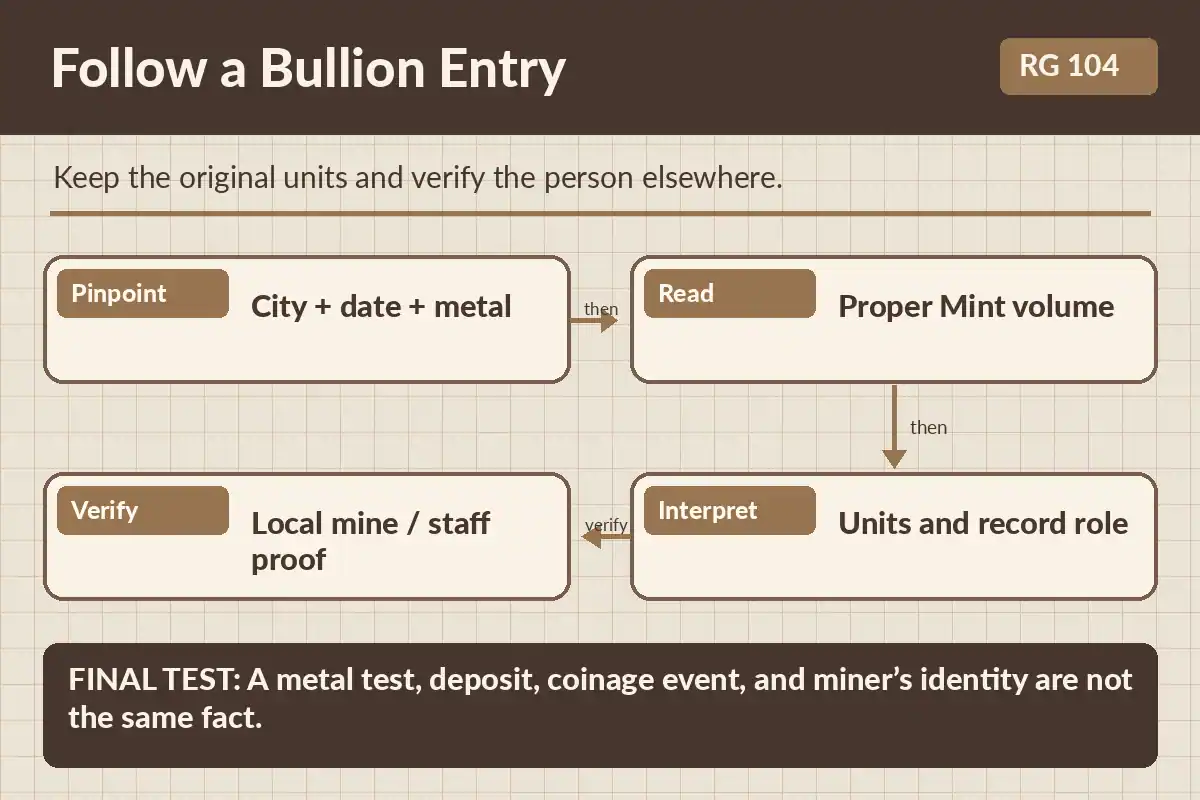
Ask NARA for RG 104, the Mint of the United States at Philadelphia, and the specific 1795–1873 assay or 1838–1873 assayers’ register, narrowed by the year and any account details. If the family paper names a different assay office, search the relevant branch or assay-office subgroup instead. Inquire about surviving indexes, volume arrangements and actual access, rather than assuming the Guide provides searchable individual names. Where a photocopy shows only a row, request the page header and neighboring entries needed to interpret the unit.
Build a transaction table with the record’s date, office, person and role, metal, units, stated action and unresolved link. Add a later local mining document only if names, places and years line up. Label what the source explicitly says and what is inferred. An assay can establish that metal was examined, a deposit that a transaction occurred, and a payroll that an employee was paid. None alone produces a miner’s full biography or proves the location from which a bar of gold originally came.
More Records and Archives Guides
How We Research This Archival Question
We reviewed the official RG 104 archival series description and checked the date spans and record types in the source against every decision shown in the accompanying explanations. We also used a second institutional source for the historical or collection-specific distinction. These are descriptions of archival holdings and practices; they are not evidence that a particular person, building, design, or vessel was present. We did not infer complete series survival or universal digitization from a collection heading. The evidence table marks what remains to be verified in an individual record.
For the research and citation workflow, we checked NARA’s Catalog guidance, which distinguishes record groups, series, file units, and individual items. Researchers should use current Catalog entries and repository staff to confirm custody, availability, exact date coverage, and restrictions because the printed Guide to Federal Records is a historical overview rather than a constantly updated item inventory. All reader-facing images on this page are original explanatory illustrations, not scans of original archival objects. We have not confirmed any paid partner referral; the site’s affiliate disclosure states the general policy.
NARA lists Assay Workbooks for that period at the early Philadelphia Mint.
Yes. NARA expressly describes those registers and separates them from assay slips and coin deposit books.
No. Depositors may be intermediaries; independent mining evidence is required.
No. The U.S. Mint history notes that some offices, including early Denver, assayed metal rather than produced coins.
No. For employment use personnel registers, appointment papers, payroll and relevant RG 56 officer files.