
The National Archives guide for Record Group 104 lists letters of application and recommendation dated 1850–1853 among administrative records of the early Mint of the United States. These papers can offer a concrete starting point when a family account says someone sought work at the Philadelphia Mint. The word “application,” however, describes a request, not a decision. To establish employment, compare any letter you find with the separately identified employee registers and compensation material, and record disagreements rather than smoothing them away.
This is a source-by-source hiring investigation, not a single surname database. Section 104.2.5 also lists employee registers for 1849–1873, compensation records for 1851–1853 and additional periods, and related officer personnel documentation in RG 56. The guide confirms that these record classes exist but not that every applicant is named, every document survived, or every volume is digitized. A carefully written family account can describe an application even when no subsequent appointment is documented. The practical question is what each surviving record actually establishes.
Choose an Application, Register, or Pay Record
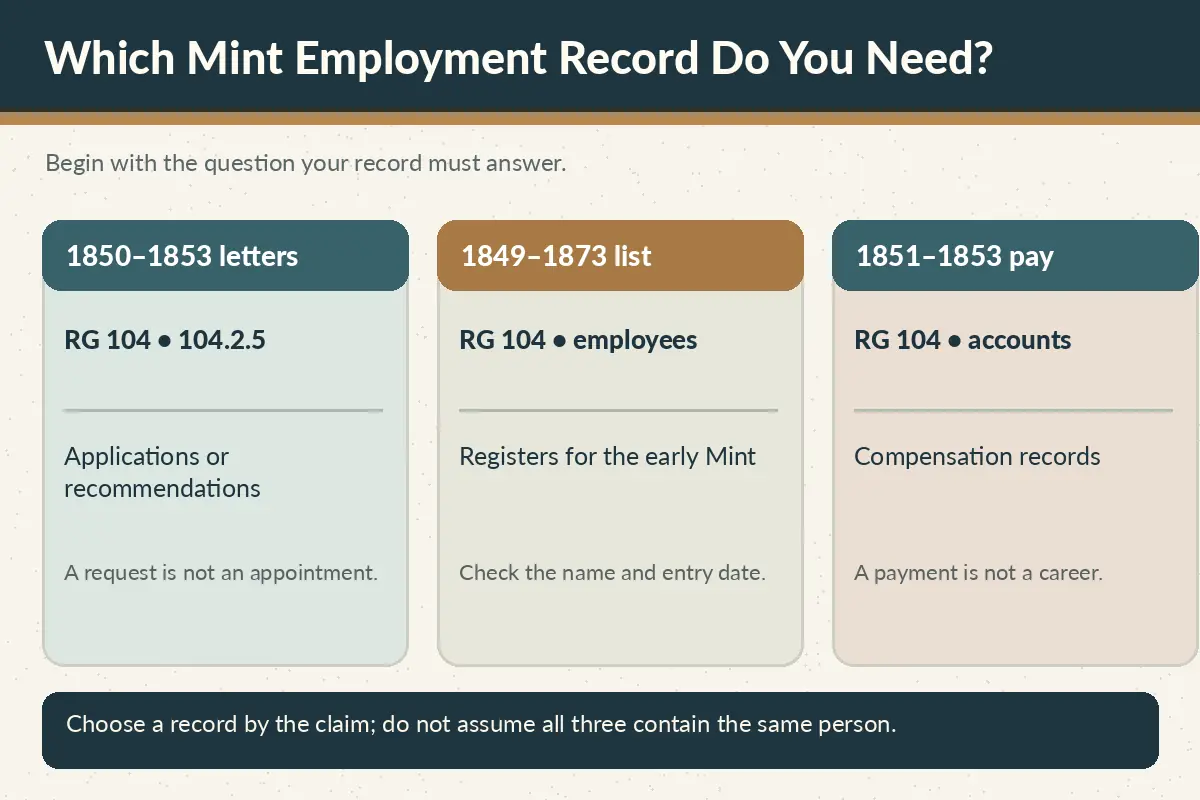
Begin by matching the family claim to a record type. “Applied for work in 1852” sends you to the application and recommendation letters of 1850–1853. “Worked at the Mint in 1852” calls for an employee register covering that period and potentially compensation records dated 1851–1853. “Held a senior federal mint office” may need additional officer papers in RG 56. These are not steps guaranteed to appear in one file; they are independent record classes, each with a different question. Write the proposed person, office, approximate date and claimed role before beginning the search.
Pay attention to the archival boundary at 1873. NARA separately describes Bureau of the Mint records after that reorganization, including later employee registers and applications. A person who applied in 1852 must not be sent to the 1879–1884 letters simply because both collections use the phrase “application.” Likewise, a later Philadelphia Mint employee register is not automatically the same register as one identified under the earlier institution. Compare creator, dates and custodial location with the document title before using a result as evidence.
Read the Letter Without Treating Praise as Fact

When an application or recommendation can be examined, establish who wrote it, to whom it was addressed, its date, any named position, and whether the writer claimed personal knowledge. A recommendation may emphasize character, political connections, technical skills or need for employment; such statements are evidence that someone made a claim, not independent proof of all the qualities mentioned. Transcribe handwriting carefully, preserve uncertain readings in brackets and distinguish an original signature from a later clerk’s endorsement if the page allows it.
Look at the reverse and nearby papers where possible. A filing notation, received date or referral may tell you how the Mint handled correspondence, but it may not represent a final hiring decision. Avoid inventing the existence of an approval stamp or standard form: the guide does not describe the layout of these letters. Record the exact words of any decision and its date. If the document only says “recommended,” write “recommended,” not “appointed” or “worked.” That restraint is especially important for relatives whose biographies contain inherited stories of government service.
Check Registers and Compensation Independently

Use the 1849–1873 employee registers to seek a name, but inspect the actual headings before assuming what a line means. A register might help with a role or period if those details are recorded; its scope, format and completeness require document-level review. Compare the applicant’s date with the register’s entries and note spelling variations. A common surname without a place, occupation, age or other distinguishing detail is not a secure identity match, particularly when families reused first names.
Compensation records dated 1851–1853 offer another potential check, not a universal roster or a substitute for an appointment order. If a payment is actually recorded, identify the account, pay period, payee and work description before inferring what service occurred. A payment may relate to a different transaction or a short period and does not automatically reconstruct an entire career. Keep negative findings qualified: absence in the inspected pages may reflect a gap, inconsistent indexing or an unidentified volume rather than proof that the applicant was rejected.
Use the Philadelphia Custody and Catalog Trail
NARA identifies the early personnel records as textual records in Philadelphia. Start with the record-group guide and then search the National Archives Catalog by phrase, creator, period and RG 104. Inspect whether the result is a series, file unit or item, and write down the identifier. A catalog description is often a map to holdings, not the page image or a searchable transcription. Try both the institutional title “Mint of the United States” and the specific personnel record type rather than searching only a family surname.
If nothing is digitized, use the official NARA copying instructions to plan a focused request: cite RG 104, section 104.2.5, “letters of application and recommendation,” 1850–1853, the name with spelling variants, and any exact catalog record. Ask whether an index or finding aid can lead to a folder and how to consult the Philadelphia holdings. Do not presume that online copying, a fixed fee or an employee-specific search service is available for these materials. Repository staff can advise on a verifiable location and access route.
Build a Defensible Employment Timeline
Make one row per document with fields for date, creator, cited wording, person identifier, action and unresolved issue. Place the 1850–1853 application beside any employee register entry and any compensation record without forcing them into a continuous story. Add an independent census, city directory, tax roll or contemporary family correspondence if it supplies a distinguishing address or occupation. Two names that look alike do not become one person simply because the records concern the same employer. Record a candidate identity and competing explanations until the evidence is stronger.
In a finished narrative, state the narrowest conclusion supported. “A letter dated 1852 recommended a person of this name for Mint work” is a valid finding if the page establishes it. “The ancestor was hired for life” would require different evidence. Cite the National Archives, RG 104, early Mint administrative records, the exact series and file details, and the leaf or image identifier used. Note whether you read the original, a reproduction or a transcription. This allows another researcher to retest the identity, employment dates and any uncertain handwriting.
More Records and Archives Guides
How We Research These Federal Holdings
Our starting authority is the National Archives RG guide, especially section 104.2.5, which supports the specific dates and record categories described above. We then use NARA’s Catalog instructions to distinguish record-group, series, file-unit and item descriptions, and consult its reproduction guidance if an item is not available online. The guide is an inventory, not a complete transcript, digitization guarantee, individual name index or certification of a family connection. Each statement about a named person needs independent support and a traceable document citation. The site’s affiliate disclosure explains our editorial and relationship policy; the public archive links here are not claimed as paid partnerships.
No. Recommendation, decision, an employee-register entry and compensation are distinct evidence types. Verify any actual appointment separately.
NARA identifies the record class but does not promise complete name indexing or online page images. Check the Catalog and an applicable finding aid.
The RG 104 guide also identifies employee registers, 1849–1873, and compensation material for 1851–1853, among other periods.
NARA points to related personnel papers concerning mint officers in Treasury Department RG 56. Not every employee held an officer position.
Give RG 104, section 104.2.5, applications and recommendations of 1850–1853, the known name, approximate date and any catalog reference.