
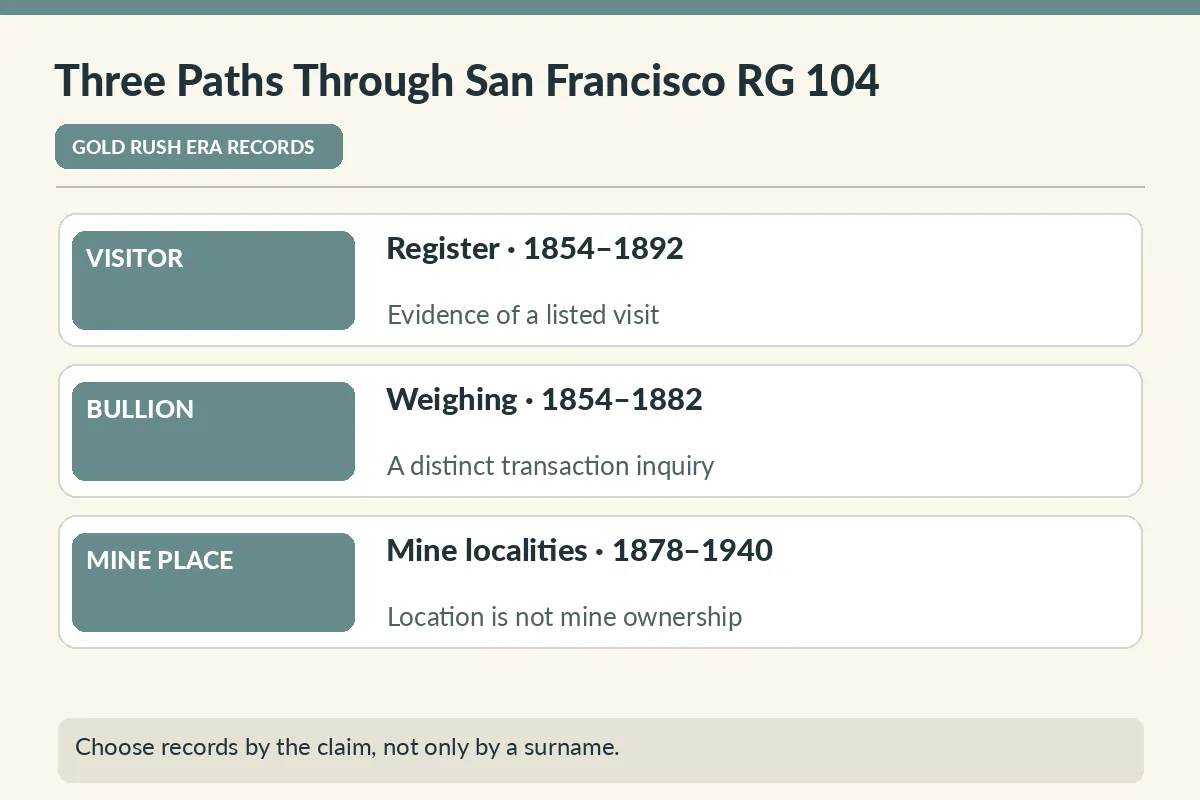
The San Francisco Mint kept visitor registers between 1854 and 1892, according to the National Archives’ Record Group 104 guide. A visitor’s name can be a compelling trace of a family member in a city shaped by gold, trade, and migration. It is nevertheless only a possible trace of a visit, dependent on the actual page and an identity match. It does not by itself prove that the person worked for the Mint, owned a mine, delivered gold, or took part in coin production. Those claims belong to different records.
For local historians the visitor book offers an unusually focused research question: who is documented as visiting a specific federal institution, on what date, and under which name? Before interpreting a signature, locate the volume, look for rules or captions on its pages, and compare other Mint series. A register may have dates, names, addresses, or notes—or fewer fields than hoped. Do not invent its form from the title. This guide treats a documented visit, a business transaction, and employment as separate hypotheses.
Identify the Exact Mint and Its Register Series
RG 104 covers the United States Mint across many cities and organizational changes, so a general search for “Mint records” can lead to Philadelphia, Carson City, Denver, or other facilities. The relevant entry is section 104.5.11 for the U.S. Mint and Assay Office in San Francisco. It explicitly lists visitor registers for 1854–1892 among local textual records held in San Francisco. Record the full unit title and archival location; do not substitute a general Bureau of the Mint correspondence series merely because it belongs to the same record group.
The guide’s overall date span describes surviving holdings, not guaranteed continuous pages for every day. Before counting a missing person as an absence, establish whether the available volumes include the precise year and what kinds of visitors were recorded. Check a cover, preface, index, or several adjacent entries when the book becomes accessible. The document might be organized by day, by arrival, or by another practice; only examination can establish the actual arrangement. Reproduce the page or folio reference and write down any uncertainty.
Read a Visit as a Visit, Not a Job
A visitor register is a record of entry or acknowledgment under the institution’s procedures, not a payroll. Even if a signature appears beside a plausible date, the safe conclusion is restricted to the inscription and any explicit identifying details. A name repeated in different years does not establish continuous residence or employment. Compare handwriting only with caution: a clerk may have entered names, rather than the visitors signing personally. Never describe a handwritten name as an autograph until that distinction has been inspected.
If a family story says a person was a coiner, assayer, guard, or clerk, the register can provide useful context but cannot prove the occupation. RG 104 contains separate personnel material in other parts of its guide, and San Francisco operational correspondence may mention employees; identifying the correct records requires a job and date-specific search. Consult city directories, federal census occupations, newspaper notices, and any actual appointment record to test a claimed role. A shared surname on a visitors’ page and a salary list could still represent different people.
Separate Bullion Deposits and Mine Locality Records
The same San Francisco RG 104 section describes assayers’ records about bullion receipts and shipments, weighing records for 1854–1882, fiscal and accounting records for 1854–1935, and records on the locality of producing mines for 1878–1940. These are substantially different evidentiary categories. A weighing entry may concern a particular material transaction; a locality record may identify a mine or producing district. Neither category proves that every visitor to the building deposited metal, owned a mine, or personally mined a claim.
NARA’s San Francisco reference paper also describes RG 104 holdings concerned with assays, coinage and gold or silver deposits. Use this overview to choose a document class, then ask the archive for the narrower series. When a surname appears in multiple financial records, match addresses, firm names, dates, and account references where present. Gold moved through merchants, banks and partnerships; a depositor’s business role is not automatically an individual miner’s work history. Distinguish the named party from the person who physically visited the Mint.

Reconstruct the Building Without Misdating a Photograph
The guide lists photographs of processes and facilities in the San Francisco Mint building at Fifth and Mission Streets, about 1930–1940. Those pictures may explain later working environments but should not illustrate an 1860 visit as if they were contemporaneous. Buildings, equipment, procedures and personnel changed during the intervening decades. If an image is useful, cite its own caption and date, and label the comparison as later context. A modern photograph or stylized image of a coin similarly says nothing about a specific nineteenth-century depositor.
Regional architectural references can add building history, but plans do not identify everyone who used a space. Start with what the document actually depicts: an elevation, a floor plan, or a photographed process. Cross-check addresses and dates before placing a visitor at a particular entrance. If the research concerns an ancestor’s daily routine, use employment records or first-person accounts for the behavior, and use the image only to describe the documented building. This avoids transforming atmospheric illustration into false personal evidence.
Make a Reproducible Visitor-Identity Ledger
In a spreadsheet or notebook, create columns for volume title, archival creator, page, recorded date, name as written, any explicit address or note, and alternate identity candidates. Add independent records rather than quietly filling blank visitor-register fields from a family tree. A distinctive name may suggest a match, but a common surname in a busy nineteenth-century city requires especially careful evaluation. Use nearby census entries or directories to test whether each candidate plausibly lived or traveled in San Francisco at the relevant time.
Write your conclusion at the strength the evidence permits: “A person named X appears in the visitor register on this date,” followed by the grounds for identifying the individual. State separately whether there is evidence of a job, mine ownership, or bullion transaction. If none has been located, say so without assuming it never existed. The result is not a sensational reconstruction, but a credible piece of a family’s movement through San Francisco’s institutions—and a citation another researcher can check.

More Records and Archives Guides
How We Research San Francisco Mint Names
We checked the National Archives record-group descriptions against the specific record type and date span used here, and consulted the related institutional or research guidance linked below. A guide identifies surviving holdings but cannot establish the contents of an uninspected page. No individual original document, photograph, or named person has been claimed as personally examined for this article. We distinguish a documented category of holdings from the facts that a particular item could establish once retrieved.
Official source references: National Archives record guide, Related institutional guidance, National Archives research guidance. Use the links to locate the proper series, then record the exact item identifier and page when you view the material. Read our affiliate disclosure; the steps here do not presume a commercial partner or paid access service.
No. Its 1854–1892 range describes the surviving series; volume and page coverage must be checked.
Only if the actual page establishes that the visitor personally signed rather than a clerk recording the name.
No. Depositor, assay, and weighing records are different documentary categories.
No. Seek personnel, appointment, payroll, or independently corroborating occupation evidence.
No. Photographs dated around 1930–1940 provide later institutional context, not visual proof of an earlier visit.