
The National Archives guide to Record Group 104 describes 154 photographic prints showing processes and facilities inside the San Francisco Mint building at Fifth and Mission Streets, approximately 1930–1940. NARA identifies their custody as San Francisco and separately notes eleven plans of the building in RG 121, dated 1867–1950. This combination makes an excellent starting point for an industrial building history. The photographs are not, by themselves, a personnel file or a list of everyone who operated the depicted equipment.
Begin with a specific process or room shown in an identified original print. A heavy machine, workshop layout or official corridor may illuminate how the mint operated at the time, but a photograph’s date and subject require item-level confirmation. One picture cannot establish the full career of a worker, the quantity of coins struck or the exact sequence of every manufacturing step. The method below separates observations about facilities from administrative, production and individual employment evidence.
Find the 154-Print Facilities Collection at Fifth and Mission

The RG 104 guide places the photographs within the records of the San Francisco Mint and Assay Office, under section 104.5.11. Search or request prints by the historical Fifth and Mission Streets facility, not by the broader name “San Francisco mint” alone. Changes in buildings and organizational names can create false matches. Note the original caption, approximate date, physical location, series or item number and repository. The 154-print figure is a guide-level holding count; it is not a guarantee that every image is searchable individually on the public website.
If an album or print lacks a stated process name, describe the visible features conservatively. A flywheel or hydraulic component may suggest industrial equipment, but it should not be assigned an exact machine model without a caption, contemporary plan or technical description. Ask whether the photograph is a view of an operating room, machinery posed for documentation, a demonstration or a later reproduction. An item’s historical caption may use terminology different from a modern collecting website. Preserve both versions and cite their provenance.
Read Machinery as a Facility Clue, Not a Complete Production Ledger
Workshop photographs can show arrangement of presses, melting or refining equipment, safety features, worktables or building infrastructure. Identify only what is genuinely visible in the specific frame. The RG 104 general guide also lists assayers’ records and accounts concerning bullion shipment, refining and mint operations, but those are different record types from a photographic print. An image of a machine does not disclose its daily output, which denomination was produced in a given run, or whether the pictured equipment was operating at that instant.
To answer a production question, identify a dated mint report, accounting or assay record that actually supplies the relevant numbers. Preserve the unit and date in the report rather than multiplying assumed capacity from the picture. The photograph can show the physical setting for a documented operation, while the administrative record can establish its quantity or official procedure. Where only an unlabeled image survives, use it for visual context and avoid constructing a fictitious shift-by-shift manufacturing sequence.
Use RG 121 Plans to Map Building Spaces, With Caution

The RG 104 section names eleven plans of the San Francisco Mint building in RG 121, Records of the Public Buildings Service, covering 1867–1950. That reference is particularly useful for distinguishing facility geography from personnel history. A plan dated decades before a photo might reveal the earlier building organization, but it does not automatically depict the room exactly as it stood in 1935. Match plan date, intended versus completed status, building level, entrance orientation and any later alterations before claiming that a camera faced a certain room.
A reliable location argument can combine a captioned photograph, a dated plan and a documented architectural feature. If the photo only shows interior machinery without identifying the floor, present the proposed match as tentative. Do not treat RG 121 as a subseries of RG 104: the plans have distinct agency provenance. Use citations for each source separately. Even when a room is correctly located, the plan does not name everyone working there or establish the dates of their appointments.
Trace Workers Through Actual San Francisco Mint Records
RG 104 includes textual records of the San Francisco Mint and Assay Office, such as correspondence concerning personnel matters, fiscal records and records of other mint operations. Such records may suggest a path for research into a named employee, but the guide does not promise a complete employee roster for every year. Start with a contemporary document that names your subject, confirm the institution and job description, and then see whether any image independently identifies that person. A silhouette near a press, a familiar surname and an oral tradition are not equivalent to a verified identity.
If a family member is alleged to have worked at the mint around 1935, use dated city directories, correspondence or administrative employment sources where available and appropriate. A shared workplace may make an image valuable as context without proving the relative appears in it. Avoid confusing a mint visitor with a worker: the record group also mentions historic visitor registers, which answer a different question. Write “the facility where the person worked” only after that workplace connection has been separately established.
Date a Process Photograph Without Inventing a Coinage Event
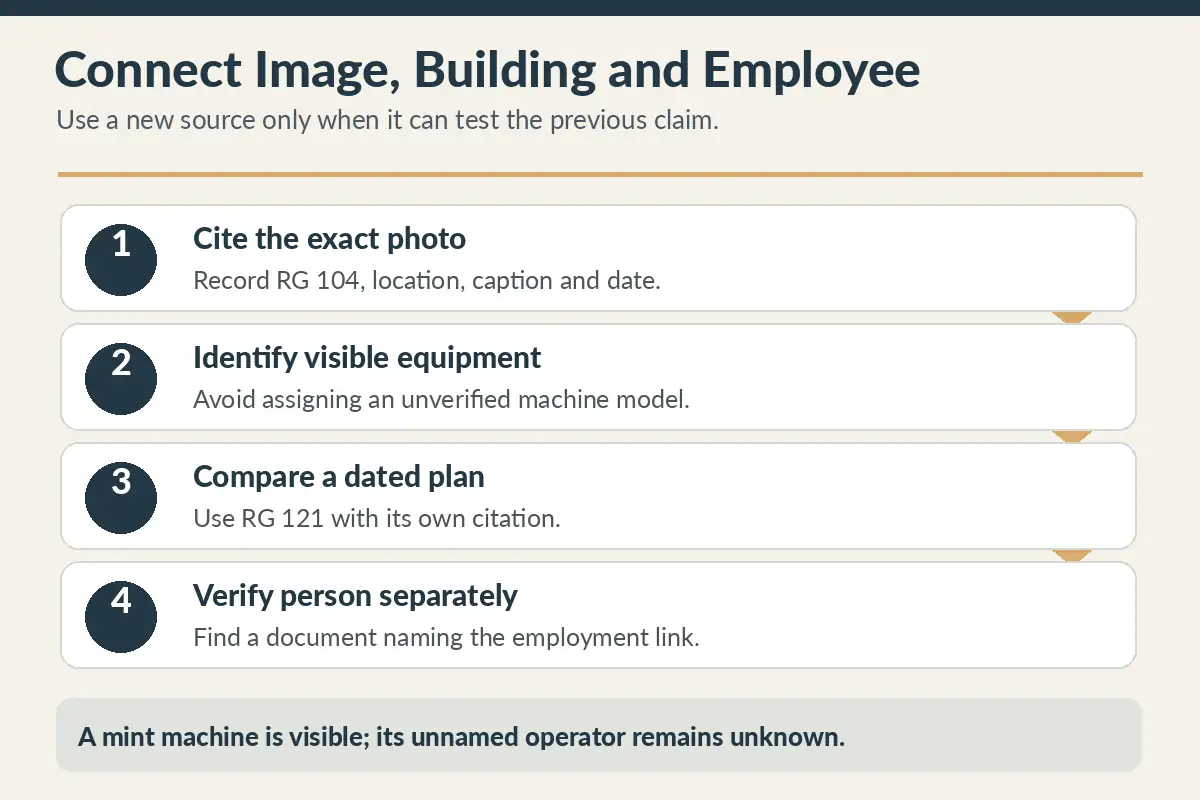
The guide uses an approximate 1930–1940 range. It does not date every print to a specific year, coin issue or event. Look first for an item caption, annotated mount, negative register or other original source that narrows the exposure date. A machine could have been in use for more than one year, and successive photographs might show a process demonstration or a later renovation. Similar background equipment in two frames does not establish they were taken on the same day.
Where a coinage story specifies a particular issue or output, compare it with independently dated Mint records. Keep the separate questions clear: when was the room photographed, what process was being illustrated, what output is actually recorded, and did a particular person participate? The photos and texts may eventually reinforce each other, but a visually compelling image cannot supply an unrecorded mint mark, worker identity or production total. Write historical uncertainty into the caption instead of disguising it as precise chronology.
A Research Scenario: An Alleged Family Member at a Mint Press
Suppose a family story says a relative worked near coin presses at the San Francisco Mint in the mid-1930s. Search the 154-print group for a precisely captioned workshop scene and preserve its item number. A visually plausible press does not establish that the relative operated it. Independently verify the person’s residence, workplace and job in contemporary records. If that connection is strong, the image may depict the type of workspace they encountered, but not necessarily their own machine or work shift. This is a hypothetical example, not a staff identification.
Then examine any relevant RG 121 building plan to locate the photographed room, accounting for the plan’s date. Use three citations: one for the image, one for the plan and one for the person-level record. If the room match remains uncertain, record two possibilities rather than selecting the more dramatic. A family history can make responsible use of an industrial view without converting a faceless worker into a named ancestor or a machine into proof of coin output.
More House and Local History Guides
How We Research and Verify the Archive
We checked RG 104 section 104.5.11 for the 154 prints, the Fifth and Mission Streets location and the ca. 1930–1940 date range, and verified the separate reference to eleven RG 121 plans covering 1867–1950. We do not assume that the photographs form a complete technical manual or employee directory. We treat the inventory count and general date range as a guide to research, not as individual-item citations.
Every claimed room, machine or person requires evidence from a particular original caption or suitable independent source. Comparisons with plans and personnel documents are identified as separate steps. We avoid pretending that a modern drawing of a mint press is an archival photograph. Before reproducing an original print, consult NARA item access and rights information. See our affiliate disclosure.
NARA describes processes and facilities, not a comprehensive staff portrait collection.
Not automatically. A dated production record is needed for a specific issue or output claim.
NARA points to eleven historic plans of the San Francisco Mint building there; plans can help investigate layout.
No. Visitor and personnel records document different relationships with a mint.
No. The guide gives an approximate 1930–1940 range; check each print for a narrower date.