
Start With the Photograph’s Provenance
The National Archives describes a 98-image album of photographs showing the aftermath of the 1906 San Francisco earthquake in the still-picture holdings of Record Group 30, the Bureau of Public Roads. That is a specific archival lead for visual local history. It does not establish that every historic earthquake image comes from the same album, that the photographs were made on April 18 itself, or that a depicted street can be identified without reading the original caption and visual evidence.
If a family owns a print that resembles a disaster view, begin by recording everything physically associated with it: handwriting, publisher or studio stamp, border style, album sequence, mount, and back inscriptions. Photograph the reverse before removing the image from its frame. A family caption written decades later can preserve a useful clue, but should not be silently treated as the photographer’s original description. Keep provenance facts separate from the scene interpretation.
Why a Roads Agency Holds an Earthquake Album
RG 30 preserves records from the federal public-roads organizations and their predecessors. NARA’s guide places the earthquake album among the group’s general still pictures, although disaster scenes may also exist in city, newspaper, museum, and private photographic collections. The record group tells you about federal archival custody and arrangement, not necessarily who stood behind the camera or whether the pictured building had a connection to federal road construction.
When describing the source, cite the 1906 aftermath album and its RG 30 context, not an invented “earthquake survivor census.” A photographer could have documented rubble, transportation damage, or streets. Whether any given image shows a particular address must be tested. An uncaptioned photograph of collapsed masonry may support a general environmental observation without proving which household lived at the visible doorway.

Separate the Disaster Date From Exposure Date
The earthquake occurred in April 1906, but “aftermath” is a broader descriptive word than an exposure timestamp. A photograph could show damage, clearance, or reconstruction later than the initial event. Do not assign April 18 to every image simply because the disaster is dated. Search for contemporaneous published uses, photographer annotations, adjacent album captions, and signs of clearing or temporary structures that may narrow the interval.
Make an uncertainty note for each image: date visible in original, date supplied by the archive, date inferred from other material, or date unknown. If the photograph has no date, keep it that way until an independent source provides one. The sequence in a bound album may reflect editing or subject grouping rather than an hour-by-hour chronology; never present page order as a literal timeline of the fire or reconstruction.
Test a Street or Building With Independent Maps
Use only visible features: a legible street sign, distinctive intersection, transit tracks, storefront name, building façade, or topography. Compare them with contemporary city directories, plat maps, fire-insurance maps, and dated streetscape photographs where available. Historic street numbering or business names may change. If you identify a storefront, record the precise visual match and the independent map or directory year instead of relying on a modern address pasted into an old scene.
A caption naming a district is not the same as a verified building address. Be especially cautious with widely reproduced earthquake images whose captions have been copied and modified. If two candidate corners share similar façades, retain both candidates until the street geometry or a unique sign resolves them. Reversible claims such as “likely near this intersection” are more reliable than a firm but unsupported house identification.
Do Not Infer a Family From a Ruined House
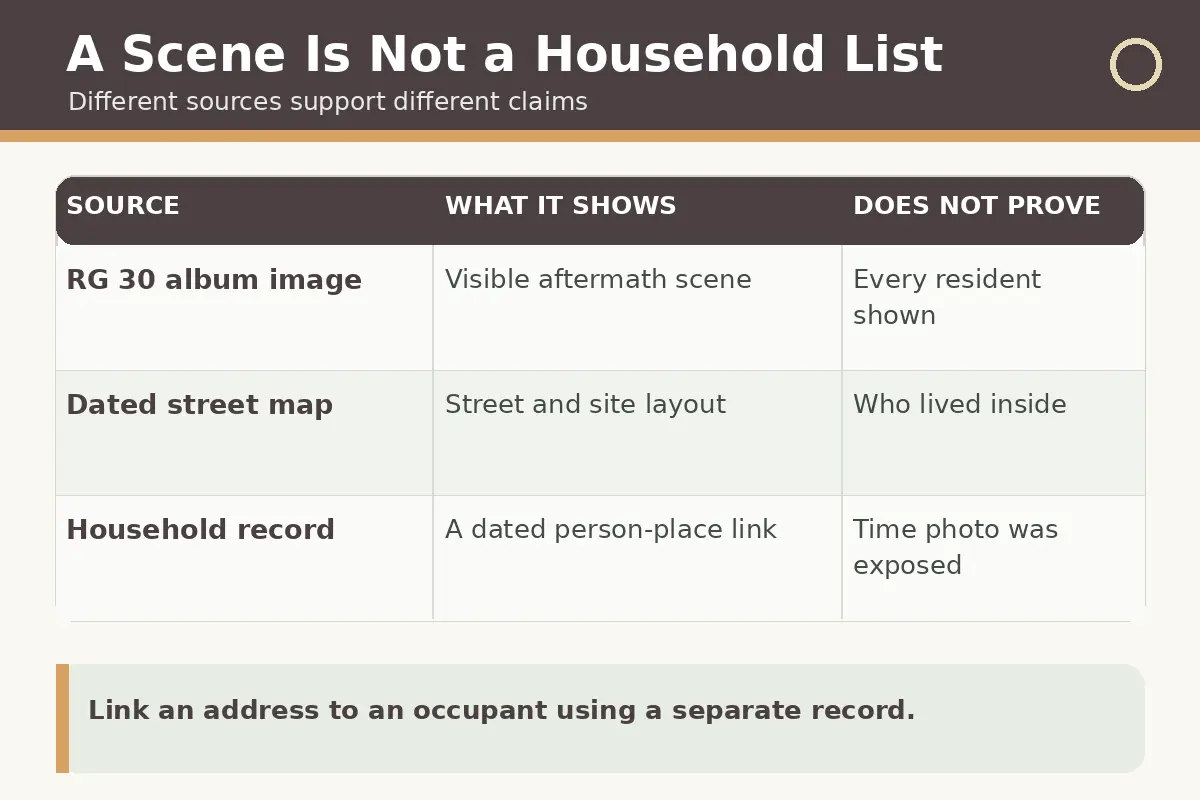
A family story may describe relatives losing a home during the catastrophe. The album can supply meaningful visual context for the disaster, but a photograph of a damaged building does not identify its residents. To connect a building to a household, look for independently dated city directories, deeds, tenancy records, insurance material, local relief documentation, correspondence, or the family’s own precisely located papers. Ownership and occupancy are separate questions.
An early city directory may show a business at an address but not necessarily every person who lived upstairs. A later deed may identify an owner after the disaster, not the occupant in April 1906. Build a date-specific chain and label each link—address, property, occupancy, relationship, or disaster loss. If a person appears in a street photograph, the image usually cannot establish their identity without other evidence.
Audit Copies and Reproductions Before Publication
If a scan appears online, preserve its full source and catalog context, not only an image downloaded from a search result. Record the archival identifier, album title, page order, caption, reproduction date, and whether a crop or contrast adjustment has altered the view. Do not make invented paper textures or illustrative reconstructions appear to be authentic federal photographs. For family archives, a clearly labeled interpretive illustration is acceptable, but cannot substitute for a source citation.
Investigate reuse rights and the history of the actual image before posting. An item in a federal record group is not an automatic determination that every underlying photographic work is free of restrictions. The safer editorial practice is to use a source-checked reproduction with its caption and credit instructions or produce original artwork that is clearly illustrative. Preserve an unmodified reference image in the research file for later review.

Search and Request the 98-Image Album
Begin at RG 30, section 30.9, which identifies the 98-image album. Search the National Archives Catalog by record group and phrases such as “San Francisco earthquake,” “1906,” and “album.” Record any series or item descriptions returned, then ask reference staff about the exact album identifier and availability of high-quality reproductions. An inventory mention does not guarantee an item-level scan for every page.
Supply the proposed scene location, candidate caption, and any visual match when writing for assistance. If an image came from a secondary website, send that page address as a lead but distinguish it from an archival item ID. If the archive cannot confirm a location, cite the album and the visible evidence while stating that the exact street remains unidentified. That is a valid result that prevents a family memory from becoming an unsupported record of residence.
More Family Story and Preservation Guides
How We Research Earthquake Image Claims
Our starting point is NARA’s RG 30 description of a 98-image aftermath album, not an invented list of victims or properties. We distinguish the known year of the disaster from the unverified exposure date of an individual picture. Then we compare geographic features with independently dated sources and separate a proven location from a proven resident, which generally requires other documents.
We maintain the original archival caption, our proposed identification, and a confidence note in separate fields. Our affiliate disclosure explains site relationships; this article makes no claim of a photographic licensing partnership. If a street name or individual identity remains uncertain, publishing a transparent research note is preferable to circulating a persuasive but undocumented caption.
NARA section 30.9 describes an album with 98 images showing the aftermath of the 1906 San Francisco earthquake.
Not necessarily. The album is described as aftermath photographs; verify any individual exposure date rather than assigning the earthquake date to every picture.
No. A building or street view requires independently dated records to establish an occupant or household.
No. The record group identifies archival context; inspect original item descriptions for authorship or compilation details.
The federal records guide identifies the album but does not guarantee that every individual picture is digitized.