
Royal Naval Reserve (RNR) ratings have a distinctive paper trail: surviving service records in BT 164 and BT 377, often representing separate five-year enrolments rather than one continuous career file. The National Archives identifies a sample of earlier records from 1860–1908 and a much wider run of service cards from 1908–1955. A reservist could receive a new service number for another term, so a search for only one number may miss later service. The correct method links terms, ships and dates, while keeping the RNR distinct from both regular Royal Navy ratings and the Royal Naval Volunteer Reserve.
Identify the Royal Naval Reserve Rather Than Another Navy Branch
The RNR was formed in 1859 to draw experienced merchant seamen into a naval reserve, and officers joined the organization later. Being a merchant seaman alone does not establish RNR membership, and a naval medal entry does not identify every service term. Before searching, collect a confirmed name, approximate birth date, home or port, rating, vessel, service number or letter prefix from an original source. Some historical family descriptions use ‘naval reservist’ casually; check whether the man actually belonged to the RNR, RNVR, Royal Navy or another seafaring organization.
The TNA personnel guide treats ratings, officers and medal rolls as separate research categories. Do not begin an enlisted rating’s search in officers’ ADM 340 files unless a promotion or commission is independently supported. A career might involve both merchant vessels and reserve duties, but the two are not the same administrative event. Write the known status and date beside each surviving name so that a ship’s crew entry is not mistaken for proof of reserve enrolment.
Choose BT 164 or BT 377 by the Enrolment Period
The official service-record guide describes BT 164 as selected records from 1860 to 1908 and BT 377/7 as service cards largely covering 1908 to 1955. Many of the roughly 148,000 records concern First World War service. Earlier coverage is only a sample, so a person absent from BT 164 cannot be assumed never to have enlisted. Use the date of each documented term to choose a series rather than forcing an entire adult career into the first result.
In BT 377, individual record cards are linked to service numbers and the original indexes are important. Some index volumes, including BT 377/1–6 and BT 377/8–27, are held for consultation at Kew and are not online. A name can appear in those indexes without a surviving corresponding card. If you find a catalogue description but the document is not downloadable, note whether access is restricted, whether the index is offline, or whether no card survives. Those causes are different and call for different next steps.

Link Renewed Five-Year Terms and Changing Numbers
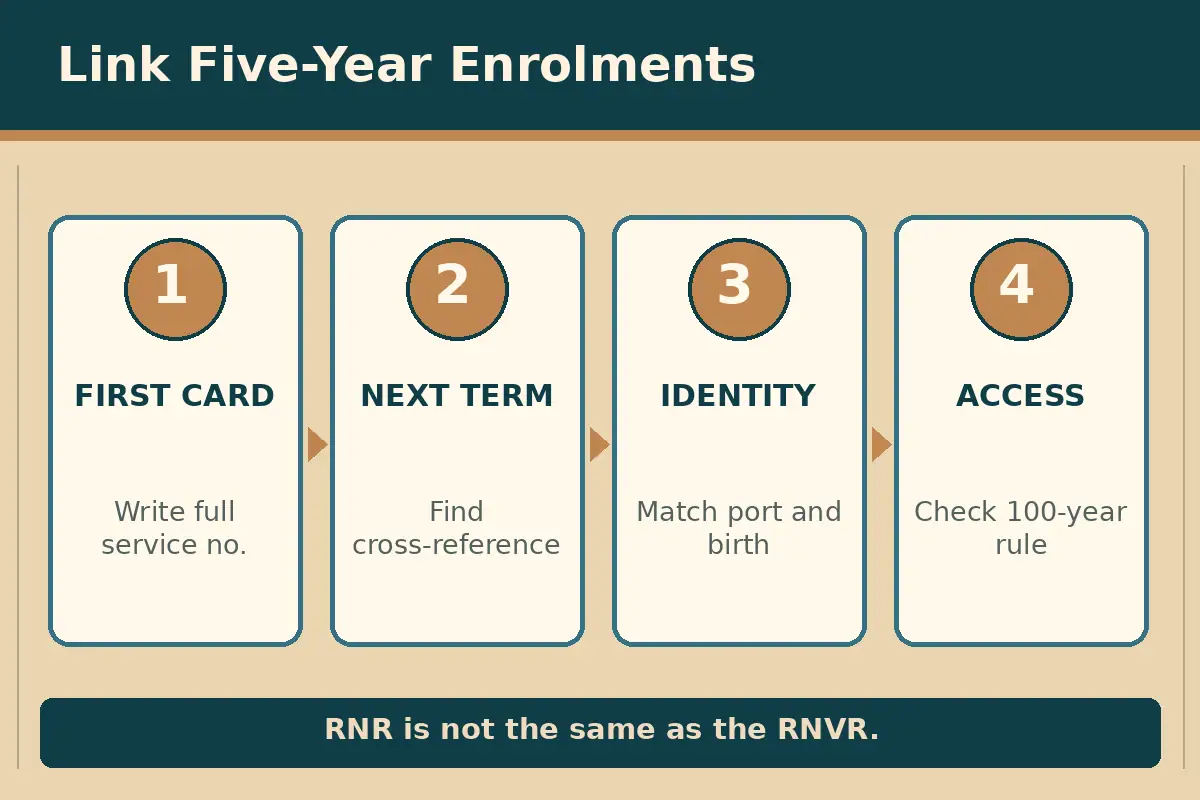
The National Archives explains that an RNR service record generally covers a five-year term and the same man could receive a different number on reenrolment. A BT 377/7 card may mention a previous or subsequent number. Transcribe the entire number including its alphabetic prefix or suffix and spacing; one digit or letter can distinguish two unrelated ratings. If the search system mishandles combined letters and digits, try a space between them as advised by the archive, but cite the original service number exactly as written.
Build a term table with number, first and last recorded dates, rating, vessel, home port, birthplace and any linking annotation. Connections should be explicit or supported by multiple identifiers, not simply guessed from adjacent number sequences. If a sailor’s term ends before another starts, do not invent the intervening employment. A gap may reflect an unrepresented term, service with merchant shipping, a missing card or a period outside the RNR. If an offline index supplies a new number, use it to locate an actual card before asserting more service dates.

Interpret the Card Fields Without Proving Too Much
Depending on the form, a record can state the sailor’s reported birth date, address, parents’ names, physical description, enrolment, training, ships, joining and discharge dates, and retainer pay. Some cards contain medal notes. These are recorded administrative fields, not automatic proof that every named person or relationship is independently established. A parent’s name on a card is valuable evidence of what the individual or clerk supplied, but birth and marriage records are still needed for genealogical proof. An address can record a contact place rather than continuous residence.
Look for a front and back: the TNA guide says some digitized cards show both sides and a later annotation may change how the main entry is read. Read the ship list chronologically but do not infer battle participation or wounds merely from a vessel name. The term ‘retainer’ concerns reserve arrangements, not a modern retirement pension. A rating’s stated place of birth may be more useful for distinguishing two namesakes than a common service rank. Where multiple cards conflict, keep the original wording, source date and possible administrative explanation separately.
Respect Closures and the Sample’s Missing Records
The archive warns that a small portion of BT 377/7 concerns seamen born less than 100 years ago and remains closed to ordinary public inspection. A closed catalogue hit must not be treated as permission to work around access restrictions. The official guide describes the possibility of requesting a review through normal Freedom of Information procedures. Keep public descriptions and personal data separate, and do not publish sensitive details about potentially living people. Access status can change as records become old enough for opening, so follow current repository guidance.
For missing records, test plausible explanations in order: a service-number variant, another five-year term, a Kew-only index reference, earlier BT 164 sampling, merchant seamen’s separate records, or genuine loss. If the person was an officer rather than a rating, use the officer route instead. RNR and RNVR similarly sounding abbreviations can lead to a wrong series. Avoid using a First World War medal roll alone to reconstruct a whole career; medal eligibility does not list every voyage or home address. Record the exact classes and years you searched.
More Records and Archives Guides
How We Research RNR Service Terms
Our workflow starts with an identity anchor from another source, chooses BT 164 or BT 377 by period, and preserves each distinct five-year enrolment number as its own entry. We then look for cross-references on the original card and in the Kew-only name indexes. We validate dates, ports and ships with independent merchant or naval evidence before joining two term records into one biography. We keep a status label for each suspected link—documented, plausible, or unresolved—so that numbers are not silently merged.
The official series descriptions distinguish downloadable records from closed items and on-site indexes. Never claim that a hidden card reveals facts the catalogue has not exposed. The archive’s coverage may evolve; recheck the original guides before ordering or quoting a description. For any public family-history write-up, avoid disclosing sensitive information about a potentially living sailor. See GenHis affiliate disclosure for site policy; the primary search method is not dependent on a commercial product.
Not necessarily. Separate five-year enrolments could have different numbers; use cross-references and Kew indexes to connect them.
No. The surviving 1860–1908 records are a selection; gaps do not prove nonservice.
No. Some records are closed under the date-of-birth access rule, and several original name indexes require consultation at Kew.
No. They are distinct reserve organizations. Establish the branch before choosing the record series.
No. It indicates recorded ship service for a period, which must be tested against independent operational evidence.