
Why WO 243 Is a Policy Source Rather Than a Nurse List
WO 243 is a War Office series for the Advisory Board for Army Medical Services, dated 1898–1914 in The National Archives’ guide to British Army nurses. It belongs in a search about the development, discussion or oversight of medical services and nursing policy. It is not a universal alphabetic roll of nurses, a hospital admission ledger, or a certificate that a named woman served in a particular institution.
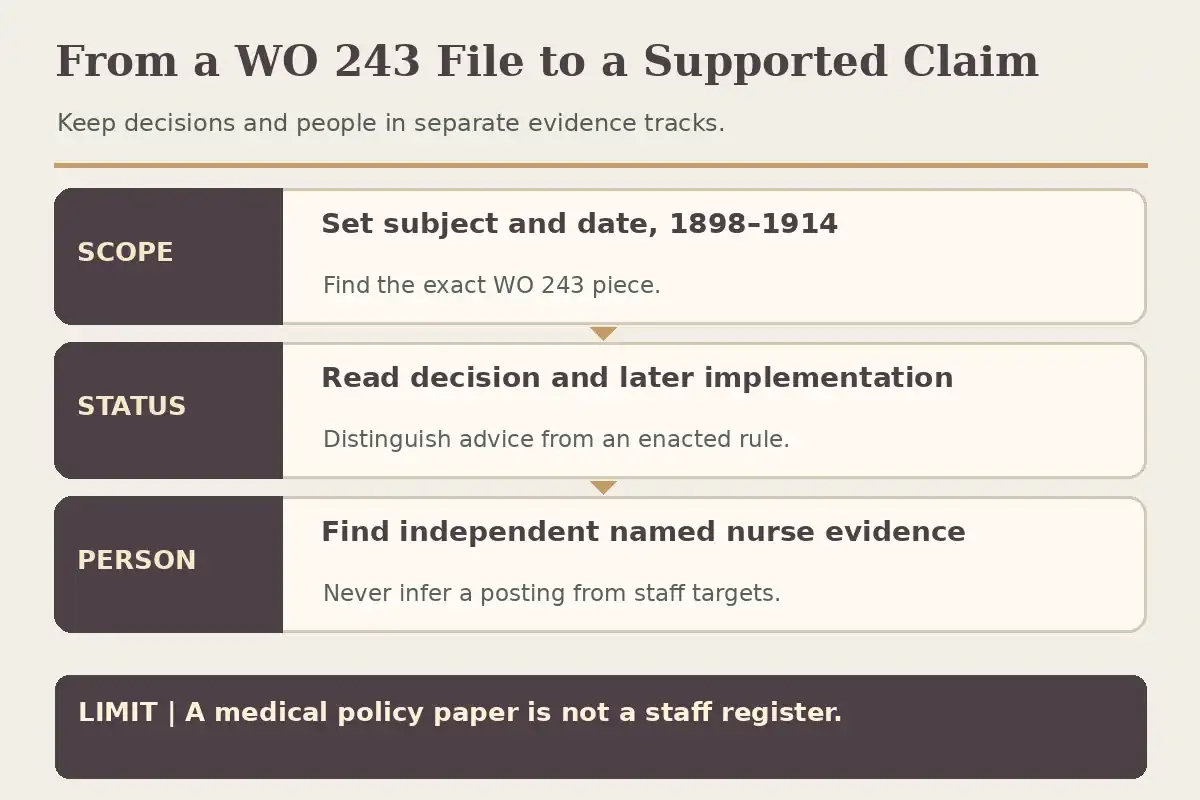
Begin with a policy question such as the organization of medical nursing, training expectations, staffing standards or an administrative decision near the turn of the twentieth century. An administrative file may mention people, committees or institutions, but a name in correspondence requires role analysis. A letter written about a nurse’s employment is not automatically the formal appointment or service record.
The National Archives British Army nurses guide states that nursing policy and administration records occur in WO 30, WO 32, WO 33, WO 222 and WO 243. These series cover different record creators and periods. Do not treat the numbers as chapters in a single chronological file sequence.
Build the 1898–1914 Administrative Date Gate
The WO 243 date range is 1898–1914, so use a year-appropriate catalogue query rather than assuming it describes every First World War nursing decision. The earlier years can reveal the context in which policies or administrative proposals were discussed. Later wartime implementation may appear in other War Office series, but that later location must be demonstrated by its own catalogue description.
Search within WO 243 using terms tied to a specific topic, such as a named institution, nursing, hospitals, medical services or the wording used by the record creators. The guidance warns that these policy records are not generally available for online viewing; identify a piece before deciding between a visit to Kew and a copy request. Catalogue coverage and item descriptions vary.
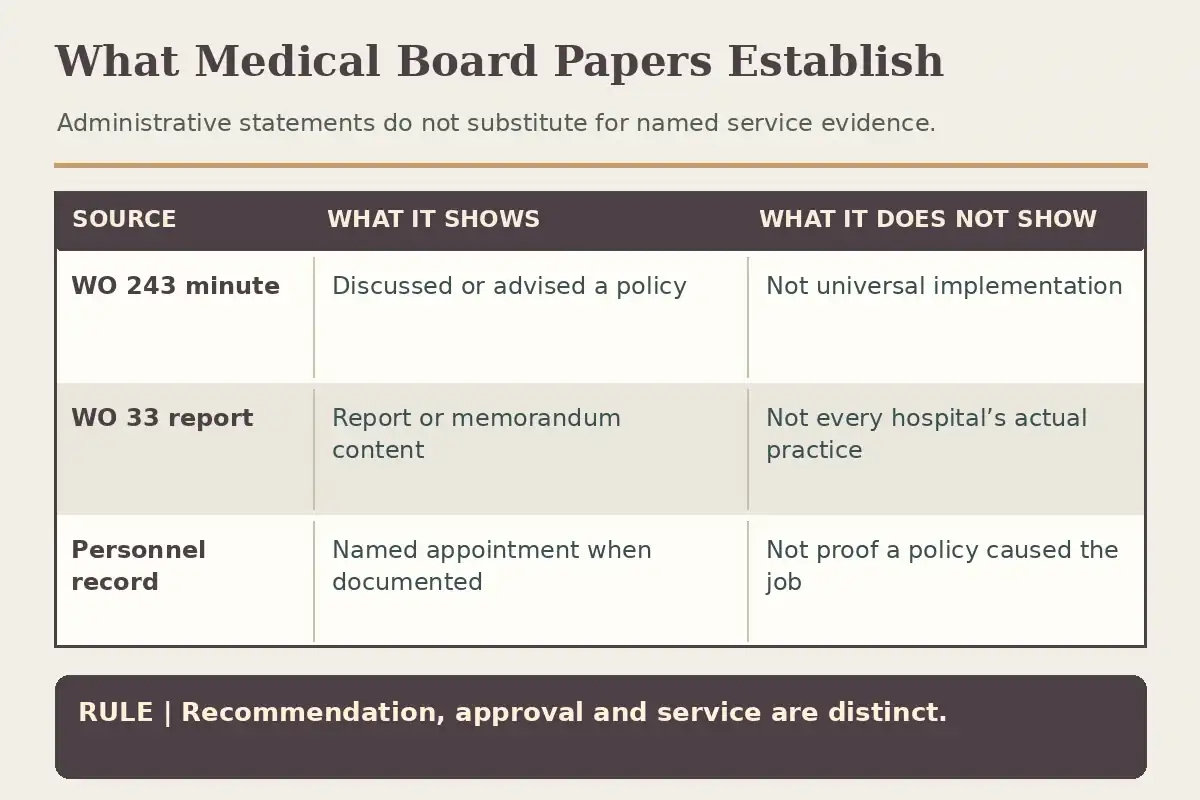
For an administrative decision, distinguish the date of a board meeting, the date of a report, the date of any approval and the effective date of a new practice. A meeting minute can show discussion without implementation. If a recommendation was deferred or amended, quote that qualification in your notes; do not turn its existence into a regulation applied everywhere.

Use WO 32 and WO 33 as Alternatives, Not Automatic Steps
The National Archives recommends searching WO 32 for Code 2 (nursing services), Code 182 (medical) and Code 68 (women’s services). These are finding aids for relevant registered War Office papers, not job titles or proof of a person’s membership. Save the code and the actual resulting item reference so a researcher can reproduce your search.
WO 33 reports and memoranda can be another policy-oriented route; WO 30 miscellaneous papers and WO 222 medical historians’ papers are additional possibilities. Choose one because its catalogue description fits the research question, rather than copying a list of series indiscriminately. A document filed under a general medical heading may mention nursing only briefly—or not at all.
If you find contradictory recommendations, build a table with creator, date, stated action, status and supporting item reference. Board advice, official correspondence and later practice should occupy separate rows. Without corroboration, the most the researcher can say is that the specific memorandum proposed, discussed or reported a change in its own administrative context.
Connect a Named Nurse to Independent Personal Evidence
If the real question is whether an ancestor served as a military nurse, switch from WO 243 policy files to individual service and appointment evidence suited to the particular period. Do not infer employment from a board recommendation, a hospital’s existence or a staff requirement. A named appointment document, personnel register or corroborated contemporary list carries a different evidentiary weight.
Use identity fields such as full name, initials, age, training institution, appointment date and service location only where a source actually preserves them. Women with the same surname may be difficult to separate, and historic roles can have variant terminology. Record uncertainty instead of assigning one person to every similarly named administrative reference.
An individual’s activity also has its own chronology: training, application, appointment, posting, leave and resignation may be recorded separately or not survive. Do not mistake the date of a policy paper for a personal appointment date. A policy can help explain conditions surrounding service once that service is independently proven.
When discussing nursing reforms, record the difference between contemporary terminology and modern professional labels. The administrative word used in an 1905 memorandum may carry a different legal or institutional meaning from a present-day qualification. Keep quotations short and cite their context. Where the record mentions a number of positions or an expected staffing ratio, treat it as an administrative figure, not evidence that precisely that number of named nurses worked at a specified hospital.
More Records and Archives Guides
How We Research Army Medical Administration
Our worksheet begins with PERIOD, QUESTION and RECORD PURPOSE, then separates administrative proposal, approved decision and named individual evidence. We cross-check the official series descriptions before presenting any date or archive code. Illustrative diagrams use documentary categories rather than claiming to reproduce an original WO 243 folio or an actual named nurse’s career.
Each citation should include the complete piece reference and a brief explanation of what the item actually says. If an item is not accessible online, do not imply that a search snippet establishes its entire content. A useful negative result reports precisely which term, series and date range was checked and what other series remain unsearched.
The distinction is a practical safeguard: WO 243 can illuminate an administrative choice, whereas an individual service record is needed to prove a personal employment claim. Check current access and closure conditions before ordering. See the affiliate disclosure for commercial transparency; neither an index nor a paid copy removes the need for source interpretation.
The National Archives describes the Advisory Board for Army Medical Services records as covering 1898–1914.
Not as a general rule. It is a policy and administration series; seek a personal service or appointment document for named employment.
They are suggested catalogue search codes for nursing, medical and women’s services, respectively.
The relevant National Archives guide says the policy series require a visit or arrangement to view original records.
No. Identify approval and implementation evidence separately from the recommendation.