
Follow a wartime child evacuee through CORB registration, surviving DO 131 files and destination sources while keeping applications, journeys, and later reunions distinct. The key is to read the specific original, not assume that an index result is the same thing. Start with The National Archives’ official guidance and see the site’s affiliate disclosure before following further research links.
Distinguish a CORB Application From an Actual Sailing
The Children’s Overseas Reception Board was created during 1940 to arrange the overseas evacuation of some British children during wartime. Applications, approvals, travel arrangements and completed departures are not equivalent events. The National Archives places these records in DO 131 and notes that many relevant files were destroyed. Start by asking whether a named child applied, was selected, sailed or arrived in a destination country; each question may require a different surviving document.
CORB was distinct from private evacuation arrangements. A later family account that a child went to Canada does not, by itself, establish that the child travelled under the official CORB scheme. Record year of birth, place of residence in 1940, parent or guardian details that can be independently supported and any known ship or destination. Because some of the children and their relatives may still be living, handle identifying documents and family stories with appropriate privacy and consent.
Start With the Surviving Applicant Registers
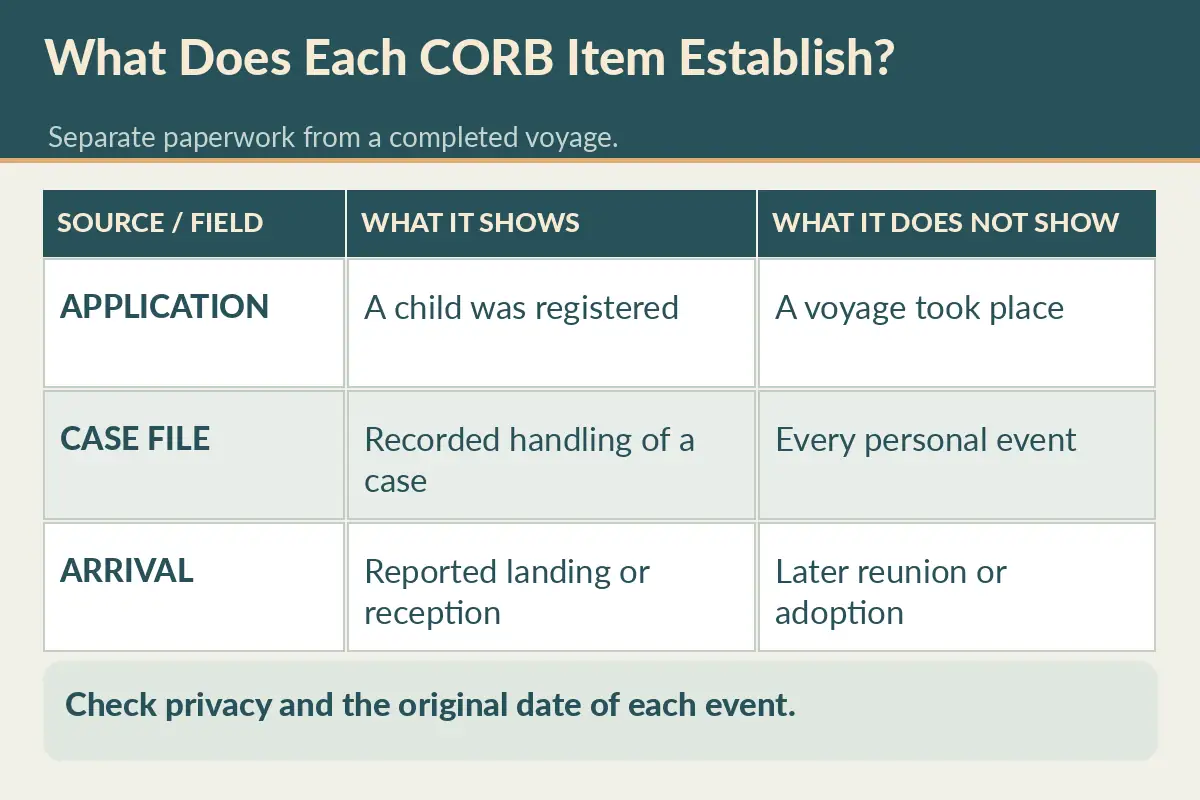
The archive guide identifies child-applicant registers in DO 131/106–113, searchable by the child’s name. An application reference can help distinguish one child from a namesake and locate possible related papers. A register entry may show that an application was made without proving that permission was given or a ship departed. Inspect the original heading and exact status fields before summarizing the result. Do not count every applicant as a successfully evacuated child.
Case files concerning children survive in DO 131/94–105, while escort-related cases are in DO 131/71–87. These are different subjects and may not use the same indexing route. Save each precise catalogue reference and inspect access instructions for that item. A paper discussing a guardian or escort may name children incidentally, but that does not prove their relationship or a shared destination. Always identify whose file it is and why the person appears.

Use the 1940 Voyage Dates as a Reality Check
The government programme sent children primarily to Canada, Australia, New Zealand and South Africa during the summer of 1940. The official education material describes a tragic turning point on 17 September 1940, when the City of Benares was torpedoed, and says the official overseas evacuations were then suspended. Use the relevant departure date and the route when assessing an alleged CORB journey. Do not assume that the application date is the sailing date or that all approved children actually boarded.
One CORB policy source may provide the context of changing transport decisions without proving the experience of a named child. Match any ship information against independent passenger or destination-arrival records wherever they survive. If a family recollection concerns an evacuation after suspension, investigate whether it refers to a private arrangement, a different organization or a mistaken year. Preserve the uncertainty instead of forcing the story into the official scheme.
Treat Destruction and Restricted Access as Real Boundaries
The National Archives states that most CORB files were destroyed under a 1959 statutory process and that many surviving documents are administrative in character. This means a no-result search is likely to reflect incomplete records, not a child’s absence from the evacuation programme. Some named-person files may require an archive access enquiry rather than an assumption that every catalogue entry is immediately downloadable. Read present-day restrictions on each piece.
When working with a living former evacuee, use consent for interviews or for publication of sensitive case details. The fact that a document was created decades ago is not a substitute for ethical judgment about personal distress, displacement or confidential family information. Record access restrictions and explain that a missing file is an archival limitation. Do not attempt to bypass a restriction or publish data about unrelated living individuals merely because a name index exists.
Keep Escorts, Hosts and Parents in Separate Roles
CORB paperwork may mention an escort, host household, parent or local organizer. Their relationship to a child is not necessarily familial. Create a role ledger with exact wording such as applicant, guardian, escort, receiving authority or host. Never infer adoption, parentage or long-term residence from a placement contact. If an arrival notice names a host, compare destination addresses and correspondence with later independently produced documents.
For continuity, set out a timeline of application, decision, embarkation, arrival, host placement and eventual return, marking unknown stages as unknown. Newspapers can be useful for reported arrivals but may be incomplete or inaccurate about individual identities. An educational narrative about the evacuation programme should not silently replace a child-specific original document. Privacy applies equally when the source names other children on the same voyage.
Finish With a Bounded Journey Conclusion
A strong result identifies which DO 131 source names the child and which discrete event it records. Cite the exact applicant-register or case-file piece, page when available and document date. Keep a separate column for external passenger or destination sources. If you cannot prove that a child boarded, write “applied for overseas evacuation” rather than “was evacuated.” A host record may show placement without proving a later reunion with family.
If the research continues abroad, consult the receiving country’s national, provincial or local archival collections for immigration, newspaper or welfare records. Avoid promising complete arrivals lists or unrestricted access. The evidence goal is a respectful, reproducible account of one person’s wartime movement, not a dramatic narrative borrowed from the broader programme. A clear finding about one application can be valuable even when much of the personal case file has not survived.

How We Research Corb Do 131 Evacuation Records
We distinguish the CORB scheme from private evacuations, begin with DO 131/106–113 name registers, and seek child-case or escort-case files only where the piece references fit. We test any reported voyage against the summer 1940 chronology and preserve the 1959 destruction and living-person privacy limits.
More Records and Archives Guides
Primary Archive Guidance and Reference Limits
These two official descriptions identify the appropriate documents, series and key survival caveats. The National Archives source 1 describes documents the 1940 CORB scheme, DO 131 piece ranges for applicant, child and escort files, and extensive records destruction in 1959. The National Archives source 2 describes provides historical background for CORB evacuation, destination countries and the September 1940 suspension.
No. An application is an administrative step; confirm a sailing or arrival independently.
The National Archives identifies DO 131/106–113 for applicant registers.
No. Most files were destroyed; surviving child cases are limited and need record-specific checks.
No. Private overseas arrangements and domestic evacuation had different records.
Use privacy-aware judgment, the archive’s access rules and appropriate consent.