
Laredo’s immigration cards and manifests use different arrangements and admission categories. Link the exact entry date, number and person before claiming migration. Begin with the official archive research guidance and read our affiliate disclosure before using any access service.
A Laredo Crossing Is an Entry Record, Not Proof of Settlement
The National Archives and Records Administration holds U.S.–Mexico land-border entries organized by port and record series. At Laredo, an immigration officer’s index card can lead to a separate manifest, but not all admissions were documented in the same way. Some cards report temporary stays, while others refer to immigration or statistical arrival categories. Being named at the border does not prove that someone became a permanent resident, married in the United States or acquired citizenship.
Before searching, note the precise crossing town, approximate month or year, the traveler’s name variants, age, citizenship as reported and destination. Laredo, Eagle Pass, El Paso and Brownsville are different ports, with different series and time spans. A family story about “crossing from Mexico” is not enough to select Laredo without corroborating place evidence. Keep the entry direction and reported intention separate from a later census or naturalization claim.
Start With A3379 for the 1903–1929 Name Index
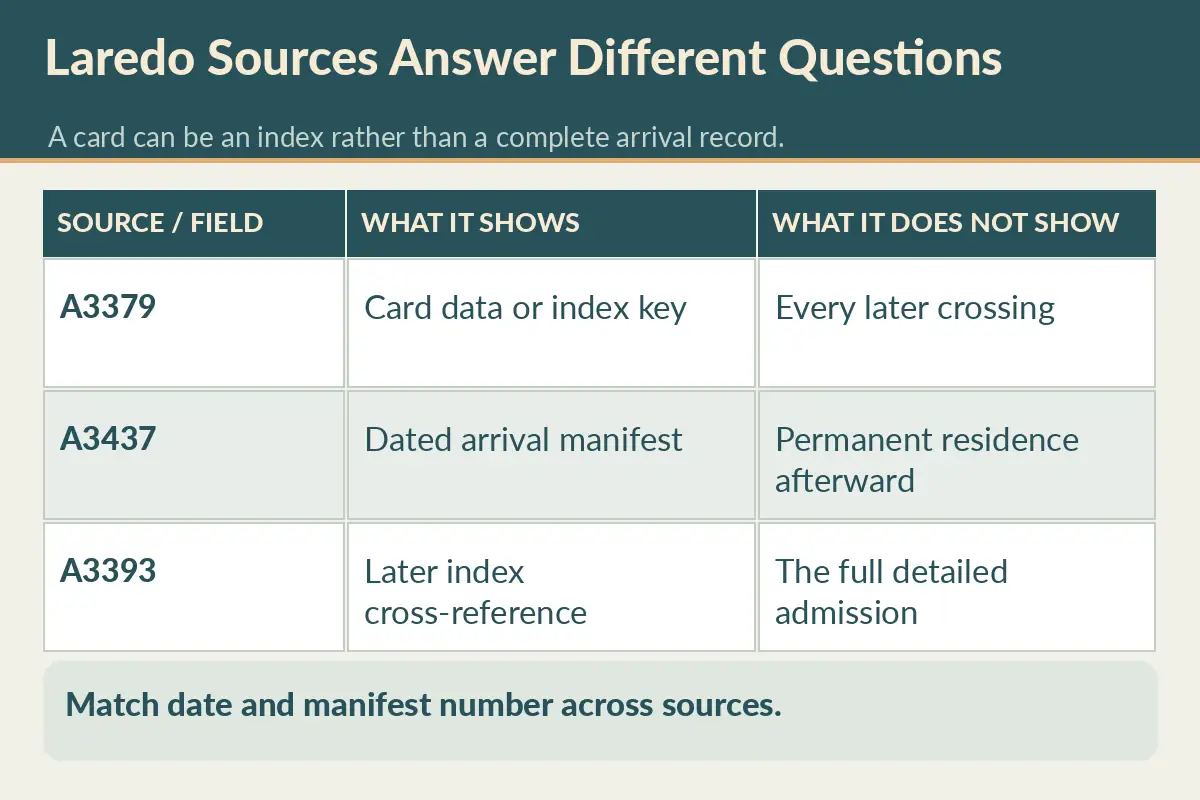
NARA describes A3379 as Nonstatistical Manifests and Statistical Index Cards of Aliens Arriving at Laredo, Texas, from May 1903 through November 1929. The publication includes more than 610,000 alphabetically organized cards or manifests. Some nonstatistical cards contain the available entry information themselves. Other statistical cards function chiefly as finding aids to separately filed records such as M2008, A3365 and A3431. This difference matters: an index card may not be the fullest record.
Inspect the whole card for surname spelling, age, date and port, case numbers and any cross-reference printed or handwritten. Do not assume that a manifest number in one line identifies a person’s only crossing. Some travelers entered repeatedly, and a later card may annotate earlier admissions. Search spelling variants and compare arrivals occurring close together. A candidate with a familiar surname but different age or destination should remain separate until the original manifest resolves the mismatch.

Use A3437 and A3393 to Locate the Matching Manifest
NARA identifies A3437 as statistical and some nonstatistical manifests for Laredo, dated May 1903 through April 1955, arranged chronologically and numerically. These records can be located through relevant index series, including A3379 and the later A3393. A3393 is an alphabetical index to permanent and statistical Laredo entries from December 1929 through April 1955. Do not treat the chronological A3437 sequence as though it were a second alphabetical surname database.
Copy the exact arrival date, manifest or serial number, index series, and personal details from the index before moving into A3437. Then transcribe the matched manifest rather than relying on the index summary alone. A number may be accompanied by administrative notations that need interpretation in context. If a link fails, check whether you have the right date range or a temporary-admission series, and document the discrepancy before concluding the person was not recorded.
Separate Temporary, Statistical and Permanent Admission Types
Border officials used multiple forms for different administrative purposes. NARA describes card Form 548 or I-448, Form 502/1502F, Form 621 or 622, Form 629 and other specialized statistical or nonstatistical records. Some forms carry age, marital status, birth place, occupation, last residence, future destination and names of persons traveling together or to be joined. Another form may be only a brief index to a larger sheet. A temporary visit is not a declaration of permanent residence.
Never fill in fields simply because another form type commonly contained them. Note whether an entry records nationality, race, temporary status, stated intention, refusal or later annotations. The exact historical terminology can be discriminatory or outdated; quote it as a source category, not as an endorsement or a present-day label. Dates of previous U.S. residence are reported answers, not automatically verified movement histories. Use independent immigration, civil or local records to test these statements.
Try M2008, A3431 and Nearby Ports When the Main Search Fails
For Laredo, NARA lists M2008 for arrivals via the Mexican National Railroad or Laredo Foot Bridge from July 1903 through June 1907, and A3431 for nonstatistical temporary entries from July 1908 through February 1912. The same port has additional later temporary series, so A3379 to A3437 is not a universal route. A3365 contains selected early arrivals from several Texas and Arizona ports. Its broad geographic scope does not guarantee that every Laredo traveler appears.
Search by port and period first, then choose the appropriate original series from the NARA list. If the family repeatedly crossed for work or short visits, search both temporary and permanent categories where they exist. Consider nearby entries only after recording the historical geography and basis for expanding the search. Absence in one alphabetical run may reflect spelling, an unindexed record, a different administrative category or a different port of entry; none alone proves that an arrival never happened.
Reconcile Identity and Movement With Later Family Records
A card may name a person to be joined in the United States, a last home address, an occupation or accompanying travelers. Those entries create leads but do not prove kinship. A named “friend or relative” may be a contact rather than a parent, spouse or sibling. A planned destination can differ from the city of actual residence. Repeated entries can document the same person crossing several times but need a careful identity test using dates and stable personal identifiers.
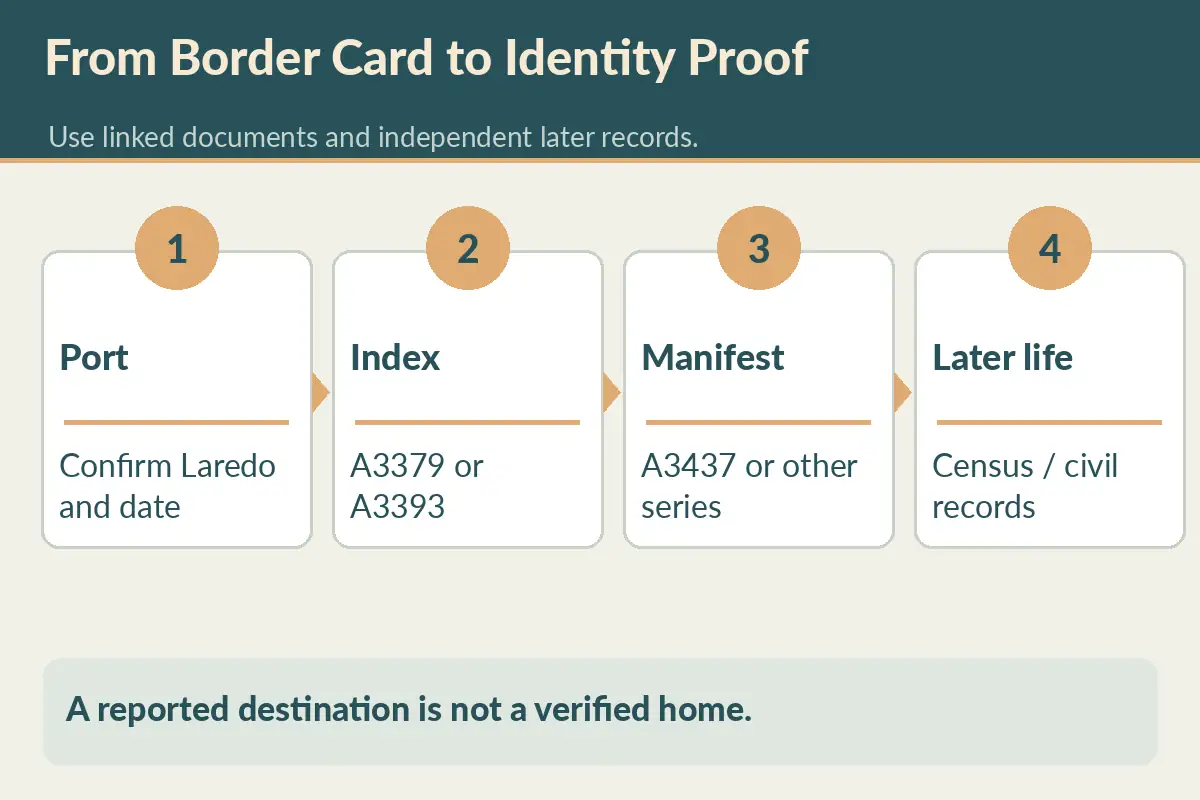
Build a three-part ledger: what the border document directly states, what a later census or civil record independently confirms, and what remains an unverified inference. Include index series and number, manifest series and page or card, port, exact arrival date and any annotation. For common names, retain rival candidates rather than joining separate households. Respect modern privacy when crossing records describe children or people who may still be alive. A careful conclusion proves a dated entry first and only then addresses residence or migration.
How We Research Laredo Border Crossing Records
We route by Laredo port and period, distinguishing A3379 alphabetical statistical-index cards from full nonstatistical cards and A3437 chronological or number-arranged manifests. For later admissions we test the A3393 index; for temporary and early records we check M2008, A3431 and applicable separate series. We compare date, number, age and intended destination across originals, and do not confuse border admission with permanent settlement.
More Records and Archives Guides
Original Archives and Evidentiary Boundaries
To reproduce this investigation, consult the principal official series guide (Details Laredo series A3379, A3437, A3393, M2008 and the statistical versus nonstatistical card and manifest distinctions.). Independently compare the secondary archive reference (Confirms border port-specific microfilm publications and RG 85 catalogue routes for Laredo.). Neither an archive catalogue title nor a later database index proves the full historical event without examining the underlying record and its context.
No. Some A3379 cards are indexes to separate statistical manifests; other cards contain their own entry detail.
No. Much of it is arranged by date or number and uses a separate index.
No. The stated relationship and actual kinship need independent confirmation.
Search temporary and nonstatistical series for that port and time rather than only permanent-admission records.
No. A dated admission is not a naturalization certificate.