
The U.S. National Archives’ St. Albans Lists can document selected arrivals to the United States through Canada beginning in 1895. They are not a single universal register of everyone crossing in either direction. A practical starting route is a Soundex name index such as M1461 (1895–1924) or M1463 (1924–1952), followed by the underlying manifest series M1464 (1895–1954) when applicable. NARA’s ports guide identifies the series and links to available access points. Check the year, port and actual direction of travel before declaring a match.
Decide whether the person entered the United States or Canada
A family story about ‘crossing from Canada’ could mean entering the United States from a Canadian land port, reaching the United States via a Canadian seaport, or later immigrating into Canada from the United States. These are not the same recordkeeping system. NARA’s St. Albans lists concern U.S. entries and fall within federal immigration administration; Library and Archives Canada describes Canadian government arrivals beginning in April 1908 and notes that earlier cross-border moves often left no Canadian entry record. Put two columns in the research plan: ‘country entered’ and ‘source custodian.’ If the target moved to Ontario, do not search for a U.S. admission card as the only possible evidence. If the target relocated to Michigan from Ontario, NARA’s port-specific series may be appropriate. Never infer legal status or citizenship merely from the existence of an arrival record.
Start with M1461 or M1463 only for their actual spans
The NARA browse-by-port reference lists the Soundex index M1461 for Saint Albans district Canadian entries during 1895–1924 and M1463 for entries associated with Canadian Pacific and Atlantic ports during 1924–1952. Soundex sorts by a phonetic surname code, so a misspelled family name can sometimes appear under a variant; it is not a perfect person-finder. Write down each candidate’s index card reference and examine other clues such as age, birthplace, companion and destination. An index card can summarize a manifest without containing every original field. For a difficult surname, retain the Soundex code, original spelling and alternative phonetic spellings in your log, since family members could use more than one written form. Note the time span carefully: an index ending in 1952 does not mean underlying 1953–1954 manifests do not exist. Conversely a card for a similar name in 1910 does not prove the later individual you seek entered on that date.

Follow the card to the original M1464 manifest
M1464, described in the NARA microfilm bibliography, contains manifests of arrivals through the Saint Albans district and Canadian Pacific and Atlantic ports for 1895–1954. Preserve the person’s exact recorded spelling and extract dates, travel route, named relatives and destination only where actually present on the image. Do not cite M1461 or M1463 as though it is the manuscript manifest. Some indexes were created decades after the recorded admission, so transcription can reflect a later clerk’s interpretation. Compare a likely manifest to a U.S. census or naturalization petition to test whether the destination and birthplace align, rather than treating every match as settled. Record page or card identifiers and digital image details, allowing another researcher to revisit the source.
Respect major changes in port coverage by year
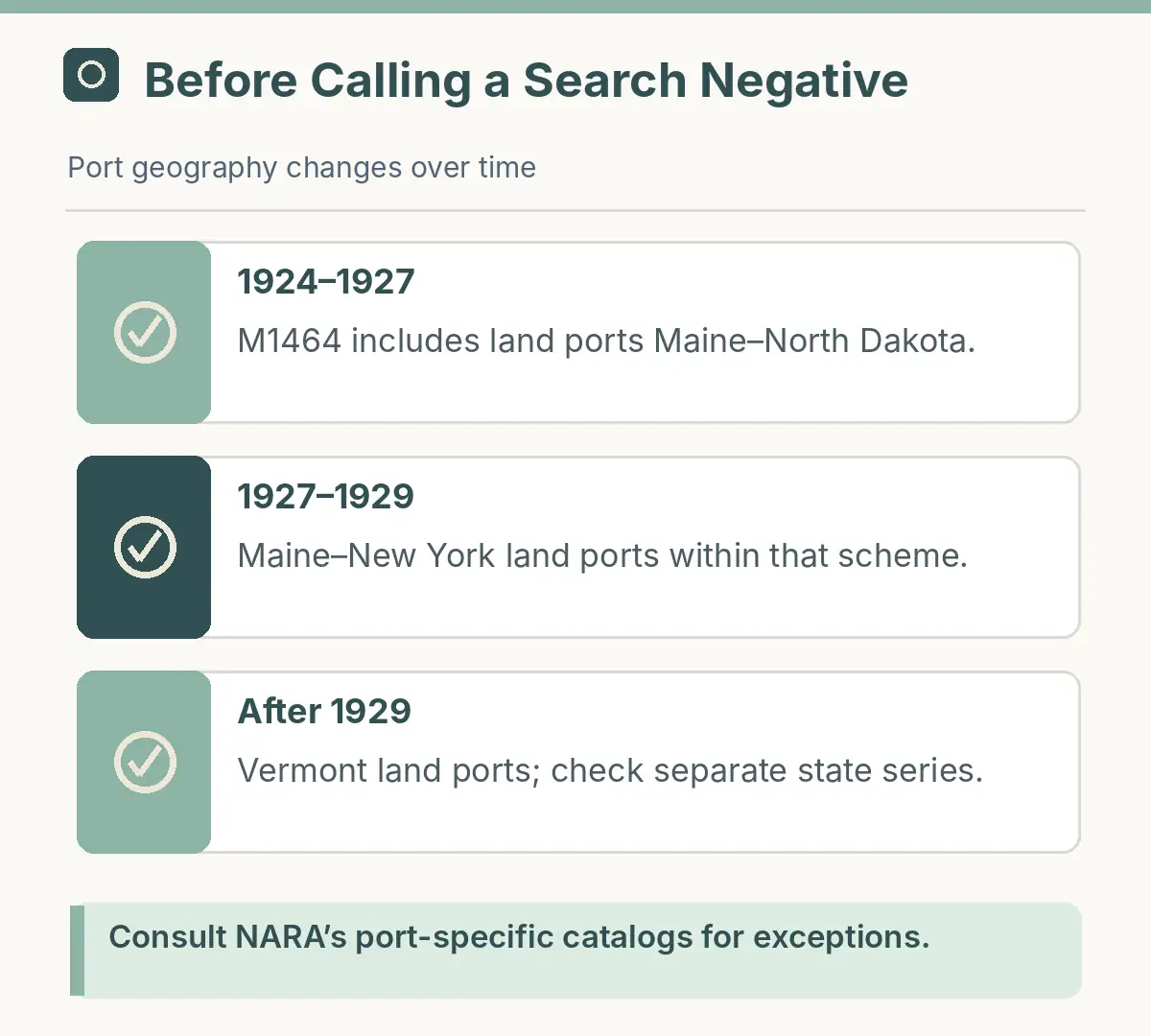
The phrase ‘St. Albans’ does not imply that all crossings took place at that Vermont town. According to NARA’s series summary, M1464 includes varying groups of northern ports in different periods: broader Maine-to-North Dakota coverage in 1924–1927, Maine-to-New York in 1927–1929, and later chiefly Vermont-only land-port entries, while also relating to Canadian seaport arrivals. Other U.S. entry points, including Buffalo and other New York crossings, have different microfilm series. Check the actual port and year in NARA’s ports catalog before claiming that a no-result St. Albans search excludes a specific person. The record title is an administrative umbrella, not a modern geographic radius around one border town.

Do not confuse an immigration card with proof of citizenship
A border-arrival card or manifest records an administrative immigration contact; it does not in itself show that the traveler became a U.S. citizen, obtained a final naturalization order or remained at the stated destination. Some travelers returned and crossed more than once. If the record names a contact in the United States, identify that person only as recorded—for instance as a reported relative or destination contact—and do not manufacture a parent-child relationship. Where entries appear inconsistent, preserve the date and exact source instead of editing them into one continuous migration story. Check separate naturalization papers, census entries or marriage records to establish subsequent residence and identity. Conversely, absence from an index can result from record survival, indexing or the fact that the person used a different port and administrative procedure. For a step-by-step method, see how to search Ellis Island immigration records and verify a passenger.
Make a two-country timeline with a clear negative-search scope
Record each border event with event date, port, country entered, source series, card or manifest, passenger-name variant and independent corroboration. Search one direction at a time. If a person made repeated crossings, keep each dated admission as a separate event, even when names, occupations and destination contacts look identical across the cards. For entry to Canada during 1908–1918 the Canadian archive describes port-and-date lists; in 1919–1924 it used individual Form 30 records, then another list regime began in 1925. These are Canadian arrival series, not interchangeable substitutes for NARA’s M1464. If the family story simply says ‘1918 border,’ searching only St. Albans could be inconclusive. Narrow the proposed direction using a dated residence in each country, and log which periods and ports were actually checked. Treat a negative result as a scoped search finding, not as proof the immigrant never crossed. To go further, our guide “Canadian Border Entry Records, 1908–1935” shows how to find lists and Form 30 without false negatives.
More Records and Archives Guides
How We Research St. Albans and Canadian Entry Routes
We use NARA’s official port list to identify M1461, M1463 and M1464, and its microfilm-series research note for geographic limitations. The Canadian archive’s border guide anchors the separate inbound-Canada regimes. We do not equate a U.S. crossing record with an inbound-Canada document, permanent residence or citizenship. Our affiliate disclosure describes site policy; these archival sources are independently verifiable.
It is the name used for an immigration administrative district and related US entry records, not only one Vermont crossing point.
A Soundex index for Canadian border entries through the St. Albans district, 1895–1924.
A separate collection of manifests for 1895–1954 whose port coverage varies over time.
No. Naturalization and continuing residence require separate records.
They primarily document entry into the United States; Library and Archives Canada holds different inbound-Canada series.