
St Matthew Bethnal Green parish records need a parish-specific coverage check before a surname search. The FreeREG register description lists transcribed St Matthew entries starting in 1745 and extending through 1837, but not all record classes are continuous. FamilySearch catalogs microfilmed books into the nineteenth century and The London Archives explains original Church of England register access. These resources overlap without being equivalent.
Confirm St Matthew rather than a neighboring Bethnal Green church
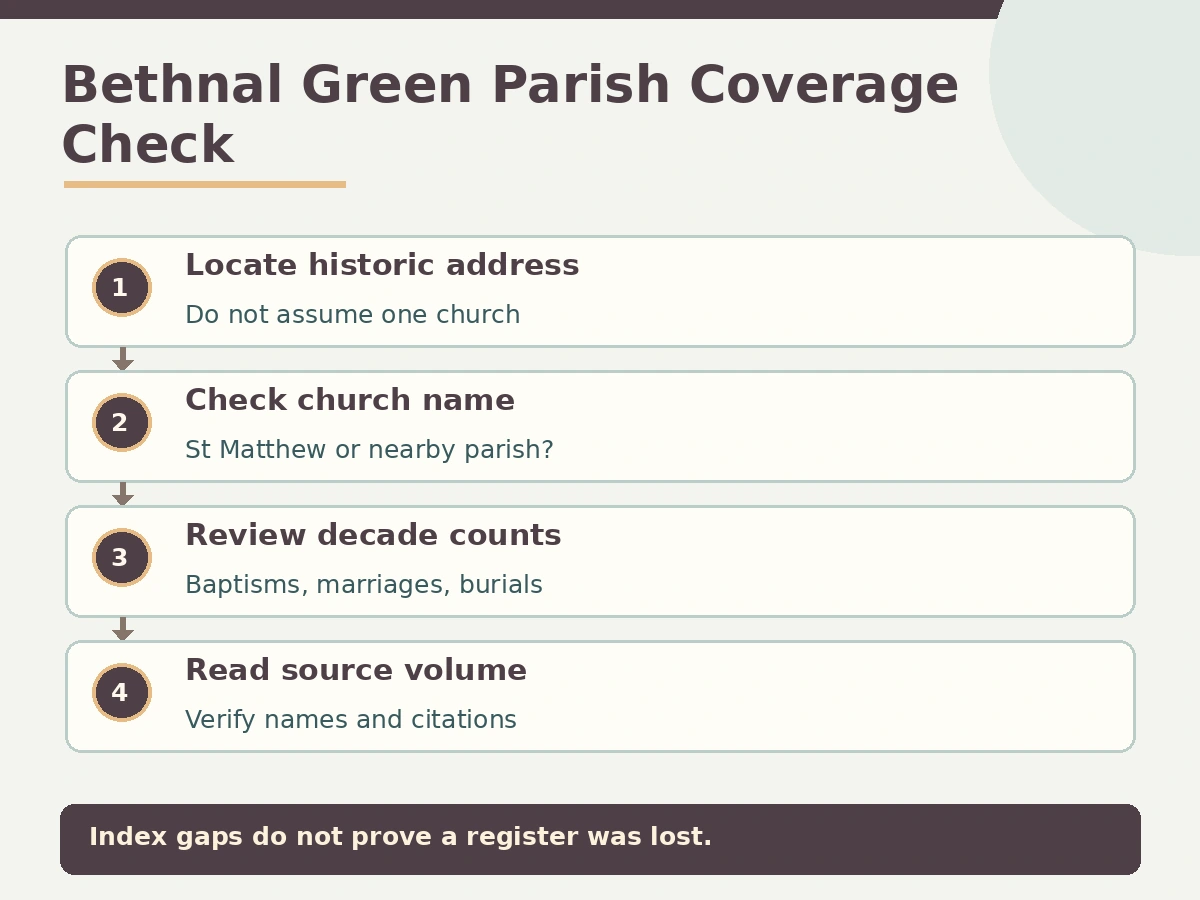
Bethnal Green developed many churches and chapel districts, so “Bethnal Green, London” is not enough to select one parish book. Start from the address and event date found in a census, civil certificate or directory. Identify the church name shown on that record, the ecclesiastical jurisdiction at the time and any later boundary changes. St Matthew is a specific Church of England parish; an event registered in Bethnal Green civil district may have occurred at a different congregation, at a nonconformist chapel or at home.
Do not search every Bethnal Green index as though it were the single St Matthew register. Build a locality list with address, historical parish, event type and date range. If a baptism was recorded after the creation of another district church, consider the new chapel’s books. Negative evidence requires knowledge that the relevant dates and pages survive and were searched. A place label in a broad database can be an indexer’s modern geographic description rather than the name written in the original book.
Read FreeREG coverage by record class and decade
FreeREG’s St Matthew register page describes its current transcribed coverage and tabulates how many baptism, marriage and burial entries appear in different periods. The overall first and last years do not promise continuous coverage for every class. For example, a row with burials but no baptisms may mean that those baptisms are not in this particular transcription, not that no children were baptized in the parish. Use the class-specific counts before searching, especially when your desired decade has a blank or unexpectedly small number.
Search the surname and likely event window, then inspect the database’s displayed transcript details and any reference to volume or source. Try variants of given names, an alternate spelling and a broader date range one change at a time. Record whether the search was conducted in the St Matthew collection or across a wider county index. An index result can direct you to a register page, but cannot certify that every word or name in the original document was read correctly.

Locate the original or microfilmed St Matthew volume
The FamilySearch Library catalog identifies parish registers for St Matthew in Bethnal Green from 1745 to 1900, filmed from originals at the London Metropolitan Archives, now The London Archives. Its detailed entries include separate registers and films, such as nineteenth-century marriage and burial volumes. Use those volume descriptions to align the event and year, then record the catalog film or volume number. “Digitized” or “online content” in a catalog is not a guarantee that every image is remotely viewable without conditions.
The London Archives’ parish-register guide describes access through indexed commercial collections, onsite consultation and its archive catalog. Home access can carry subscription requirements while archive reading-room facilities may permit different access. Verify the current method rather than describing an inaccessible microfilm as freely downloadable. When possible, inspect neighboring entries on the original page to check chronology, handwriting and page-level anomalies that a single-line index cannot show.
| Source | What it can show | What it cannot prove alone |
|---|---|---|
| FreeREG | Transcribed candidate | Every surviving entry |
| Library film list | Volume, register and date | Unrestricted online access |
| Original parish book | Wording and context | Unstated family connections |
Interpret baptism, banns, marriage and burial separately
A baptism register may name parents and residence, but the ceremony date is not necessarily the birth date. Marriage banns record a proposed marriage announcement; they do not by themselves prove that a subsequent wedding took place. A marriage register can provide witnesses, occupations or residence details depending on the era and form. A burial register records a burial rather than an independently verified death. Transcribe each event under its own heading instead of collapsing them into a combined birth–marriage–death timeline.
Record exactly how a child’s surname or a witness’s name appears. Someone with the same surname might be related, but the register does not always identify the relationship. In large, rapidly growing London districts, same-name families are particularly easy to conflate. Compare a prospective baptism with civil registrations after July 1837, household census relationships and addresses documented near the event. If a proposed marriage has only banns and no marriage entry, label the wedding unverified.
Audit missing results without fabricating destroyed registers
Before calling a St Matthew book missing, check whether the index you used covers that decade and event type. Then investigate the actual catalog volumes and the larger London Archives collection. A digitized transcription may omit pages for reasons that have nothing to do with physical destruction. If the desired volume survives but the entry remains absent, examine the family’s address and parish affiliation again. An alternative nearby church or nonconformist register may be the next reasonable search. Our guide “Limerick Archives” covers a related question.
Write a negative-search statement narrowly: “no baptism found in the FreeREG St Matthew transcription for the tested years and spellings.” Do not expand this into “the child was not baptized in Bethnal Green.” For each hypothesis record the exact collection, coverage, spelling variants, date window and source that would change the assessment. This discipline helps prevent repetitive searches and false assumptions about an entire London district.

Cite the St Matthew book as a retraceable source
An adequate citation distinguishes the original parish register, the archive that preserves it, the specific volume or film, the folio or page where available, and the platform consulted. If you used only a FreeREG transcription, name the transcribed collection and retrieval date and record the status of the original image as unexamined. Keep the FreeREG and FamilySearch references separate if they reflect different derivative copies of the same underlying book.
For a hypothetical family with two Elizabeth Browns baptized a year apart, compare both original entries before assigning parents or a later spouse. Capture witnesses, residences and neighboring entries when present. A proof statement should explain why one candidate fits independently documented geography and relationships, not merely repeat the spelling from a database row. A careful register audit can establish an event without making unsupported assertions about identity beyond the document.
More Records and Archives Guides
How We Research Bethnal Green Parish Registers
We compared FreeREG’s published St Matthew transcription statistics with the FamilySearch Library catalog’s volume list and The London Archives parish-register access guidance. We do not imply that a blank transcript decade proves record loss or that all microfilms are unrestricted online. No paid platform is required by recommendation; see affiliate disclosure.
No. The shown transcription spans particular dates and record classes with gaps; consult original-volume catalogs.
FamilySearch identifies the originals used for its films at the former London Metropolitan Archives, now The London Archives.
No. It identifies the religious event and may contain other details; do not convert baptism automatically to birth.
No. Look for the separate solemnized marriage record or other contemporary evidence.
Only that the query found no entry in the searched transcription and period; test surviving volumes and neighboring parishes.