
Limerick Archives preserves local government and other historical records for Limerick City and County, including a small number of collections particularly useful to family historians. The council explicitly notes that its archive is not a specialist genealogy service. Its digitized genealogical resources include St. Michael’s parish rate books, 1810–1846, a Limerick Union Board of Guardians deaths register, 1907–1915, and vaccination case registers, 1864–1912. These collections can corroborate address, administrative involvement or a reported event. None should be mistaken for a universally indexed civil birth, marriage and death database.
Choose the local record that matches your question
Use the Limerick Archives genealogy overview as a holdings-first guide rather than entering a surname with no plan. If the problem concerns early nineteenth-century property assessment in a city parish, begin with St. Michael’s rate books. If it concerns a death associated with the Limerick Union administration in the early twentieth century, examine the specific Board of Guardians series. A vaccination register may provide a recorded name, age or local contact detail but should not be read as a baptism register. The Council also maintains digitized cemetery resources, though that is a separate burial-intent search. For each question write down the record creator, date span and likely information before deciding the right collection to browse or request.
Read St. Michael’s rate books as assessments
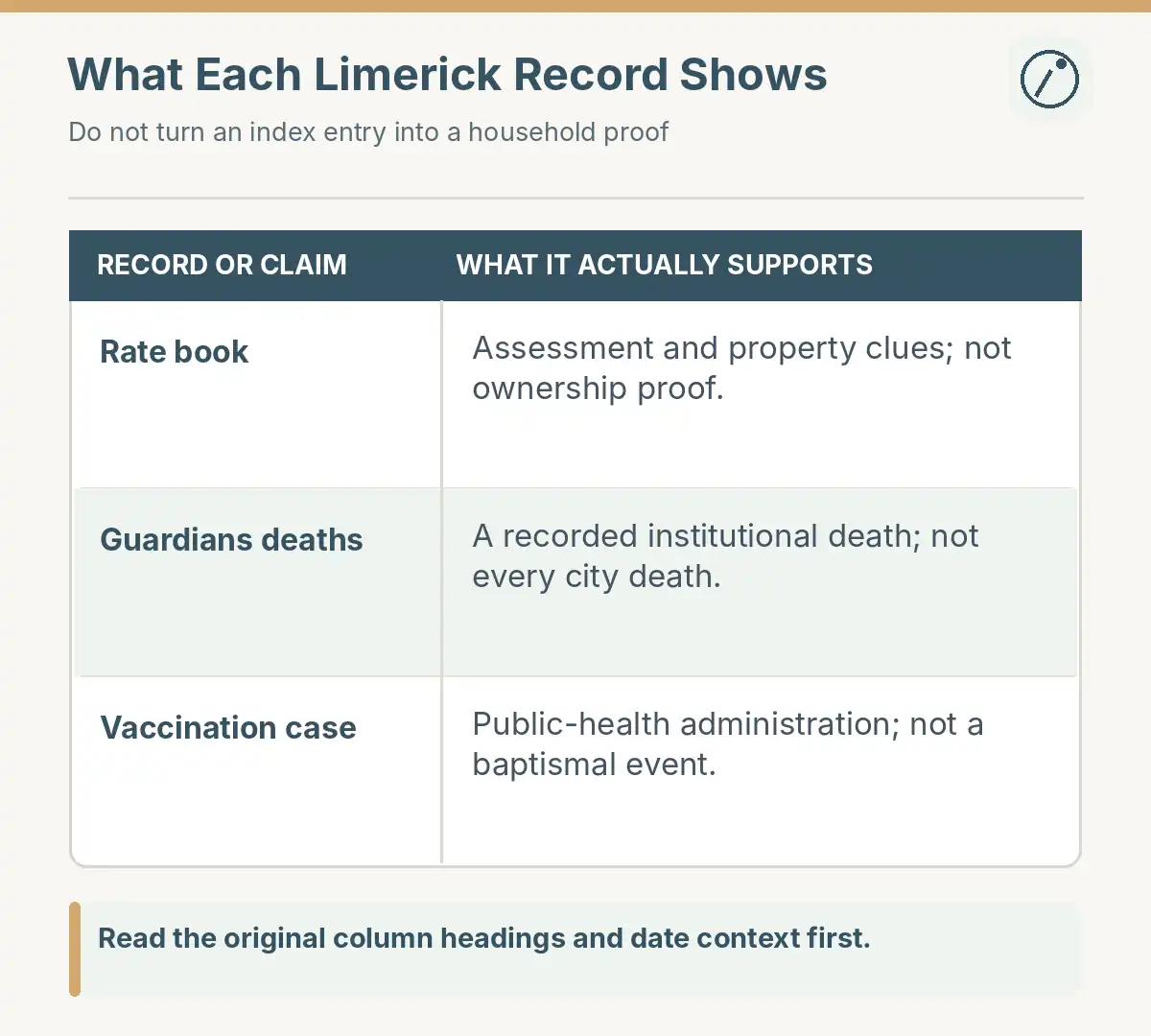
The St. Michael’s Parish rate books cover 1810–1846 in the archive’s published genealogy listing. Rate records can help build a sequence of occupier or ratepayer names for a property or street. But an assessed person is not necessarily the legal owner or every resident. Rate liability can change with local rules, tenants, agents, vacancies and property transfers. Record exact year, address, assessed description, amount if present, and where the material sits in the digitized collection. Compare adjacent years to test whether a name persisted, appeared abruptly, or was replaced. An entry is particularly useful when linked to a contemporary directory or a later valuation, but two matching surnames do not establish a parent-child relationship. Empty years may reflect archival gaps rather than a move.

Separate workhouse deaths from civil death registration
The Limerick Union Board of Guardians register of deaths, 1907–1915, is a local administrative record created for Union activity. A death appearing in a Guardians series should be transcribed using that document’s exact names, dates and institutional context. Avoid treating an inferred Union association as evidence of long-term institutional residence, pauper status or a complete medical diagnosis unless the document actually states it. A later civil death registration, funeral notice or cemetery interment may provide separate dates and additional information. Compare those claims carefully: a death in an institution, official registration, religious burial and plot memorialization can occur on different dates and in different administrative systems. The archive’s mention of the series establishes its existence, not that every death in Limerick city during those years appears there. For the next step, our guide “Limerick Gravestone Inscriptions” explains how to compare Mount Saint Lawrence sources.
Interpret vaccination registers without inventing kinship
Limerick Archives identifies registers of successful vaccination cases, 1864–1912 among its genealogical resources. This is a record of medical or public-health administration as defined by the register, not a complete child birth list or a household census. A person could be missing because of different local jurisdiction, limited coverage or incomplete preservation, rather than because that child was never born or vaccinated. If the register names a guardian, address or age, distinguish what the original handwriting actually reports from any parentage hypothesis. Avoid revealing sensitive details about living descendants and never use a historical public-health entry to make a present-day medical claim. A corroborating civil record or parish baptism is needed when the objective is to identify parents.
Use digitized material and an archive appointment appropriately
The Council’s digital archives make selected collections freely available while protecting originals from unnecessary handling. Not every relevant item is digitized or indexed at person level. Consult collection descriptions, note the archival reference, then check whether the material is available online or requires direct enquiry. The about page says the archive provides physical collection access on Wednesdays by appointment. Confirm current arrangements directly rather than planning a visit from an old tourist listing. Include the record group, approximate years, parish or street, name variants and the historical question in an enquiry. A request for an identifiable book is more actionable than asking staff to reconstruct a whole family tree.
Distinguish Council Archives from other Limerick custodians
The council archive’s administrative collections are not a substitute for civil birth, marriage and death registrations, denominational parish registers or the separate professional research organization called Limerick Genealogy. The council itself notes that most of its archive relates to civic administration and contains limited person-level genealogy. If the question is a Catholic baptism, identify the historical parish or diocese and consult the appropriate register holder or documented digitized microfilm. If the question is a statutory event, use the relevant civil registration office. The Limerick Diocesan Archives separately describes access restrictions on parish books and confirms that original baptism and marriage registers are held in individual parishes. Do not assume a town-based local government archive has authority to certify those events.

A practical archive request sheet has eight fields: research question, historical place, record creator, series title, date range, document reference, name variants and exact evidence needed. For example, a reported nineteenth-century St. Michael’s householder can be checked in sequential rating years before a separate search in a street directory. The two sources should be cited individually. When a property name changes, preserve the older street wording and do not assume the same parcel continued under one number. For a Union death or vaccination entry, ask what administrative form the original volume used and which columns were actually completed. These are defined research questions, unlike an unrestricted surname sweep.
More Records and Archives Guides
How We Research Limerick Council Sources
Our route starts from Limerick City and County Council’s own inventory, distinguishes digitized collections from original physical custody, and checks the diocesan register guidance for a different type of claim. The named date spans belong to specific archival series, not all city records. We have not invented a successful search or a named family. The affiliate disclosure sets out commercial transparency; free municipal records are the first step when they meet the question.
No. The Council says it is principally a local government archive and does not specialize in family research.
Limerick Archives lists St. Michael’s Parish rate books covering 1810–1846.
No. It is a specific Guardians register dated 1907–1915, not an all-city statutory death index.
Not automatically. Transcribe any stated details and confirm birth or parentage in an independent source.
No. Some digital collections are free, while other physical holdings require an archive enquiry or appointment.