
To find Irish ancestry records, choose the repository for the kind of evidence you need. Civil registration, Catholic registers, Northern Ireland archive holdings and valuation documents do not cover identical dates or people. A search result can be a name index, a transcript, a register image or merely an archive catalog description. Knowing which one you found determines what you can responsibly conclude. This guide is a locator for specific record classes, not a general family-tree tutorial; begin with the event you need to document and then move to the custodian who preserves that kind of evidence.
Identify the record event before selecting a website
Write a narrow question such as ‘What name did this marriage register give for the bride’s father?’ rather than ‘Who were my Irish ancestors?’ Choose the approximate period and the smallest place supported by existing evidence. A baptism, civil birth, marriage, property transfer and probate file can answer different questions. Create an evidence-needs list with columns for event, likely year, jurisdiction, likely repository and the exact fact sought. Searching a giant all-records box first often hides the reason a candidate matters.
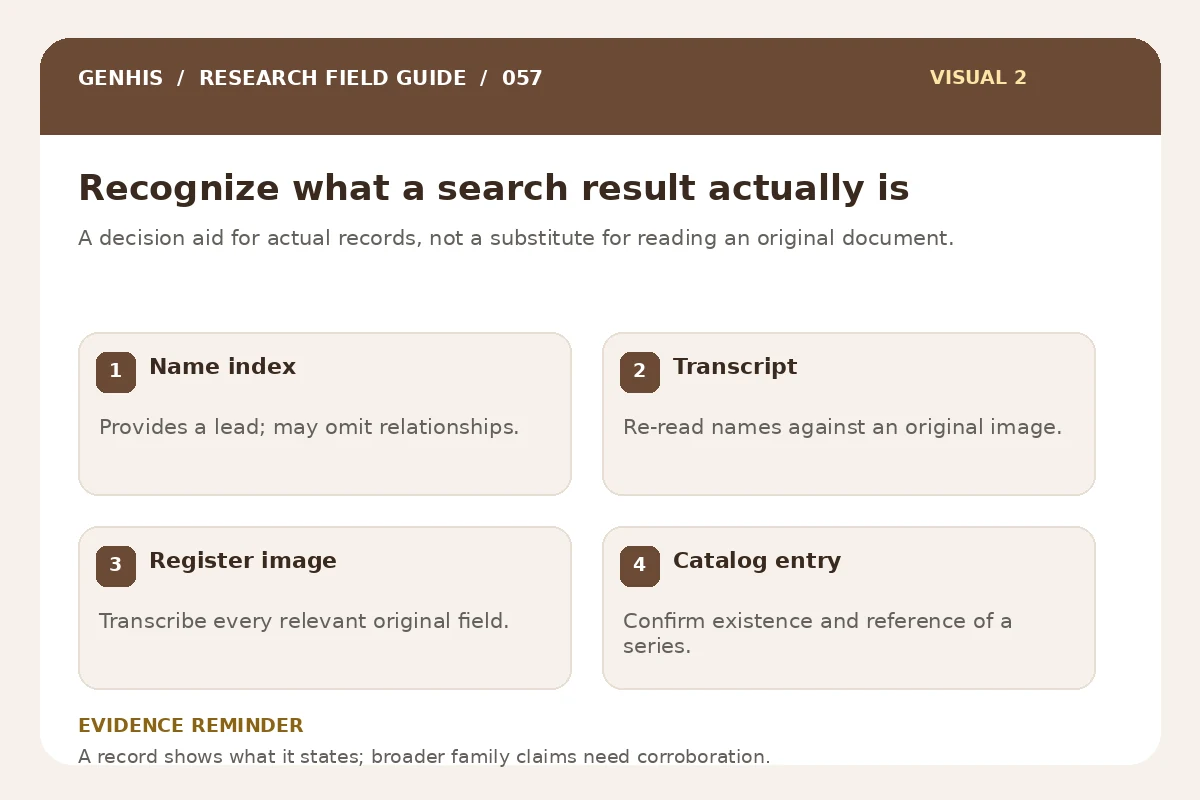
Decide whether you need an image, a transcript or an index reference. A digitized index might contain the name, registration district and year but omit crucial relationships or signatures from the original entry. Treat user-contributed family trees and memorial transcriptions as leads for discovering custodial records, not substitutes for those records. If no image exists online, note the archive reference and investigate consultation or ordering rules directly with the institution rather than guessing about access or fees.
Find civil registration entries on IrishGenealogy
The official IrishGenealogy service supplies searches of historic civil records, with general registration of births, deaths and Roman Catholic marriages beginning in 1864 and non-Catholic marriages from 1845. The portal publishes current coverage and privacy restrictions; available image years can change with annual releases. A civil marriage entry may identify age, residence, witnesses and parent information, depending on the form and date. First locate the index match, then inspect the actual register image and transcribe only fields that really appear. Our guide “Northern Ireland Marriage Records” covers a related question.
Use variant first names, surname spellings and a date interval before rejecting a result. Different registration districts can cover the same broad locality in different periods; check where the event was registered instead of assuming it happened in the town named by a family tradition. Note whether you viewed a scanned register, copied index entry or derivative transcript. If the person’s event occurred in Northern Ireland or after political changes, confirm the applicable registration service and the record’s jurisdiction rather than assuming one contemporary portal contains everything.
Locate Catholic parish images at the National Library
The National Library of Ireland hosts images derived from Catholic parish register microfilms for the majority of parishes in Ireland and Northern Ireland through around 1880. This is principally an image resource; an automatically searchable person-name result may come from a different organization’s indexing. Locate the correct Catholic parish on the Library’s map and inspect the register’s event dates. The civil parish name or nearby town is not always the name of the Catholic parish where a baptism occurred.
Follow a search deliberately: locate parish, select the baptism or marriage book, inspect pages around the approximate date, and save the microfilm or viewer reference with the entry. A missing name can mean an event was recorded at a neighboring chapel, a register began later, a page is illegible or the guessed date is wrong. Compare witnesses and sponsors but do not declare them relatives without corroborating records. For other religious traditions, locate separate denominational collections and surviving local church archives.
Search local Irish archives beyond vital records
Use Griffith’s Valuation for mid-nineteenth-century property occupiers and the Tithe Applotment Books for many rural occupiers in the 1820s and 1830s. These collections cannot replace full civil records or supply every household member. They can, however, identify a townland or property associated with a name, giving you a concrete locality in which to search church, estate or later census sources. Check exactly what the record covers and whether the listed person was a tenant or occupier rather than a freehold owner. For the fuller picture, see our guide “Irish Registry of Deeds”.
Probate calendars, estate papers, school registers, local newspapers and directories may preserve distinctive names and addresses not present in an index of births or baptisms. First search the archive catalog to learn whether the relevant series survives and which dates it covers. An archival catalog hit is not a statement that a specific person appears inside the item. Record the collection title and call number and check access conditions before making a trip or asserting that the record is available online.
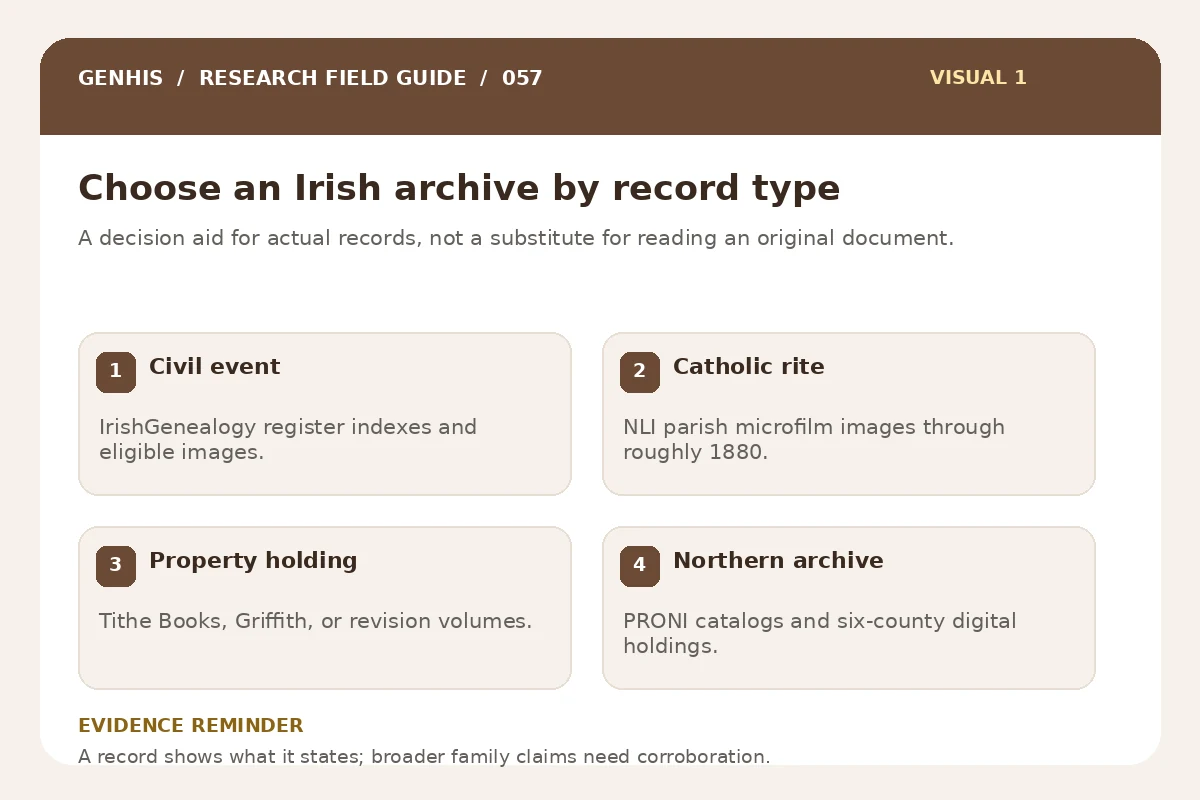
| Decision point | Recommended research action |
|---|---|
| Civil event | IrishGenealogy register indexes and eligible images. |
| Catholic rite | NLI parish microfilm images through roughly 1880. |
| Property holding | Tithe Books, Griffith, or revision volumes. |
| Northern archive | PRONI catalogs and six-county digital holdings. |
Use PRONI for six-county historic collections
For a family linked to the six Northern Ireland counties, the Public Record Office of Northern Ireland offers an institutional starting point for valuation revisions, will calendars, freeholders, street directories and its wider catalog. The digitized valuation revision application covers many historical changes from 1864 to 1933. Searching a property across successive revision volumes can show when a named occupier changed, but the date of an annotation is not necessarily the date of a death, inheritance or change of ownership.
Do not assume all Irish records from the nineteenth century belong exclusively to one current administration. A pre-partition return may cover the whole island, while later civil and census records belong to distinct systems. Write down the county and place for each event and note the time of record creation. Searching an archive by county, parish or townland can be more discriminating than searching a common surname alone; when relevant, consult adjacent counties and alternative place spellings. For a related choice, see our guide “County Donegal Birth Records”.
Evaluate matches with a source-type matrix
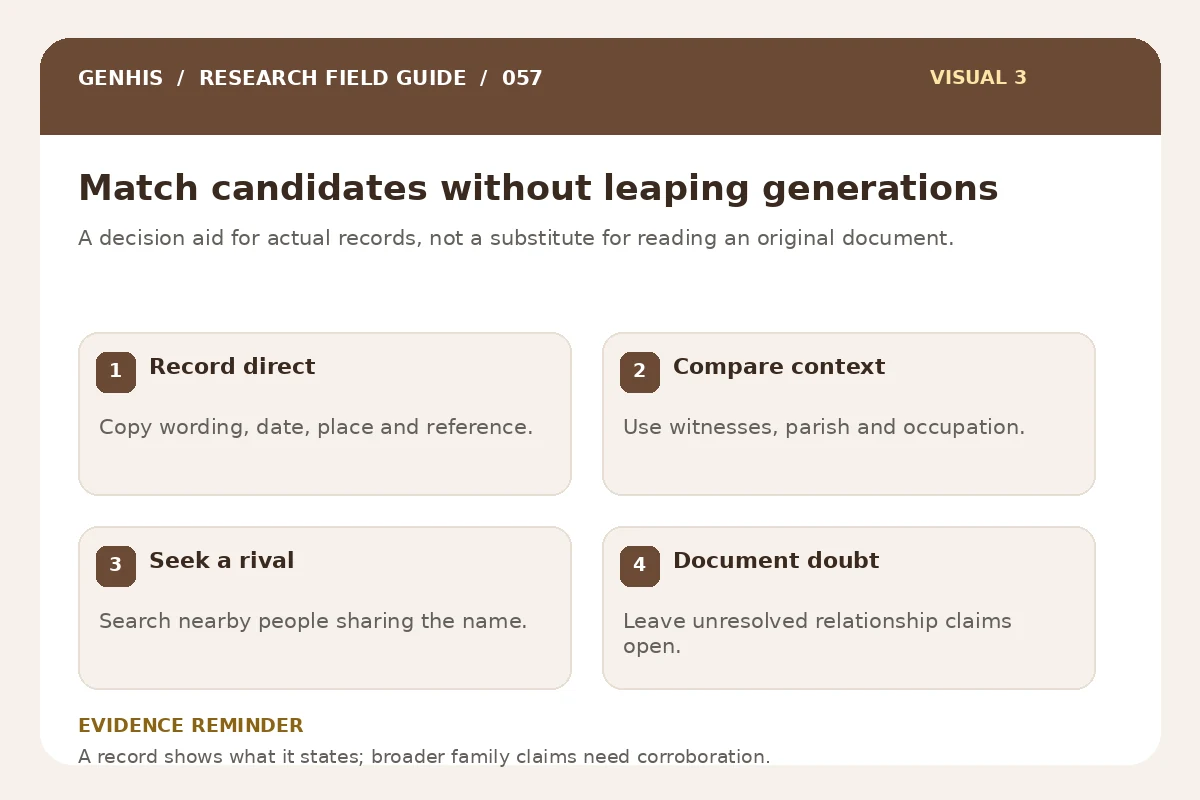
Imagine a fictional Bridget Nolan in a baptism transcript, an 1860s property valuation and a civil marriage index. These are three separate candidate records, not three confirmations of the same woman’s life. Ask what each document directly says, when it was created, who provided the information and whether a different person of the same name could fit. A baptism might identify parents; a valuation might name an occupier; a marriage index might contain neither parental detail nor the complete marriage entry.
Before accepting identity, compare date intervals, address, parish, witnesses, trade and later household associations. Make a spreadsheet or paper table with one row per candidate and distinct columns for direct facts, interpretations, and missing evidence. If two candidates remain plausible, preserve the ambiguity rather than changing your tree to the more convenient story. Build the research log around a disambiguating question, such as which marriage register image gives the father’s occupation. Our walkthrough on how to research Irish genealogy across changing borders and missing records sets out each step.
Preserve archive-ready citations and follow-up requests
For an Irish civil image, save the event type, year, register district, entry or volume-page details shown and the source URL. For a parish image, keep denomination, parish, book dates, event page and microfilm or image identification. Also, for PRONI or a National Archives catalog entry, retain the exact reference number and document description. Screen captures stripped of archival context are poor evidence and may not be retrievable after a website redesign. Keep a copy of what you transcribed and note doubtful letters.
Conclude by writing a precise next action: inspect a second parish book, order an eligible certificate, verify a property revision page or search a named probate calendar. Log an absent search result with location, dates, search terms and repository; do not present it as evidence that the event did not occur. Do not republish records or personal details of living people just because a search interface technically reveals them. Search methods and legal access rules are separate questions.
How We Research: map dates, documentary scope, and uncertain conclusions
We compared record class and media type in official IrishGenealogy, NLI, National Archives and PRONI descriptions. This guide is organized by the record a researcher needs to obtain rather than by a broad family-history journey. The named case is fictional. Current online year coverage and archive access must be checked at the institution before requesting a record.
Authoritative sources and collection-specific limitations
www.irishgenealogy.ie — institutional source. Official FAQ identifies historical civil-registration starting points and current image coverage.
registers.nli.ie — institutional source. National Library explains Catholic parish register microfilm scope and time limits.
www.proni.gov.uk — institutional source. PRONI lists six-county historic local and family-record resources.
www.proni.gov.uk — institutional source. PRONI explains revision book date span and property-based search.
nationalarchives.ie — institutional source. National Archives Ireland describes historic record classes and current service limitations, including redevelopment of its legacy genealogy website.
More Records and Archives Guides
Privacy, disclosure, and responsible interpretation
Civil record interfaces and local archive catalogs are not blanket permission to publish identifying details about living people. A place or surname match alone never establishes a biological relationship, and paid access or official registration is not a claim of certainty. We name civil, parish and local archives for their records, not because they sponsor GenHis or certify any suggested pedigree. Read the GenHis affiliate disclosure for site policy.
Begin at IrishGenealogy for available historical civil indexes and eligible images, and check its current year coverage.
No. Its parish project principally provides images; names may be searchable through separately produced indexes.
No. They describe valuations and occupiers of property; use other documents for birth and family relationships.
PRONI is an important source for Northern Ireland valuation revision books and related local series.
Include custodian, series or register, event or holding, jurisdiction, image or call number and retrieval details.