
To find a Northern Ireland marriage, first determine whether the ceremony took place before or after the civil registration changes. The General Register Office Northern Ireland (GRONI) indexes registered non-Roman Catholic marriages from April 1, 1845, and all registered marriages from January 1, 1864, for the six counties now in Northern Ireland. The online historic-search service only provides marriages more than 75 years old. These boundaries decide whether an absent index entry is meaningful or whether a church register is the right first source.
Route the search through the April 1845 and January 1864 thresholds
GRONI’s official introduction distinguishes non-Roman Catholic marriage registrations beginning April 1, 1845 from all registered marriages beginning January 1, 1864. If the couple married in 1852 in a Catholic parish, a missing GRONI entry is expected and you should look for parish evidence. If the couple married in 1867, the civil marriage registration is a relevant target regardless of denomination, subject to actual registration and historical survival.
Use the jurisdiction at the time and the county where the ceremony took place, not simply the later residence. GRONI holds registrations for the area that is now Northern Ireland, although the island was one jurisdiction when many early marriages occurred. For a ceremony elsewhere in Ireland, choose the appropriate Irish register service rather than searching Northern Ireland blindly.
Search GRONI historic marriages only within its access window
The GRONI online guidance states that marriage records must be more than 75 years old to be searched as historical records online. The cutoff rolls forward over time, so check the published rule on the day you search instead of copying a fixed terminal year from an old blog. GRONI has other routes for more recent records, including its Belfast Public Search Room and certificate applications, each governed by separate access conditions.
Plan a query around both partners, an approximate year and a credible place. Search the other spouse’s name if the first spelling fails. Registration districts are not identical to every church parish or townland. Preserve the exact spelling and reference from the search result; then compare that candidate with independent family records before deciding it is your couple.

Read the actual marriage entry rather than a derivative index
A name hit can point to a registration but cannot by itself prove the parents, addresses or earlier marital status of the people involved. Obtain a view or certificate using the access route applicable to the record and read the complete entry. Record date and place of ceremony, spouses, residence, age or full-age wording, occupations, fathers where present, witnesses and the officiant or registrar. Do not convert a reported father’s occupation into evidence that the father was still alive.
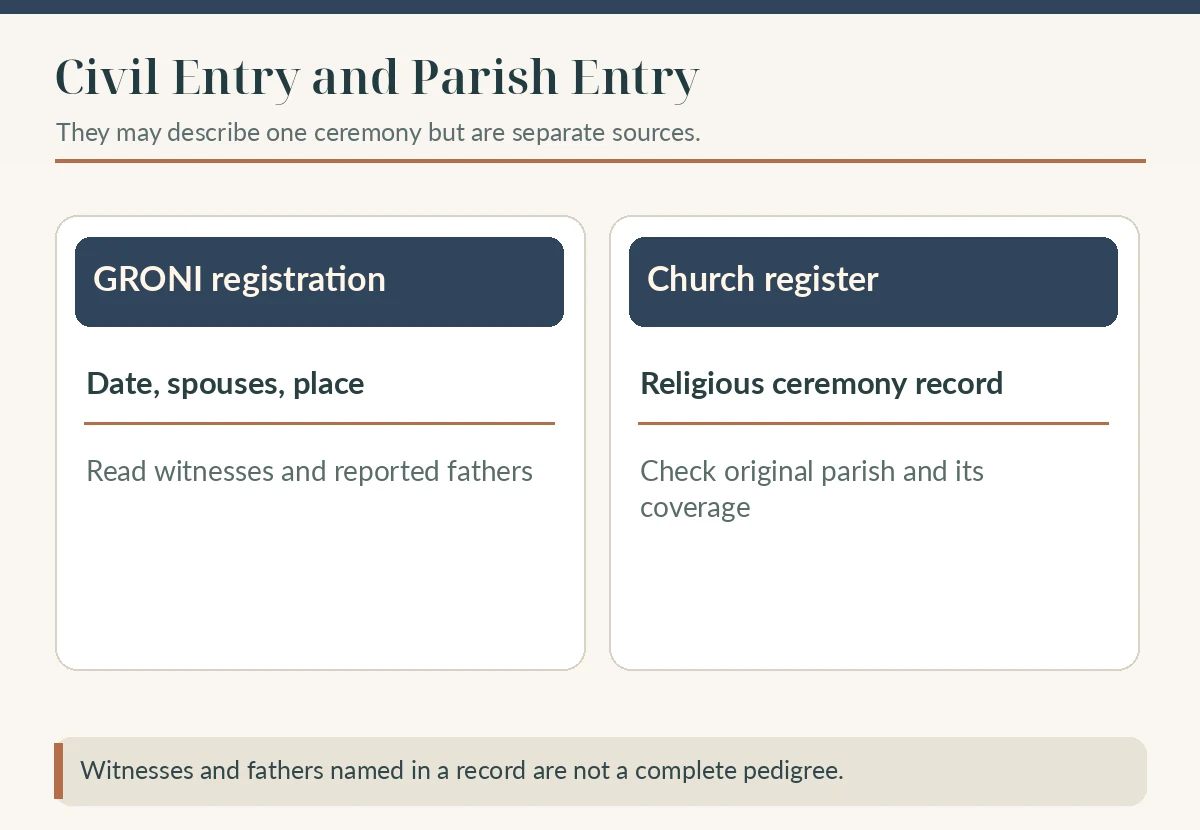
When a couple shares common names, witness names and the ceremony location can be especially helpful comparison fields. A church or chapel register may contain an independently created or near-contemporary counterpart. Keep the two sources separate: a civil entry and parish entry might reflect the same ceremony, yet the informants, copying route and fields can differ.
| Marriage period | Civil search route | If no result |
|---|---|---|
| Before April 1845 | Church books first | Check church survival and parish boundaries |
| April 1845–December 1863 | GRONI for non-Catholic registered marriages | Catholic parish entries; alternative districts |
| January 1864 onward | GRONI for all registered marriages | Recheck names, dates and jurisdiction |
Use parish registers appropriately for Catholic and pre-1845 marriages
For a Catholic marriage before 1864, use the documented parish and approximate date to seek surviving church registers. For non-Catholic marriages before April 1845, or any ceremony before the relevant civil system, the parish is likewise the appropriate starting point. Identify historical church boundaries and custody; do not assume the present-day parish holds every earlier volume. A transcript with no image is not equivalent to examining the original entry.
A couple’s marriage may have occurred outside the county where children were later baptized. When a parish search fails, expand by adjoining parishes in a reasoned circle, not by accepting every same-name couple found throughout Ireland. Write down dates covered by surviving registers; an unpreserved parish book cannot serve as strong negative evidence. Our guide “Dublin Church of Ireland Registers” goes into more detail.
Distinguish marriage registration from the later certificate order
The government’s certificate ordering guide explains which registered marriages it covers and what details assist an application. The historical registration is an event recorded at the time; the modern certificate is an official copy issued later. When citing a certificate, include both the marriage date and the issuing source. A download or purchased copy is not a new marriage event.
Charges, user accounts and viewing rules can change. Verify current terms on nidirect before paying and avoid publishing any personal details belonging to living people. If a record is too recent for the historic online service, do not misrepresent that restriction as a missing or destroyed nineteenth-century register.
Compare two same-name couples with dates, witnesses and residence
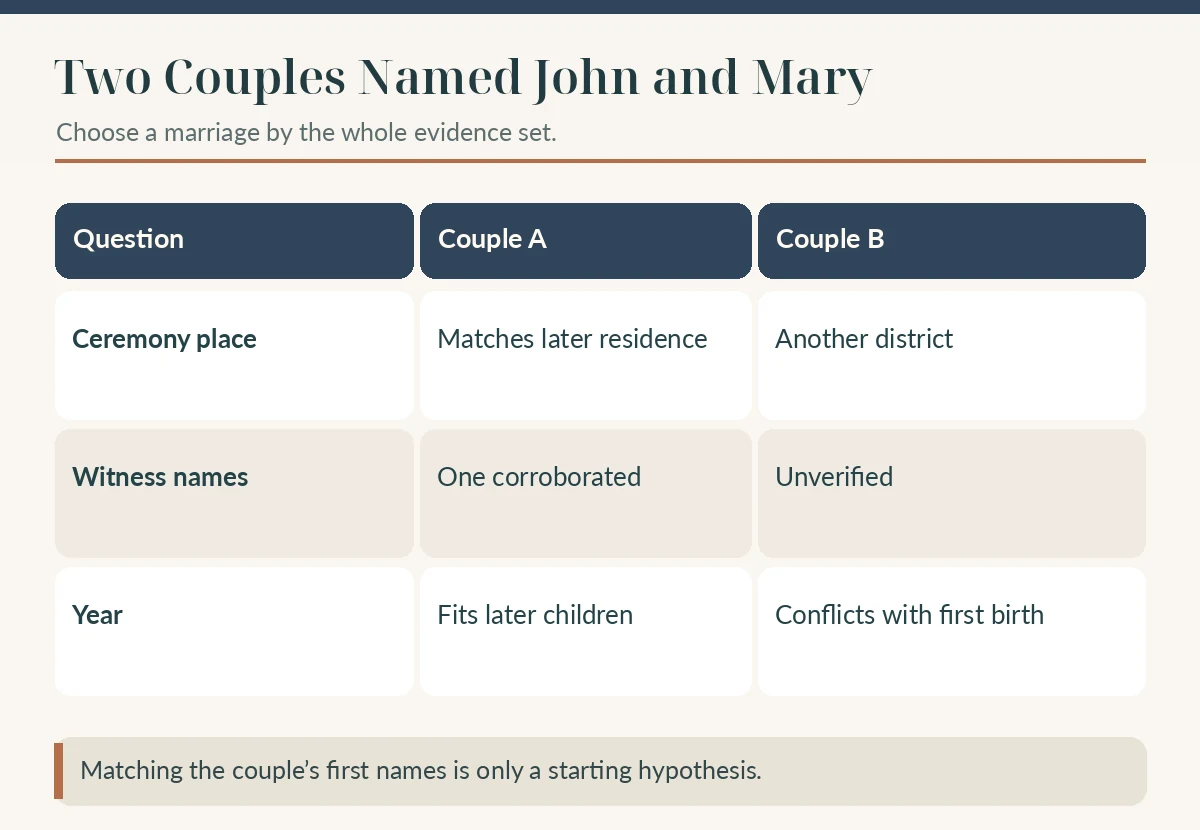
Imagine two John-and-Mary couples marrying within five years in neighboring districts. Build rows for ceremony date, district, bride’s surname, stated ages, occupations, witness names, and subsequent children’s baptismal places. A surname match across records is only a candidate match. If ages conflict, test whether an age was rounded or a “full age” statement was used instead of declaring identity proven. For a related choice, see our guide “Tasmanian Marriage Records”.
Treat the relationship between a named witness and the couple as unknown until another source identifies it. Witnesses may be relatives, neighbors or friends. A father named in the register is a reported relationship, not automatic proof of every other person with that surname in a family tree. Preserve the full chain of source references.
Keep a date-specific GRONI search log and explain unanswered claims
Capture search date, all spelling variants, event window, registration district, results considered and whether the original record was inspected. A no-result statement should say “not found within the searched database and dates,” not “they never married.” The next source might be a pre-registration parish register, a different district, or another Irish civil repository.
For the final family argument, separate what GRONI directly records, what the subsequent censuses suggest and what is still unknown. A certified entry can document a legal ceremony and spouses, but it does not independently verify every reported birthplace or prove kinship to everyone at the same address. Our guide “GRONI Death Records” goes into more detail.
More Records and Archives Guides
How We Research GRONI Marriage Entries
Our review starts with the record creator and holdings guidance rather than repeating an index description. We compared the dated archival instructions and forms above, checked which fields are genuinely present, tested the difference between an original record and a derivative index, and built the visual worksheets around one specific failure mode: assuming Catholic marriage coverage started in 1845 or ignoring the rolling online cutoff. The examples are illustrative, not transcriptions of real individuals, and source claims should be rechecked if a custodian changes its access policy.
All recommended resources here are informational archival sources, not sponsored endorsements. We have not inserted paid links or assumed that an affiliate relationship exists; see the affiliate disclosure. Keep identifying information about living people private, and document unresolved claims rather than publishing unverified family connections.
GRONI indexes non-Roman Catholic registered marriages from April 1, 1845 and all registered marriages from January 1, 1864.
The pre-1864 non-Catholic civil series does not cover Catholic ceremonies; begin with an appropriate parish register.
More than 75 years old, according to the official guidance; the cutoff changes as time passes.
No. A signature proves a person was recorded as a witness, not a biological relationship with either spouse.
Use the civil or parish custodian for the actual place of marriage; GRONI is not the registration service for the whole island.