
For most births in the six counties of today’s Northern Ireland before 1864, a modern government birth certificate will not exist. PRONI explains that civil birth registers held by GRONI begin in 1864. Earlier evidence is often a baptism entry in a church register, but the baptism date is not automatically the date of birth. Begin with a known townland or parish and probable congregation, inspect PRONI’s Guide to Church Records for dates and reference numbers, and then check the actual entry where access permits. A missing baptism is not proof a child was never born.
Place the birth in the correct pre-1864 legal era
GRONI’s civil registers of births and deaths begin in 1864. Non-Roman-Catholic marriage registration began earlier in 1845, but that exception does not create civil birth certificates for the 1840s or 1850s. When a family story gives a birth in 1857, search a baptism or another near-contemporary document rather than inventing a GRO birth registration number. Record the supposed birth year as an estimate until an original source supports a precise date. Sources from later life can disagree about ages without any one of them necessarily being fraudulent. For a related choice, see our guide “County Donegal Birth Records”.
Find the historic parish before choosing a church
A townland name is a useful starting point, but church registration follows congregations and religious jurisdictions, not always the modern civil parish boundary. Establish the townland’s historical county and parish, then list plausible Church of Ireland, Roman Catholic, Presbyterian and other congregations used locally. A family may have traveled outside its immediate parish for worship or baptism. Use a dated map or directory to avoid searching a newly formed congregation for an earlier event. Record why each congregation is a candidate rather than searching only one matching surname.
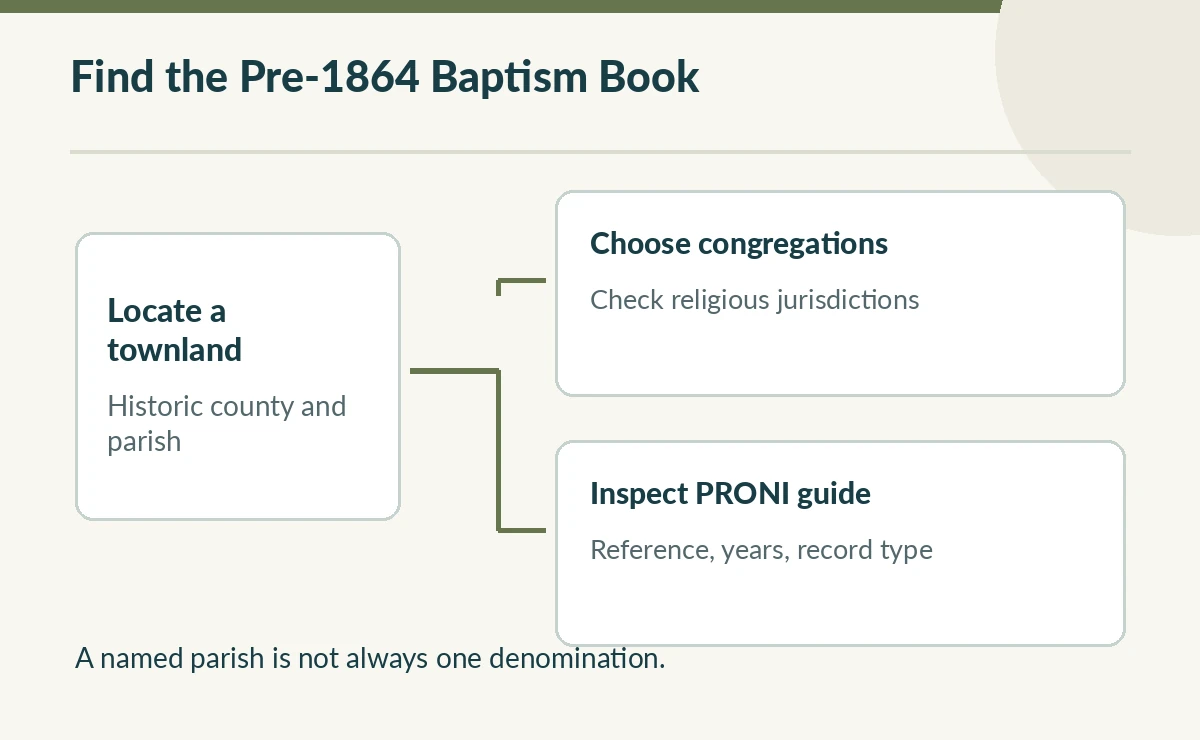
Use the PRONI Guide to Church Records as the holdings test
PRONI’s Guide lists churches, denominations, relevant record series, date coverage and reference identifiers. A denomination code such as C.I., P. or R.C. identifies the church tradition used in the guide, not the religion of any particular ancestor until a record is located. Note the book’s start and end years, whether baptism, marriage or burial entries are included, and whether there are documented gaps. PRONI holds material from many but not every congregation; some original books remain with the church or another custodian.
Distinguish register custody from digital access
A catalog entry may describe a microfilm copy even though the original is still kept by the congregation. PRONI reports that some church microfilms are being digitized and that digitized materials can be consulted in its search room. Do not assume that a reference number guarantees free remote access to full images. Before ordering or visiting, check the current access route, opening status and any applicable privacy closure. Where a recent volume is restricted, do not attempt to identify living people through circumvention.
Transcribe baptism, parents and residence as distinct claims
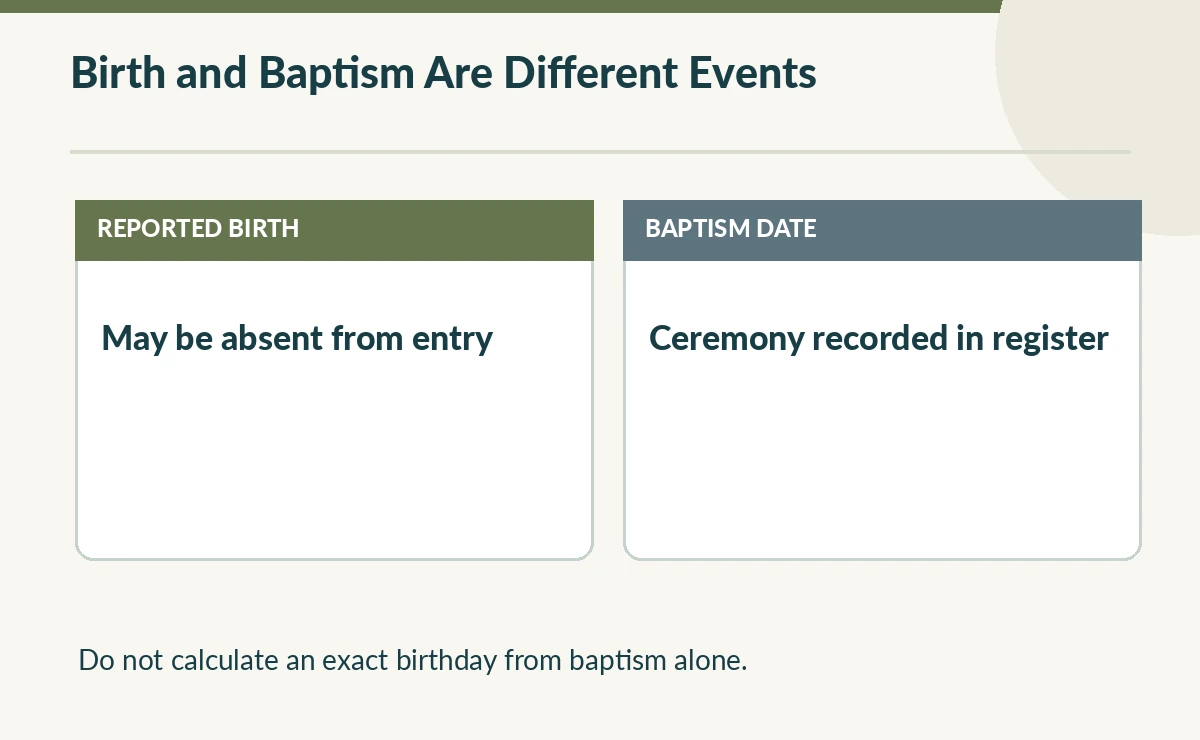
A baptism record may name a child, parents, witnesses or sponsors, residence and ceremony date. These fields vary by denomination, minister and era. If only a baptism date appears, record it as such; a person could have been baptized days, weeks or much later after birth. Where a mother is not named, the missing field should be marked “not stated,” not reconstructed from a later family tree. Cross-check a household with several children to distinguish common-name parents in nearby congregations.
Compare the original image with any volunteer transcription
An index or handwritten extract is a finding aid and may omit witnesses, marginal remarks, residence, an alternate surname or an unclear date. On an original image, inspect the lines immediately before and after your candidate entry. Look for register headings and repeated abbreviations: the minister may have used one heading for several events. Record precisely what is legible and label uncertain readings. The historical spelling may differ from modern standardized forms. Avoid treating a transcription’s silently normalized name as a second independent source.
Recover after a gap in the parish book
If the relevant baptism book starts in 1820 and you need 1805, a failed name search tells you very little about the person. Document the uncovered years and inspect a neighboring congregation, surviving session or vestry records, marriage entries, grave registers, school registers or later civil records. A sibling’s baptism could connect the household to a congregation, but it still does not establish the other child’s exact birthplace. PRONI’s holdings guide should drive the search boundary, not an assumption that all records were lost in the same event. For a related choice, see our guide “Ontario Wesleyan Methodist Marriage Records”.
| Question | Evidence to check | Do not assume |
|---|---|---|
| Identity | Name plus independent family clues | Every namesake is the same person |
| Date | Original field and its event label | A later record gives the exact date |
| Coverage | Place, years and document type | A failed index search proves absence |
| Access | Custodian and current restrictions | All original pages are downloadable |
Avoid conflating two children with the same name
For a hypothetical William Brown born around 1850, two baptisms several miles apart may both fit a later census age. Compare named parents, father’s occupation if stated, sponsors, townland, siblings and later marriage evidence. Keep separate rows for each candidate and explicitly identify conflicting facts. A shared minister or witness can suggest a research network, not prove two Browns are the same person. A baptism itself establishes that the ceremony was recorded; biological parentage should be evaluated in light of the informant and other sources. Our guide “German Census Records” covers a related question.

Request the most useful page with a precise citation
When contacting PRONI or a congregation, provide the county, parish or town, denomination, church, approximate dates and PRONI reference when available. Explain whether you need a baptism image or only confirmation of survival. Copy the book title, register span, folio or page and repository into your log. PRONI notes that copies of digitized pages may be requested and that sensitive information can be redacted. A precise request is more useful than asking for “all Brown births in Northern Ireland” with no place or period. To go further, our guide “Northern Ireland Marriage Records” shows how to use GRONI and the 1845–1864 divide.
An unmarried mother, a child baptized outside the family’s usual church, or a congregation that changed location can complicate an otherwise straightforward surname search. These possibilities should generate research alternatives rather than assumptions about identity or social status. Transcribe historical wording faithfully, but distinguish the minister’s observation from conclusions the surviving evidence does not justify. Period sources can omit or misstate family relationships. For a related choice, see our guide “Jamaica Historical Birth Records”.
More Records and Archives Guides
How We Research Pre-1864 Church Holdings
We compared PRONI’s current visitor guidance, its church-holdings guide and its digitization/access policy. We describe a baptism as an event separate from birth, distinguish GRONI civil custody from PRONI church copies, and do not infer that every parish book or modern record is publicly accessible. Check the primary references directly: Official archive guide. Original collection or archive information. Additional access guidance.
This article offers research methods, not guaranteed records or paid recommendations. We do not claim an affiliate relationship with the listed archives or services. Read our affiliate disclosure for site-wide information.
No ordinary civil birth registration exists for 1850 under the general system; look for church evidence and other records.
Not unless the entry explicitly supplies a birth date, which must be transcribed separately from the ceremony date.
No. PRONI’s guide covers its holdings, and some originals remain in church custody.
No. PRONI describes onsite digital and microfilm access, with some privacy restrictions.
Record the congregation, years sought, extant coverage and next alternate source, rather than a claim that the person did not exist.