
An Ontario Wesleyan Methodist marriage may be recorded in a congregation’s register or a preacher’s circuit book, even when a provincial civil marriage registration is absent or not yet available. The Archives of Ontario identifies Methodist materials in its Church records collection (F 978) and separately describes miscellaneous religious marriage documents in F 982. Start with a known community and approximate wedding date; consult the congregational holdings table for an actual surviving book, then verify the original image or film. Do not assume that a church index entry is identical to a government marriage certificate.
Start with the marriage date and the Ontario locality
The Government of Ontario began its province-wide system of vital statistics registration in 1869, according to the Archives of Ontario. Earlier marriages may be traced through religious registers and district or county records, but early coverage is uneven. Establish whether the place was known at the time as Upper Canada, Canada West or Ontario, and identify its county or township at the relevant date. A family that moved between a rural circuit and a town congregation might have left a marriage entry in an unexpected location. Record historical and modern place names separately. For a related choice, see our guide “Jamaica Historical Birth Records”.
Search Wesleyan congregations and preaching circuits
Wesleyan Methodist communities were often served by traveling ministers and circuits rather than a single fixed parish structure. A marriage may appear in a minister’s notebook, circuit register or local church book, and later church mergers can change its custodian. Search by historic township or town and consider neighboring communities reached by the same minister. A surname alone is a poor starting point because a common couple name may occur across several circuits. Try to identify the minister or chapel named on another contemporaneous family document before choosing a volume.
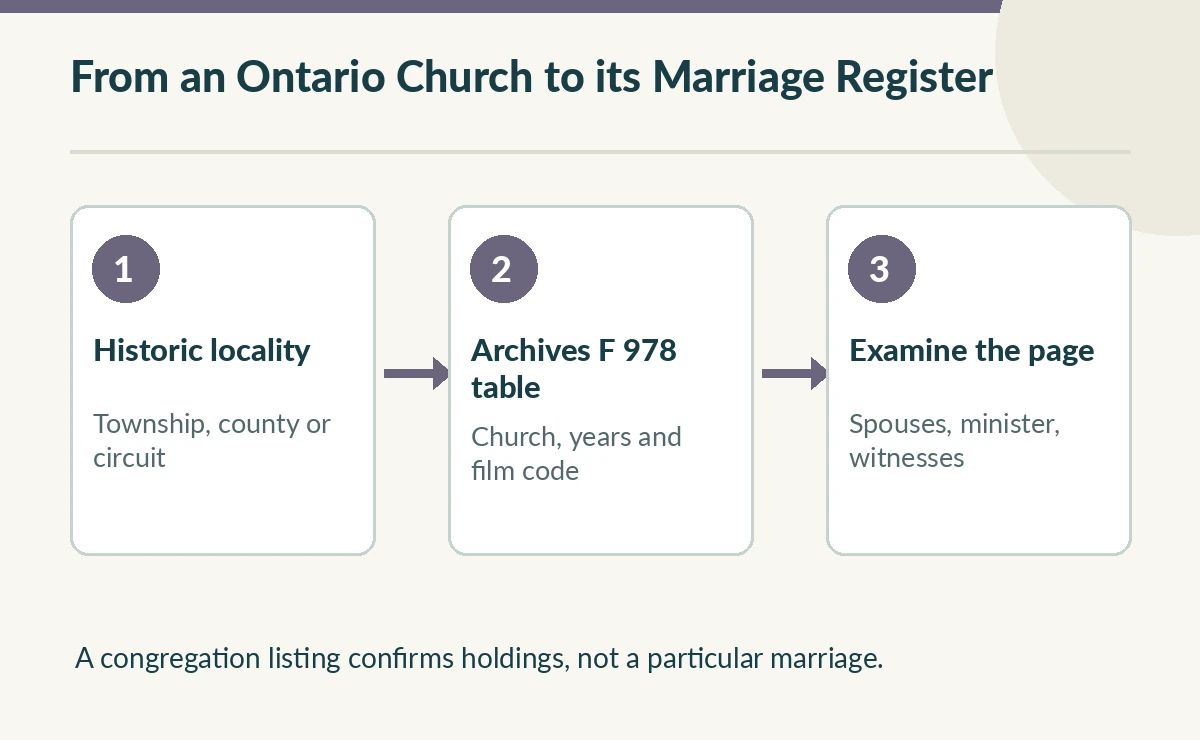
Read the Archives of Ontario F 978 holdings table
The provincial archives’ church-records collection, F 978, includes Methodist material alongside several other denominations. Its searchable data table supplies congregation names, localities, date spans, descriptions and reference or microfilm details. One documented example is the Wesleyan Methodist Huntly Church register at Bell’s Corners, with marriage entries for 1858–1895 and a film reference. Do not turn that one example into statewide coverage. Record the exact congregation, series and film or digital identifier before requesting a page. Our walkthrough on how to trace Methodist ancestors through local and conference records sets out each step.
Distinguish F 978 from the assorted F 982 marriage files
F 978 groups surviving church and congregation material. F 982 is a separate Archives of Ontario Marriage records collection covering religious marriage documents such as licenses, registers or contracts that could not be assigned to one congregation in the normal church series. The archive describes F 982 records spanning 1784–1933, with noncomprehensive geographic coverage and access on microfilm in person. A surname missing from F 978 might warrant a targeted F 982 search, but not every F 982 item is Methodist and neither series is a complete list of all provincial marriages.
Check what the original Wesleyan entry actually reports
A marriage register may identify the ceremony date, the spouses, a minister, residence, witnesses, ages or previous marital status, depending on book and period. Other books can be more abbreviated. Transcribe exactly the fields you see and leave missing details blank rather than substituting ages or parent names from an online tree. A minister’s name is a clue for locating other circuit entries; it is not proof that the couple permanently resided in the chapel’s town. The ceremony entry is more direct evidence of a wedding than a marriage notice announcing an intended future event.

Locate microfilm or onsite material using the precise code
Use the archive’s congregation table and access instructions to record F 978, the congregation entry, dates and its reel or catalog identifier. Archives of Ontario explains that a large microfilm collection is available for self-service research in its reading room. Access may depend on the particular reel or digital rights; a table entry alone does not mean the entire register is downloadable. When requesting assistance, give the archival reference, the names and an estimated date range. Cite the original volume and image or page, not merely a search interface.
Compare early church marriage with later civil registration
For an 1860 ceremony, a surviving Wesleyan register or district marriage return may be the closest evidence; for an 1880 ceremony, check both the church record and the provincial registration system introduced in 1869. Compare dates, witnesses and spellings, but recognize that two versions may be copies of the same report rather than independent eyewitnesses. Later government records can contain more standardized fields, yet a clerical discrepancy can still occur. Document which institution created each source and when, before deciding a conflict has been resolved. Our guide “Northern Ireland Births Before 1864” covers a related question.
| Question | Evidence to check | Do not assume |
|---|---|---|
| Identity | Name plus independent family clues | Every namesake is the same person |
| Date | Original field and its event label | A later record gives the exact date |
| Coverage | Place, years and document type | A failed index search proves absence |
| Access | Custodian and current restrictions | All original pages are downloadable |
Separate Methodist denomination changes from family moves
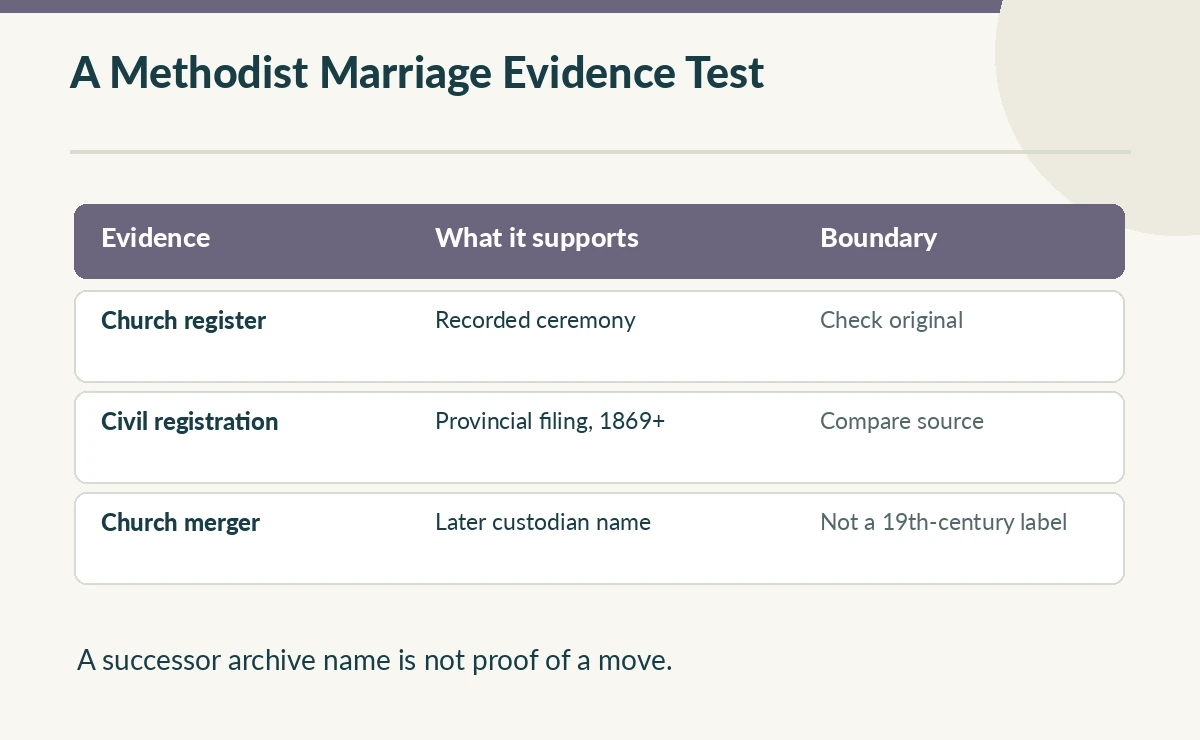
In 1925 Methodist, Congregational and most Presbyterian churches joined to form the United Church of Canada. A modern archive label reflecting that merger does not mean a nineteenth-century ancestor belonged to the United Church at the time of marriage. A Methodist register might now be preserved by a successor congregation or church archive, with only a microfilm copy in the provincial institution. Write the historic denomination as recorded, identify the current custodian separately and do not infer migration because a circuit was renamed.
Build a two-couple identity comparison when names repeat
Suppose two historical marriages involve people named John Smith and Mary Jones in the same decade. Create separate candidate rows with church or circuit, actual ceremony date, witness names, residence and any age or status details on the pages. Then consult a child’s later baptism, land record or later civil registration to determine which couple fits your target household. Do not attach the first index hit to a tree. If neither candidate has a decisive independent corroboration, retain both as hypotheses and name the next archive volume to search.
A Wesleyan circuit’s register may include families who lived far from a church building and traveled to meet a minister. Try finding a witness’s household or the minister’s contemporary circuit appointment if the couple’s own address is unclear. These contextual associations can narrow the search but do not replace a record of the ceremony. Later Methodist historical narratives may summarize a church merger, yet the original entry is the better source for a marriage date.
More Records and Archives Guides
How We Research Ontario Methodist Marriages
We checked Archives of Ontario’s F 978 and F 982 collection descriptions, its church-records data table, provincial registration guide and present reading-room access instructions. We distinguish the one specifically documented Huntly Church example from general Methodist coverage and refrain from asserting that a chosen marriage or digital image has been found. Check the primary references directly: Official archive guide. Original collection or archive information. Additional access guidance. Registry service.
This article offers research methods, not guaranteed records or paid recommendations. We do not claim an affiliate relationship with the listed archives or services. Read our affiliate disclosure for site-wide information.
The systematic provincial vital registration system began in 1869; earlier church and district records may survive.
No. The holdings are noncomprehensive; local church custody and other archive series must also be considered.
An Archives of Ontario collection of assorted religious marriage documents not assigned to a single ordinary congregation series.
No. First check the specific film or item access; many materials are researched through the reading room.
Not by that name: the United Church was formed in 1925, long after the proposed ceremony.