
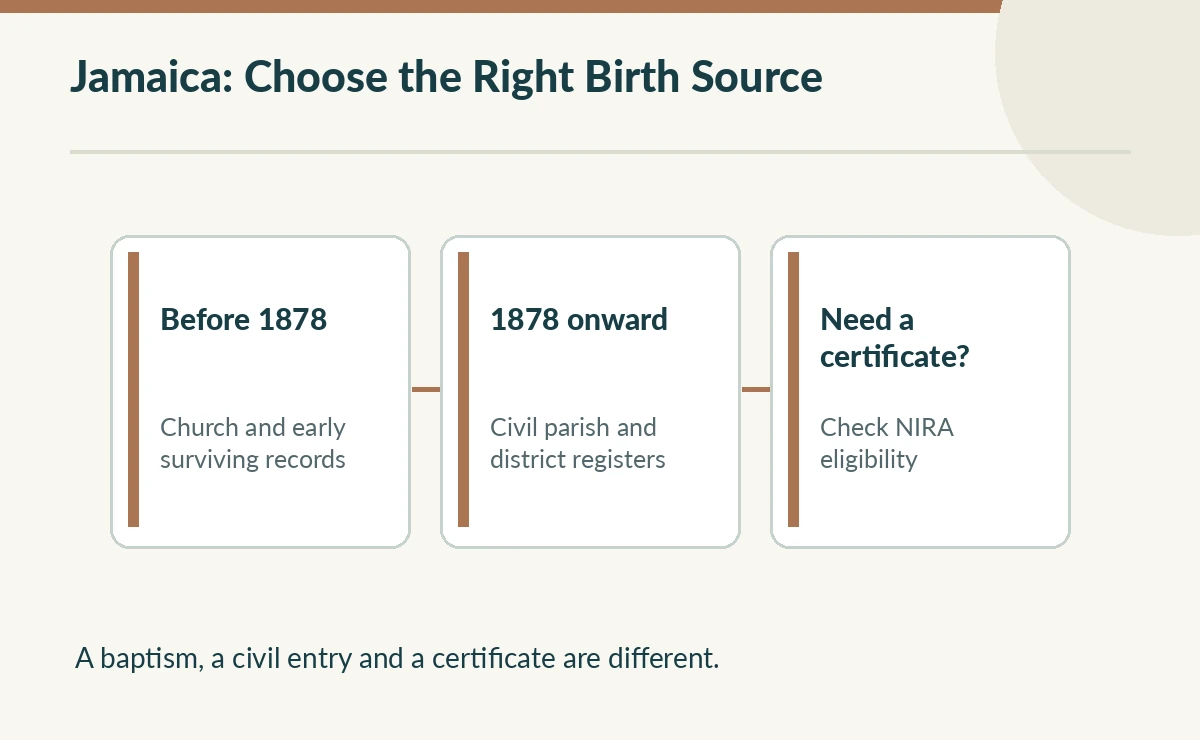
Historical Jamaican birth research has two different starting points. For a nineteenth-century birth before the general civil-registration system began in 1878, investigate surviving church registers, especially where the family’s denomination and parish are known. For a later birth, look for the civil registration by parish and district, then decide whether a historical image can be viewed or a formal copy must be requested. The National Identification and Registration Authority (NIRA) now provides registrar-general services; a FamilySearch index entry is not the same thing as a certified Jamaican birth certificate.
Place the event on the correct registration timeline
The Library of Congress Jamaican genealogy guide places the beginning of civil birth and death registration in 1878 and marriage registration in 1880. It also identifies a limited earlier attempt at birth and death registration in the 1840s that was not consistently implemented. Therefore an 1865 birth should not be pushed into a collection of civil certificates from the 1880s. Start with a parish, denomination and date-range question. Later baptism can help establish a family link, but it is a different event from the biological birth.
Identify the Jamaican parish and registration district
A parish is an administrative geographic area in Jamaica and must not be confused with an individual church parish. FamilySearch describes historical civil registers arranged by Jamaican parish and then district. If a surname search produces several candidates, record each registration parish and district alongside the reported parents and date. An address from a later death or marriage does not prove the family was born in that district. A place-first search is particularly useful when first names or surnames vary in spelling across handwritten registers.
Search the digitized civil records without assuming complete indexing
FamilySearch describes a Jamaica civil registration collection beginning in 1878 with some indexed and searchable entries and images arranged by location. A name search may not cover every image or every year. If it misses a likely birth, look for a browse option or image group associated with the correct parish. The Library of Congress warns that many digitized Jamaican records have access restrictions, so an image may not be viewable from your account or location even though the collection is described publicly. Log whether you searched the index or actually read a page.
Move from the index entry to the original register details
An index can locate a possible event; the original handwritten page may include informant details, registration dates or additional context not shown in the result card. Transcribe the name, parents as recorded, birth date, registration date, parish, district, entry number if present and any legible remarks. Spellings can reflect the recording clerk rather than the person’s lifelong preferred usage. Always cite the source record itself when available. An index and a copied transcription of that same page are not two independent confirmations.
Understand the difference between an image and a certified certificate
A historical register image is valuable research evidence, but it is not necessarily the official document accepted for legal identification. NIRA’s current birth-certificate service is a separate application process, with required information, identification and fees that may change. Its guidance limits applications to the individual, parent or guardian and authorized representatives; researchers should respect those requirements, particularly for living people. Do not promise that finding a name in a public index automatically entitles anyone to a certified copy of the entire record.

Keep birth, registration, naming and baptism dates separate
A birth may be registered days or much later after the event, and a naming or baptismal entry can supply yet another date. On a worksheet, use separate columns for each explicitly reported event and its informant. For a historical individual with an index showing only a registration month, do not fill the exact birth day from a guessed age. A relative’s later death certificate may give a birth year, but compare who supplied that information and how long after the birth it was recorded.
Use Anglican and other church books for earlier generations
The Library of Congress notes that Jamaican Anglican parish record transcripts reach back to the seventeenth century, but survival, gaps and the availability of particular registers vary by locality and denomination. Search the appropriate church series for baptism and family witnesses when civil records do not yet exist. Be cautious with coercive and unequal colonial recordkeeping, especially sources involving enslaved people. An owner’s surname, an administrative designation or a baptism notation does not by itself establish a biological relationship or an individual’s chosen identity.
| Question | Evidence to check | Do not assume |
|---|---|---|
| Identity | Name plus independent family clues | Every namesake is the same person |
| Date | Original field and its event label | A later record gives the exact date |
| Coverage | Place, years and document type | A failed index search proves absence |
| Access | Custodian and current restrictions | All original pages are downloadable |
Resolve matching names through a sequence of independent documents
Suppose you have two index entries for an Elizabeth Brown in the same decade. Compare parish and district, parent names if visible, and neighboring family events; then seek an independent marriage or later death entry tied to a known spouse, residence or occupation. Do not select the first matching result simply because it has a preferred date. Write down unresolved differences: one parent name, a three-year age discrepancy or an alternate spelling can determine whether further browsing is worthwhile. Names here are illustrative, not archival discoveries.

Preserve reference numbers and protect modern personal records
For each historical registration, save the collection title, Jamaican parish, district, register date, image number and entry identifier if the page shows one. NIRA explains that its birth entry number identifies a registration and can assist in locating a record. Historic archival research should not expose living people’s identifiers or restricted certificates without permission. If access is limited, contact NIRA through its official service rather than seeking an unauthorized workaround. Finish with a source-based statement of exactly which claims were confirmed. Our guide “German Census Records” covers a related question.
Jamaican parish and district names should be entered exactly as displayed, even where a modern map uses a spelling or boundary that differs. When a family moved between plantations, towns and parishes, registration locality is not necessarily long-term residence. Identify the event’s administrative jurisdiction before searching adjacent districts; avoid equating an employer, household head or enslaver listed in another type of document with a verified parent.
More Records and Archives Guides
How We Research Historic Jamaican Civil Entries
We cross-checked the Library of Congress Jamaica genealogy guide with current NIRA certificate guidance and FamilySearch’s civil-register collection description. We kept nineteenth-century historical image searching separate from modern eligibility and certification, and we did not presume that all historical images are freely viewable. Check the primary references directly: Official archive guide. Original collection or archive information. Additional access guidance. Registry service.
This article offers research methods, not guaranteed records or paid recommendations. We do not claim an affiliate relationship with the listed archives or services. Read our affiliate disclosure for site-wide information.
The Library of Congress places the general civil system in 1878, while noting a limited, earlier 1840s attempt.
Yes, use surviving church and other period records; do not expect complete modern civil certificates for that era.
No. NIRA is responsible for formal certificate services and has its own application requirements.
The Library of Congress notes that many digitized Jamaican historical records are currently restricted.
No. Follow NIRA’s identification and authorized-applicant requirements and protect living people’s privacy.