
Examination papers in ADM 6, ADM 13 and ADM 107 may trace a prospective lieutenant’s early ships and baptismal evidence; passing is not appointment. Start with the custodial archive guide for the actual series and coverage. See the GenHis affiliate disclosure when comparing commercial access options.
Identify the Examination Rather Than a Commission
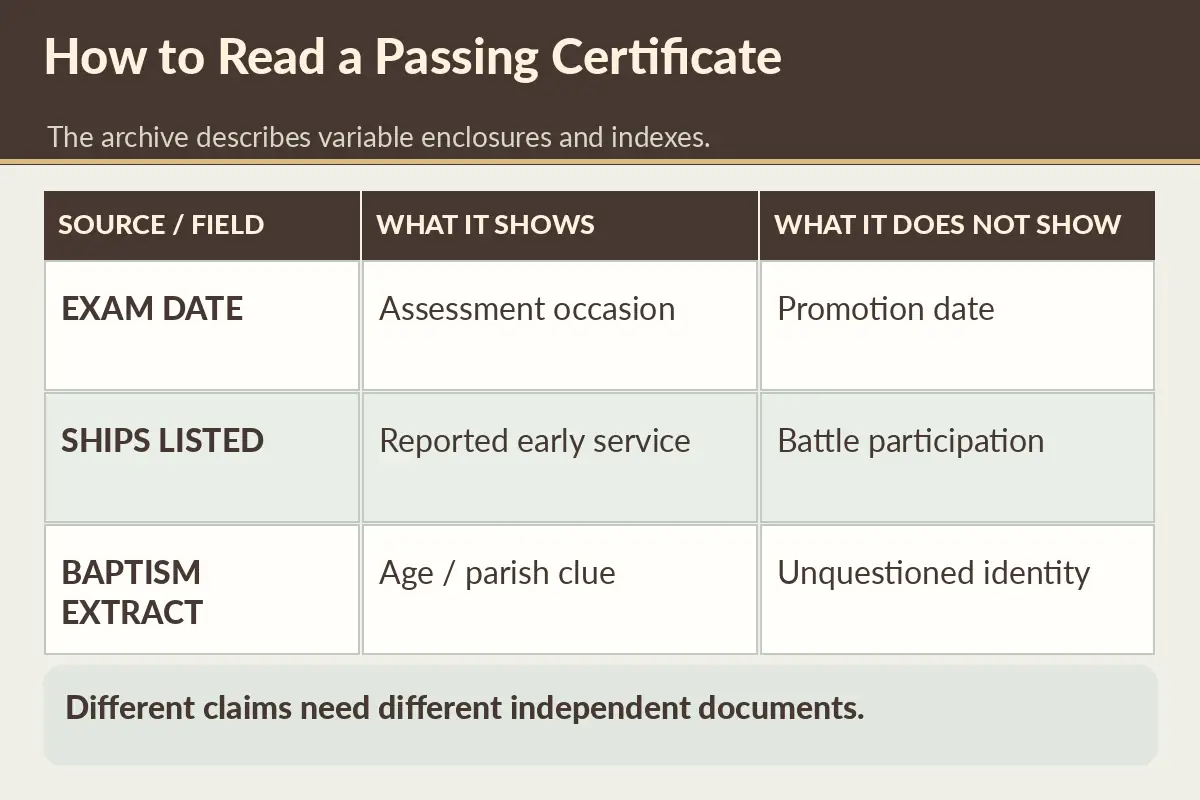
The National Archives describes lieutenants’ passing certificates in ADM 6, ADM 13 and ADM 107 for 1691–1902. These papers concern examinations taken by junior officers seeking to qualify for the rank of lieutenant. They document an assessment of fitness and previous experience; they do not, by their existence alone, prove that a commission was granted, when a promotion took effect or that the candidate eventually commanded a vessel. Keep examination, appointment and subsequent posting as three separate events.
Begin with the person’s name and spelling variants, approximate date of naval service, and a ship already supported by family correspondence or a separate Admiralty record. Distinguish a later biographical account of a career from the passing paper created near the examination. Where several men have the same name, an examination date can exclude candidates before any baptismal record is considered. Do not use a modern family tree’s inferred birth year as though it were reported by the certificate.
Select the Correct Passing-Certificate Series
The Archives’ Trafalgar Ancestors explanation identifies the three core series for lieutenants; its commissioned-search guidance gives wider groupings across ADM 6, ADM 13, ADM 106 and ADM 107 for other ranks. A carpenter, gunner, master or surgeon did not necessarily undergo the same examination or leave identical supporting material. The rank and date should therefore be written into the search question before selecting a volume. Not every passing-paper series is comprehensively indexed by a person’s name.
Catalogue descriptions often identify bound series or chronological spans, not the name of every officer mentioned. Where a name query finds no result, look for the appropriate year and class rather than assuming a document never existed. The National Archives notes that nominal indexes for lieutenants’ papers are available in its reading rooms. Record which printed or in-house index was used and whether the actual manuscript or an archival extract was inspected.

Extract Ships and Dates From an Early Career
For a lieutenant, a successful passing-certificate search may provide ship names, service dates, ranks and the examination date. Some applications include a baptismal certificate. These are exceptionally useful clues because early service can be harder to reconstruct from later officer lists alone. Nevertheless, a stated posting on a candidate’s papers is not an automatically confirmed presence aboard a ship at a particular battle; that requires a dated ship muster or other independently created evidence.
Copy vessel names, any corrections, ratings and dates in separate fields. Watch for ships with reused names and for periods aboard different vessels that overlap in an implausible way. Preserve the examination location or examiner where legible, but do not manufacture a consistent career from uncertain handwriting. If the attached baptism refers to a namesake, compare parents, parish and independently established age before connecting it to the man who sat the naval examination.
Read Baptismal Enclosures With Care
The archive says baptismal certificates are often attached to lieutenants’ passing papers, not that every candidate has one. An enclosure may show an administrative copy or extract prepared for the examination. Record who certified it, when the certificate was drawn up, the baptism date and the parish before comparing it with the surviving original register. A baptism date is not necessarily a birth date; do not convert one to the other without explicit wording.
To test identity, seek a corresponding parish entry and a second naval event that fits the reported age and name. A certificate found among a candidate’s papers was provided for a purpose; it does not prove every other family claim circulated in later service biographies. Distinguish an original contemporary parish page, a later certified extract, a catalogue description and a family transcription. Each has a different chain of custody and possible copying errors.
Confirm Appointments and Shipboard Service Separately
Passing an examination is a qualification event, whereas appointment to a ship and the grant of a commission are administrative decisions. Follow the passing paper to the relevant officer service or commission record and the ship’s own documentation for a specified date. ADM 196 may be useful for later officer-service questions, while earlier records can require other series. A register assembled long after an examination must not silently overwrite a conflicting contemporary date.
If a ship is named in the passing papers, test whether it existed and was in commission in that period. A captain’s log establishes the ship’s movements but not automatically an individual officer’s presence; identify the officer through a complementary personnel document. For a battle or injury claim, require event-specific corroboration rather than treating eligibility for examination as a marker of operational service. Record disagreements instead of averaging dates or deciding by the most polished-looking source.
Write a Finding That Separates Three Career Events
The narrowest sound conclusion states that a named candidate was examined for a particular rank on the recorded date and that the paper reports the attached list of prior ships or certificates. A stronger statement, such as “commissioned lieutenant,” needs an additional commission or appointment record. A claim that the officer served aboard a particular ship at a named encounter needs separate evidence for both the man and the occasion. These distinctions prevent inflated naval biographies.
Cite the exact ADM series and piece, any folio or page, and the identity controls linking it to the target officer. If only the Archives’ guidance or a catalogue description has been seen, phrase the discovery as a lead, not as a personally inspected certificate. Carry forward a question about a ship, parents or commission and choose the independent source most likely to resolve it. Missing baptismal paperwork alone does not disprove a recorded examination.

How We Research This Archival Series
Our method starts with the record creator and the legal or administrative purpose of the surviving series. We distinguish a public catalogue, searchable index, manuscript page and later transcription rather than treating them as interchangeable proof. A meaningful negative search documents the actual place, years, variants and holdings examined. To identify a person, we cross-check an independently created source and preserve conflicts in wording or dates. We do not claim that general collection descriptions confirm any individual’s history.
More Records and Archives Guides
Official Sources and Exact Evidence Limits
The main National Archives resource supports this key point: Describes lieutenants passing certificates in ADM 6, ADM 13 and ADM 107, 1691–1902, ships served and sometimes baptismal certificates.. The additional official guidance supports a separate limitation: Provides certificate series and different rank-specific ranges, fields and name-indexing limitations.. Check the current Discovery catalogue item for piece-specific coverage and access before ordering or citing it. If only the official guide has been inspected, use conditional language for the content of a specific person’s record.
No. A separate commission or appointment record is needed.
The Archives describes passing certificates for 1691–1902 across ADM 6, ADM 13 and ADM 107.
No. Such enclosures occur in some papers, not all.
No. Verify the ship, the officer’s posting and the event separately.
Some series are not completely name indexed; try date, rank and relevant reading-room indexes.